CivicScience has the world’s largest proprietary database of real-time declared intent, allowing brands to activate high-performing advertising that drives up to 80% better performance. See how our partners achieve superior marketing outcomes here.
With summer vacations well underway, cookouts planned, and long days in the sun on many Americans’ minds for the next several weeks, sunscreen has once again become top of mind. While SPF isn’t something worn exclusively in the summer, it is the time of year when an increasing number of Americans reach for it to ward off the harmful effects of UV rays. Especially as a new FDA-approved sunscreen ingredient prepares to hit shelves, how are Americans feeling about sunscreens? CivicScience has the most up-to-date figures on sunscreen use in 2026.
Overall Sunscreen Usage Trends Up, Led by Gen Z
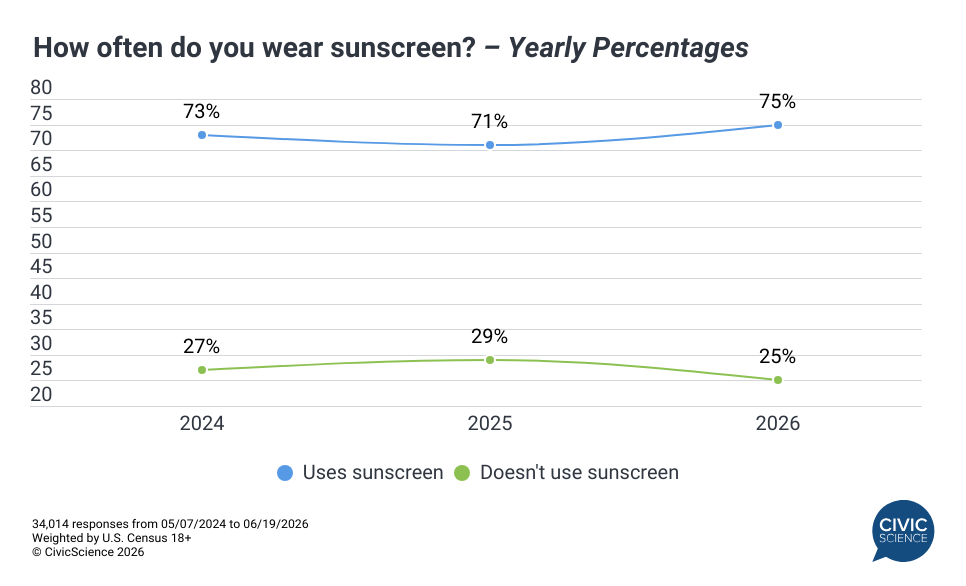
The latest consumer-declared data show that 75% of Americans use sunscreen at least occasionally, representing a four percentage point increase YoY, driven by a two-point uptick in daily usage and a three-point bump in weekly use. Those most likely to wear sunscreen skew younger and higher income, possessing, perhaps, the means and interest to prioritize SPF. However, reapplication of sunscreen is less popular, with the percentage of those who say they do not reapply their sunscreen rising from 33% to 40% since 2025.
When looking specifically at protection levels, the share of those using an SPF of 25 or higher increased marginally, rising from 56% to 58%, suggesting that a demand for higher protection levels has not fallen in step with higher rates of use ahead of the summer season.
Despite Expanded Usage, Concerns Over Effectiveness Loom
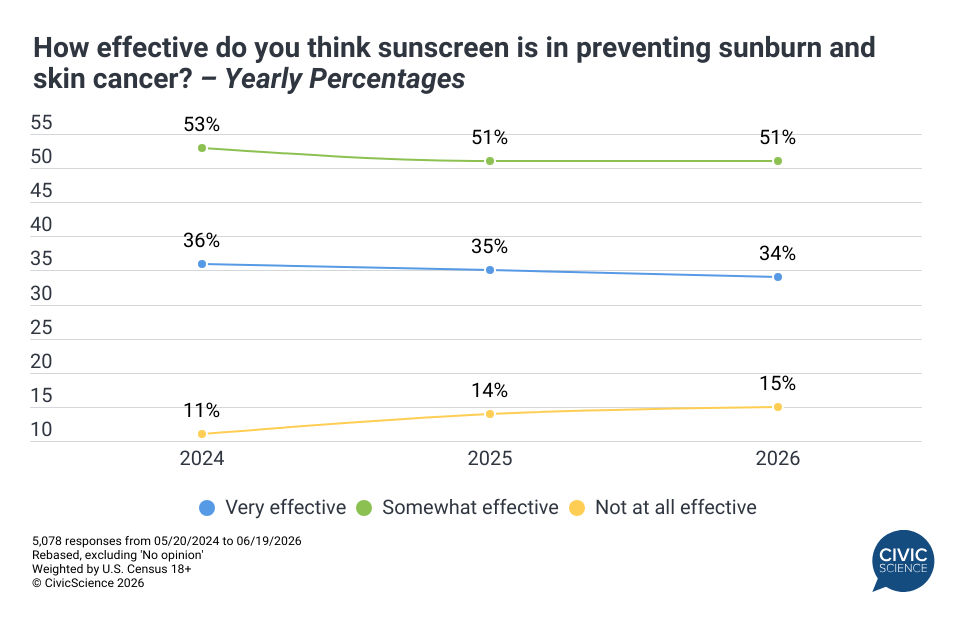
Yet, higher usage doesn’t mean higher confidence. While more Americans say they’re using sunscreen, the data show there’s another trend happening beneath the surface – skepticism about the effectiveness of sunscreen in protecting against sunburn and skin cancer is slowly rising. Though this percentage remains firmly in the minority of U.S. adults with an opinion, the share of those who believe sunscreen is not effective at preventing sunburn and skin cancer is up slightly over last year, after a more noteworthy jump between 2024 and 2025.
Eighty-Five Percent of Americans are Open to Trying Sunscreens With the New FDA-Approved Ingredient
Amid this subtle increase in skepticism about the effectiveness of sunscreens, it is prime time for a new ingredient to become available in U.S. markets. Right on cue, bemotrizinol, or BEMT, has just been named the first new active ingredient to be approved for over-the-counter sunscreens in the U.S. since the 1990s. It provides protection against both ultraviolet A and B rays and has low levels of absorption through the skin into the body. And new data show Americans are ready to try it.
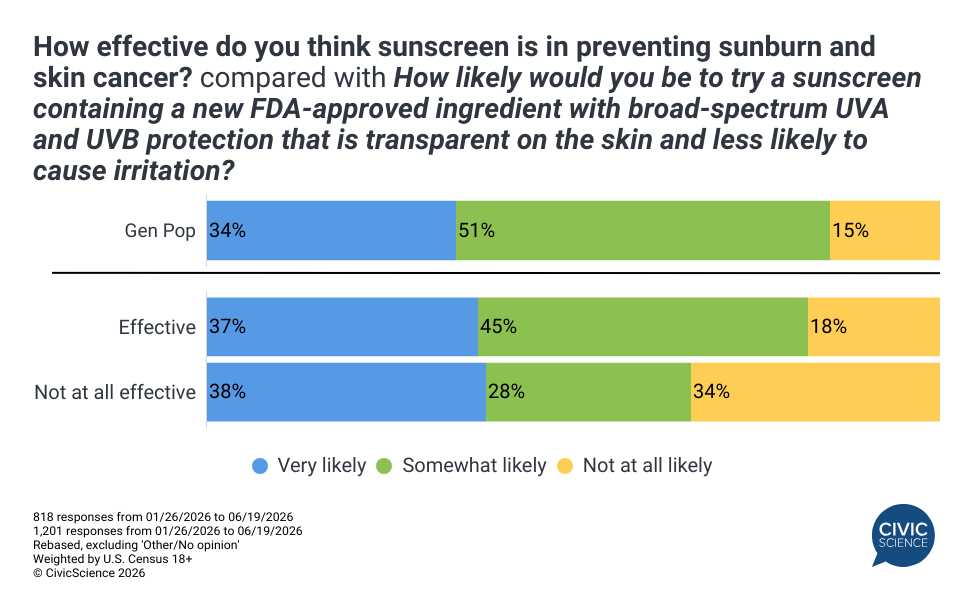
New data indicates strong consumer interest, with 34% of Americans ‘very’ likely and 51% ‘somewhat’ likely to try a sunscreen with BEMT. This means a strong majority of the population is open to the new ingredient. Support spans political lines, led closely by Democrats, but the ingredient’s real triumph may be its potential to win over skeptics: 38% of Americans who currently believe sunscreen is completely ineffective against skin cancer say they are highly motivated to try a product containing BEMT.
As summer 2026 comes into view, sunscreen usage faces conflicting forces, with usage increasing in step with rising skepticism about its effectiveness. Amid this tension, Americans appear receptive to the new FDA-approved sunscreen ingredient hitting the market, which may offer discerning consumers an option that provides greater peace of mind as well as the sun protection they desire.