CivicScience has the world’s largest proprietary database of real-time declared intent, allowing brands to activate high-performing advertising that drives up to 80% better performance. See how our partners achieve superior marketing outcomes here.
The summer ahead is poised to be eventful, packed with travel, America 250, and the World Cup, among other near-term highlights. But it’s not without its stressors, as persistent inflation, economic uncertainty, and geopolitical tensions continue to apply pressure. Given that media is a go-to source of comfort and self-care, it’s important to understand how consumers navigate their content choices during turbulent times.
This new multi-part series maps today’s media consumption dynamics using the latest first-party data from CivicScience, delivering a clear view of how audiences are interacting with content right now.
To help publishers and creators stay ahead, here are five defining consumer podcast trends to watch for this summer and H2 2026:
1. The Share of Americans Who Listen to Podcasts Weekly or More is Up 70% From 2022.
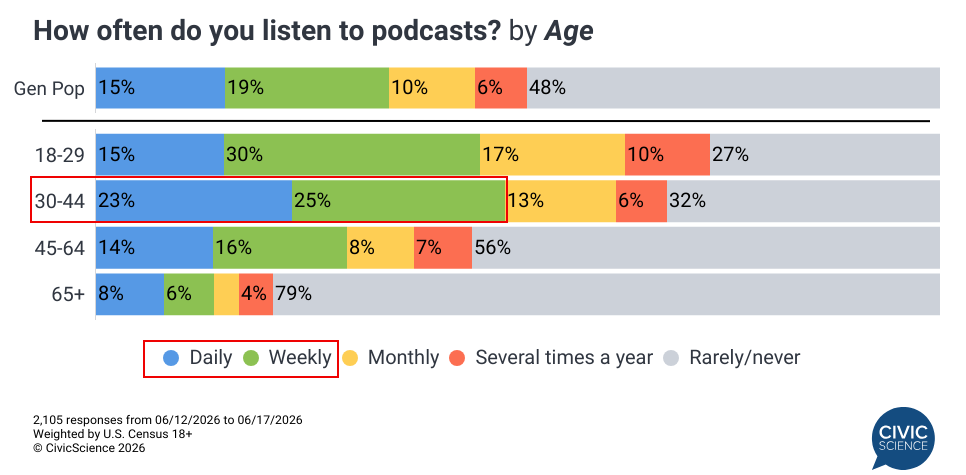
Podcasting didn’t begin during the pandemic, but it was another trend that boomed in the pandemic era. New CivicScience data show that popularity has not slowed in the years since – 52% of U.S. adults tell CivicScience they listen to a podcast at least ‘several times per year,’ a substantial jump from 35% back in 2022. Not only are more Americans turning to podcasts, but they’re also doing so more often. The data show that 34% now listen at least once per week, a 70% increase from 20% in 2022.
While overall listenership is largely driven by Gen Z adults, with nearly three-quarters (73%) listening at least some of the time, it’s Millennials who are the most frequent podcast listeners, with 48% tuning in weekly or more. Additionally, 3 in 10 Gen Xers aged 45-64 also check in as weekly+ listeners.
Many of these podcast listeners are likely tuning in for stress relief. Additional data show that 61% of those who listen to podcasts report ‘somewhat’ or ‘very’ strong feelings of worry recently, nearly 20 points higher than non-listeners (42%)
2. Summer is prime podcast-listening time.
Summertime would seem to be a natural period for increased media consumption (such as podcasts), thanks to more time spent traveling or relaxing in the sun, but is that really the case? New consumer-reported data suggest that this is, in fact, likely the case. When CivicScience asked Americans about their summertime podcast habits, 43% said they typically listen to podcasts more often than usual during the summer months. This share is roughly 2.5x the number of listeners who say they typically cut back on podcasts during the summer (17%). Meanwhile, 40% report their podcast listening habits do not change at all during the summer.
This increased summer podcast listening trend also spans all adult age groups under 64, while the majority of listeners aged 65+ say their podcast behavior remains unchanged.
3. Podcast preferences shift from comedy to deep-dive information as listening habits grow.
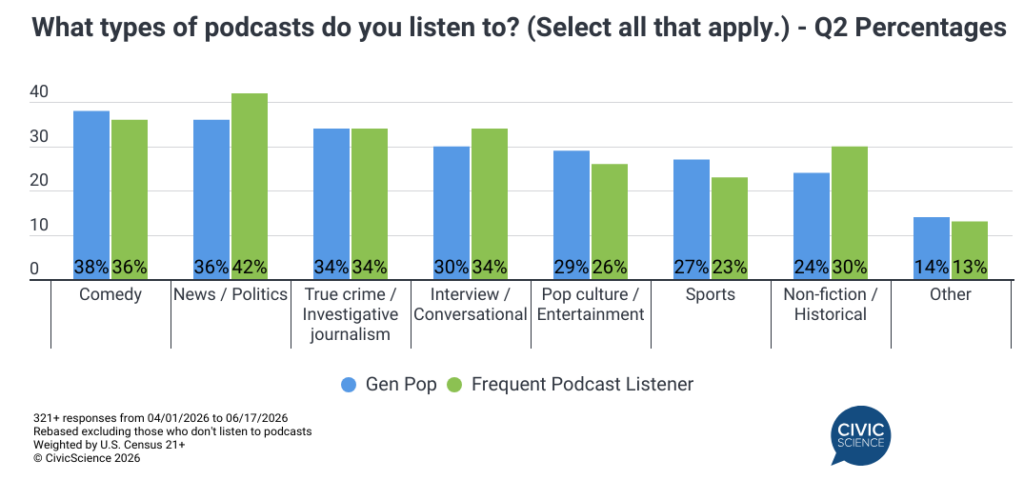
When looking at the specific genres capturing audiences’ attention, a clear trend emerges where frequent listeners–those tuning in at least once a week–prioritize information over casual entertainment. While comedy is the top choice for the Gen Pop, it takes a backseat to news and politics among frequent listeners. This appetite for deeper substance is further highlighted by frequent listeners showing a stronger preference for conversational interviews and non-fiction or historical content than the average listener.
4. Social media and media publishers lead as sources for discovering new digital content, while frequent podcast listeners turn to more tailored avenues.
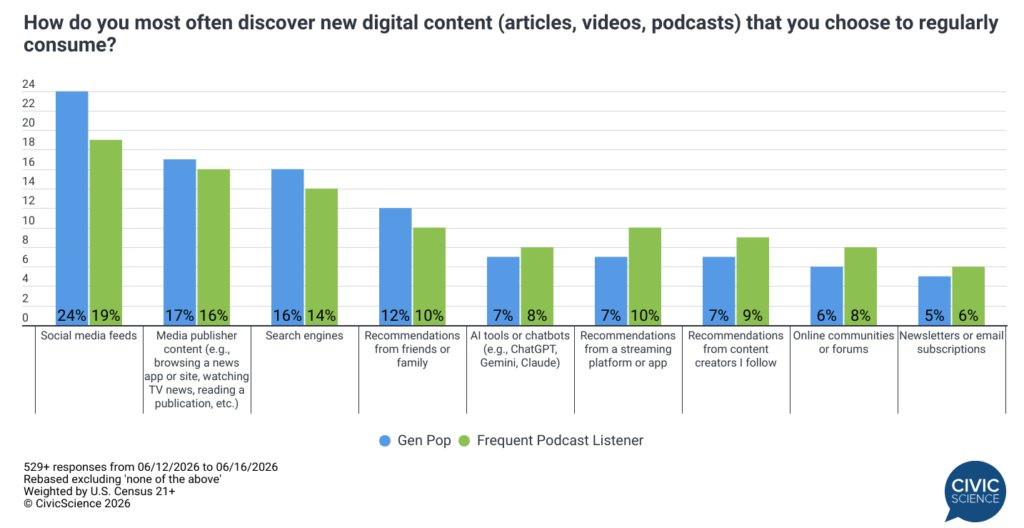
When exploring how audiences find new digital content (e.g., articles, videos, or podcasts) to regularly consume, the Gen Pop relies most heavily on broad discovery channels such as social media feeds, media publisher content, and search engines (excluding ‘none of the above’). However, a distinct shift occurs among frequent listeners, who are noticeably less dependent on social media and search engines. Instead, frequent podcast consumers lean more than average toward ecosystem-driven methods, discovering content through streaming platform recommendations and the creators they already follow. This audience’s habit of digging deeper also shows up in their greater tendency to use tailored paths, such as online communities and AI, to surface new material.
5. Why the growing listenership matters for content creators and publishers.
Self-reported data from CivicScience offers a glimpse into what makes this growing audience of podcast listeners one that should be on publisher radars this summer, and beyond:
- Receptive to advertising: Nearly half (47%) of podcast listeners say ads played during podcasts (including ads read by the host) hold at least ‘somewhat’ of an influence on the products they buy.
- Paid Publisher Subscriptions: 41% of podcast listeners have 2+ paid publisher subscriptions (e.g., Wall Street Journal, ESPN, New York Times), outpacing the average American by nearly 20 points.
- Elevated Content Consumption: When asked how their consumption of digital content (articles, videos, podcasts, etc) has changed compared to this time last year, 49% of podcast listeners say it’s increased, 11 points higher than Gen Pop, who say the same (38%).
This data highlights a premium audience segment that is actively accelerating its content consumption and is open to spending in the second half of the year. Capturing this momentum requires creators and publishers to deliver high-substance, informative content that these audiences crave while leveraging platform-driven and creator-led discovery channels. Engaging this demographic now connects your brand to an active, high-value consumer base uniquely primed to invest in premium content.