CivicScience has the world’s largest proprietary database of real-time declared intent, allowing brands to activate high-performing advertising that drives up to 80% better performance. See how our partners achieve superior marketing outcomes here.
Amazon is kicking off its first major sale of the year today: the Big Spring Sale. Unlike Prime Day, this sales event is open to both non-members and Prime members – so, where does consumer intent stand?
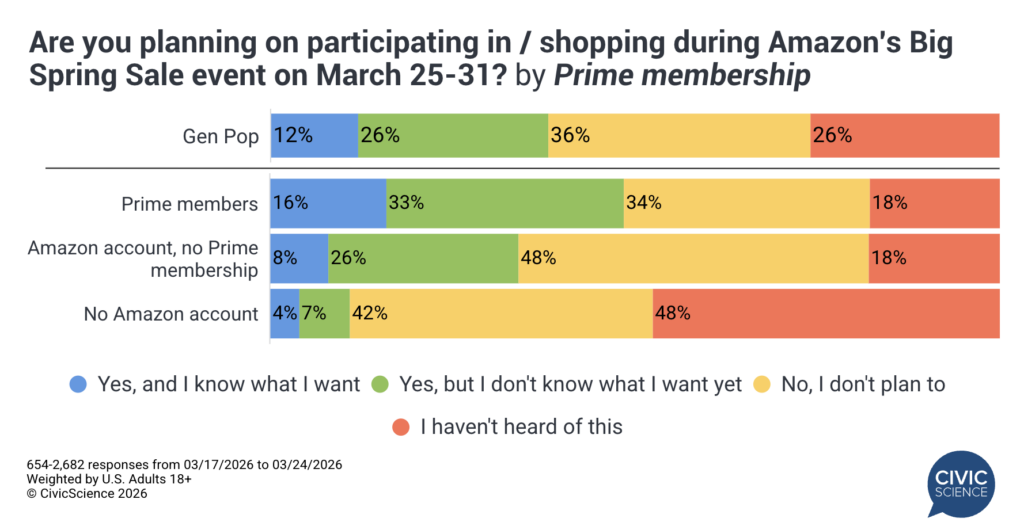
CivicScience has been polling consumers about Amazon sales events over the years, and new data from a nationally representative sample of over 3K respondents shows that 38% say they’re likely to participate in the Big Spring Sale, compared to 36% who are not. Another 26% haven’t heard of the sale, leaving room for intent to grow as awareness builds. Still, compared to previous Amazon Spring sales events, both shopping intent and overall awareness are tracking lower this year.
Interestingly, consumers are more likely to report that they don’t yet know what they want to buy (26%) than to say they already have something in mind (12%).
As expected, Prime members show the greatest interest in shopping the sale (49%). Still, 34% of those with an Amazon account but no Prime membership also express interest. A small but notable 11% of consumers without an Amazon account or Prime membership say they’re likely to shop the sale.
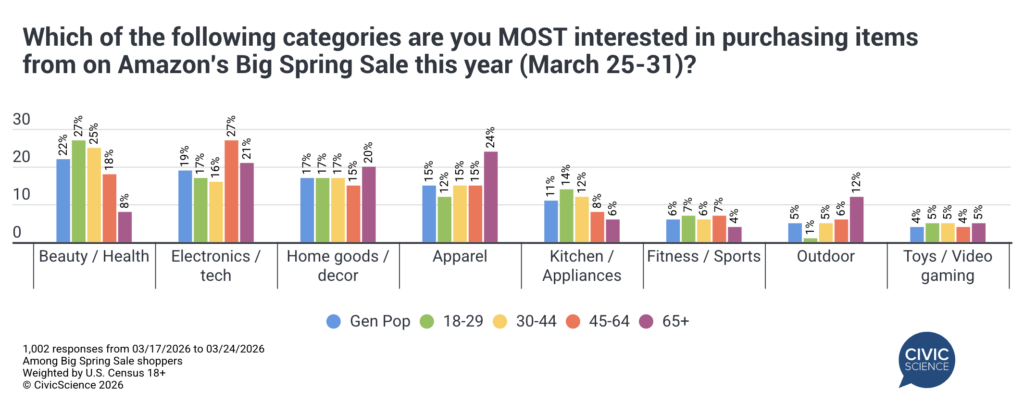
A closer look at categories of interest shows that intent to shop for beauty and health products is strongest, in line with CivicScience data indicating that consumers are prioritizing health and wellness spending in 2026 and investing in self-care to cope with daily stressors.
Gen Z adults and Millennials are the strongest drivers of beauty and health interest, while Gen X leads in electronics and technology, and Baby Boomers show the most intent around apparel and home goods and décor.
Drawing from the world’s largest database of over 6 billion consumer-reported responses, CivicScience moves beyond categories to highlight the real-time behaviors and sentiment of these shoppers:
- Competitor sales: With other retailers running similar spring promotions this month, Amazon Big Spring Sale shoppers show the greatest overlap with Target Circle Week (35%), Ulta’s 21 Days of Beauty (26%), and Wayfair’s Spring Cyber Week (21%).
- Purchase drivers: Compared to non-shoppers, Big Spring Sale shoppers are less likely to say purchases are driven by necessity. Instead, they over-index on discovery-based triggers, such as seeing products in-store, receiving recommendations, encountering online ads, or viewing social media ads. They are also nearly 3X as likely as non-shoppers to say their retail purchases are mostly spontaneous, meaning reaching them at the right time is crucial.
- Beauty: Amazon Big Spring Sale shoppers are 30 points more likely than non-sale shoppers to say they’re brand-sensitive (vs. price-sensitive) when buying beauty products. They’re 2.5X more likely than non-shoppers to report spending over $100 on beauty products in the past three months, and they also lead in purchasing beauty products for specific occasions and events, notably birthdays, holidays, and work.
- Well-being: Americans reporting strong emotions – both positive and negative – show greater intent to shop Amazon’s sales event this month. Intended sale shoppers are also more than twice as likely as non-shoppers to say their desire to leave the house has increased over the past month (26%), though a larger share report that it has decreased (35%).
As Amazon’s first major sale of the year, the Big Spring Sale offers an early read on how consumers may engage with key retail moments in 2026. While intent is still taking shape, the data points to a broader shift in what’s driving participation: shoppers are leaning into health and wellness categories, and emotional factors appear to be playing an increasingly important role in purchase behavior. This highlights a key opportunity for brands to meet shoppers at the intersection of well-being and discovery.