The wealth gap in our country feels like a ticking time bomb.
It may tick for several more years, but it’s counting down. That’s for sure.
Over the 13 years we’ve been tracking consumer confidence in America, it has become increasingly detached from fiscal reality. People at large have been relatively miserable about their economic outlook ever since the post-COVID inflationary surge. Nonetheless, economic growth and the consumer spending that explains two-thirds of it have consistently defied logic.
We’ve espoused different theories to explain the discord between macroeconomic sentiment and real economic performance. The effects of political tribalism – namely, the inclination of partisans to love or hate the economy based on whoever’s sitting at the Resolute Desk – is one such factor. But those gyrations largely cancel each other out in the aggregate.
Post-pandemic “well-being spending” was another plausible reason. Indeed, many consumers spend beyond their means in priority categories. But they’re counterbalancing by cutting back in others. The net effect is break-even, give or take.
The real answer is less nuanced, more intuitive, and more troubling.
Per the Federal Reserve, 50% of consumer spending in the U.S. last year was attributable to the wealthiest 10% of U.S. households. Think about that. Calling our economy “K-shaped” is a misnomer when the “leg” of the K is 9x longer than the “arm.”
Economic sentiment measures like ours weren’t built for this. We manicure our survey samples to perfectly match the population across known demographic, geographic, and – yes – income groups. Our quest is to accurately measure how all Americans feel. It’s a worthy endeavor.
Alas, today’s economy no longer cares about your feelings.
If we want our ESI to better align with or predict economic growth, we need to reweight our sample to multiply the top 10% of our wealthiest respondents by 5X or the top 1% by much more. It is what it is. And it’s a problem.
There’s little reason to believe things will improve anytime soon. Government policies (and their PAC-funded stewards) disproportionately benefit those who can influence them, a privilege that few would willingly relinquish. The stock market and real estate are awesome if you can afford the price of admission. If not, you might as well bet on prediction sites, crypto, or Mega Millions.
Then, there’s AI. I challenge anyone to explain how it will do anything but widen the gap. Companies, their shareholders, and executives will undoubtedly realize massive financial windfalls (many are already), if only by dramatically reducing their expenses (see: headcount). At least everyone else can use ChatGPT to edit job applications.
Perhaps the only thing standing in the way of a populist revolt in our country is the fact that so few people have a window into how the richest Americans live. They don’t take field trips to Jupiter or Palm Beach to see it for themselves. They’d find it somewhere between unfair and obscene.
As the truism goes, middle-class fiscal conservatives have long derided higher taxes on the rich – or anything remotely resembling a redistribution of wealth – because they believed those lofty heights were available to everyone. They’re not. The current structure won’t allow it.
Most people just don’t realize it.
But it’s only a matter of time.
Here’s what we’re seeing:
Speaking of consumer confidence, it fell again this week. After a positive bump last time around, our Economic Sentiment Index dipped again in its latest reading, proving that the “average” American is still feeling crabby. The biggest culprit was a >3-point decline in people’s optimism toward their personal finances (see: gas prices), traditionally our highest and most important metric. Meanwhile, our collective outlook for the long-term U.S. economy is reaching depths we’ve never seen before.
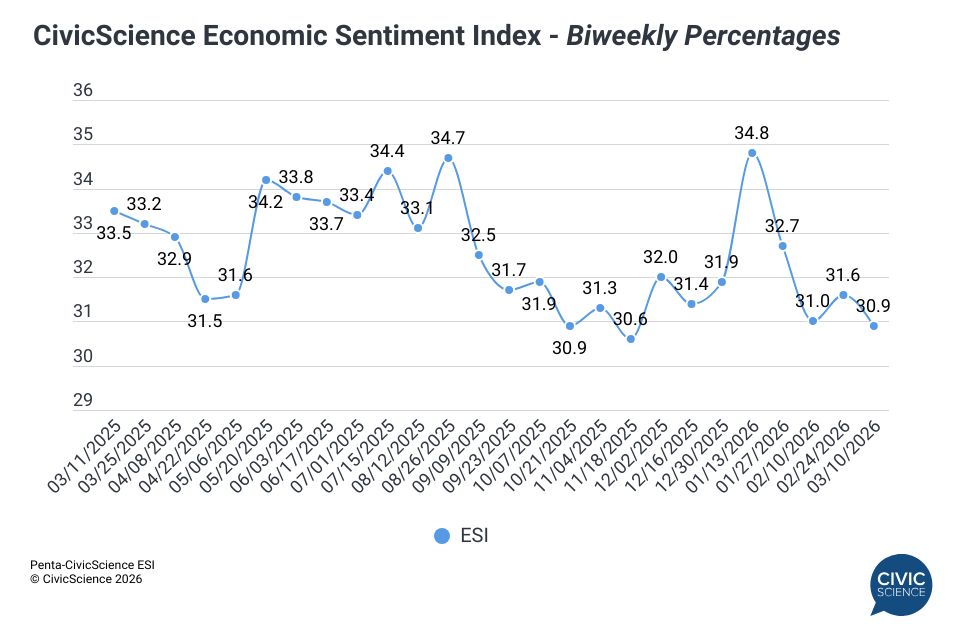
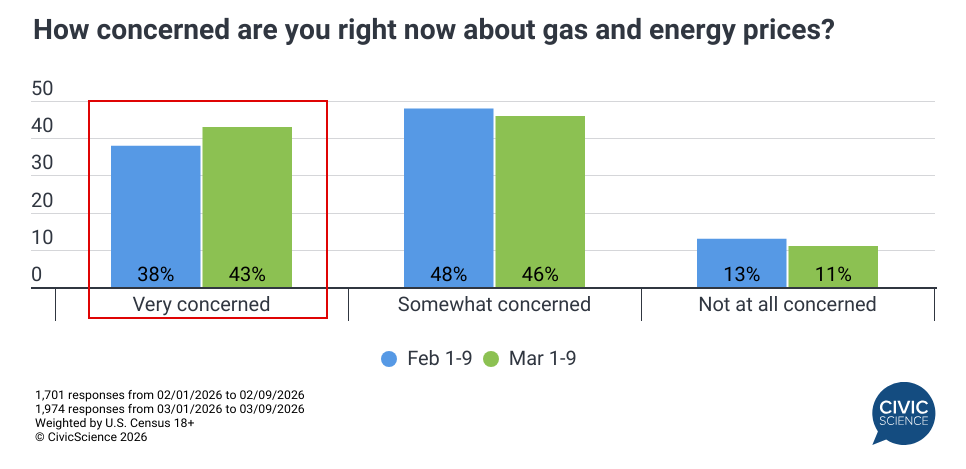
People are glued to the news on Iran right now. In our 3 Things to Know this week, we learned that 8 in 10 Americans are following the war in Iran at least somewhat closely. As an obvious result, concerns over rising gas prices have skyrocketed compared to the same period last month. We also examined how people view influencers/creators online and how quickly they’ll “cancel” them if they step out of line with things like prejudice, hypocrisy, or dishonesty. Finally, we looked at likely viewers of this weekend’s Academy Awards show, an audience that significantly over-indexes as parents.
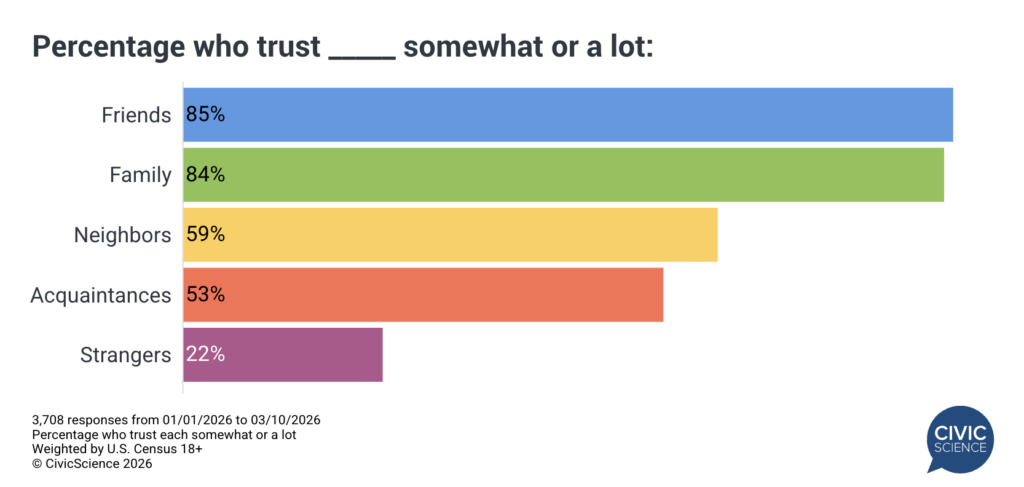
As institutional trust wanes, we’re relying increasingly on personal connections (and online ones) to fill the emotional void. With faith in institutions like the media, politicians, and corporate America at low levels, U.S. adults are still leaning on family and newfound friends to keep them sane. A few things stood out for me from this study we published this week: First, Gen Zs are particularly resourceful in where and how they make new friends online; Second, Millennials are our most introverted generation; Third, none of us trust strangers anymore; and Finally, I feel sad for the 15-16% of people who don’t trust their friends OR family.
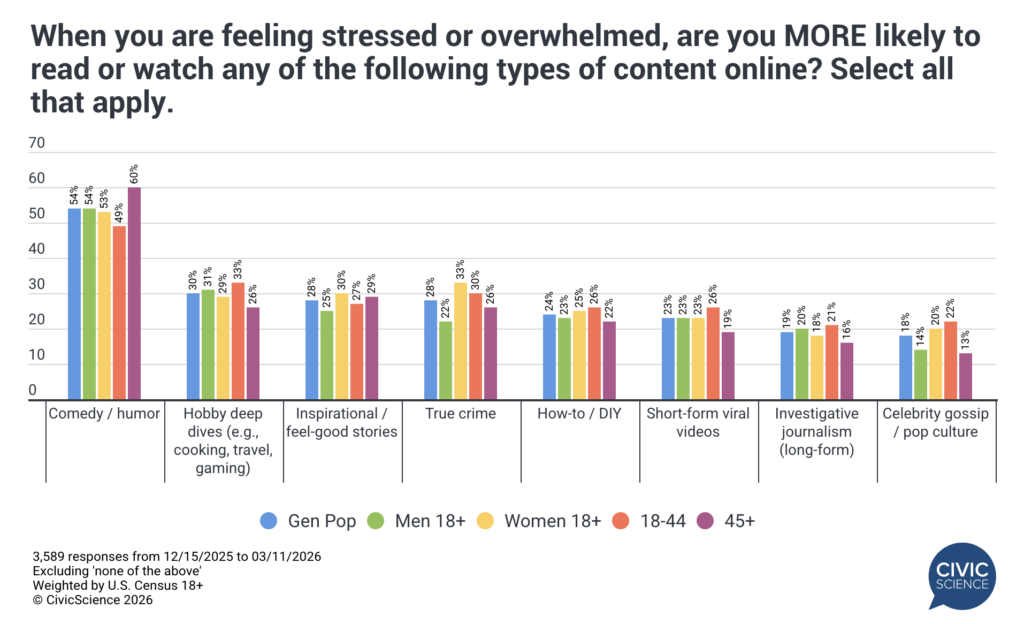
We’re also relying heavily on media to manage stress on our own. While outdoor activities and extra sleep are on the list, television, movies, and online content have become the biggest crutches for Americans looking to treat anxiety in their lives or to simply bounce back from a bad day. So-called “comfort media” – namely, watching or rewatching our favorite shows or movies – is the go-to emotional salve for 45% of Americans today. While comedy is clearly the most popular choice overall, there are notable variances across gender and age groups. Women seem to really dig true crime. Younger groups, like hobby-related shows such as cooking and travel.
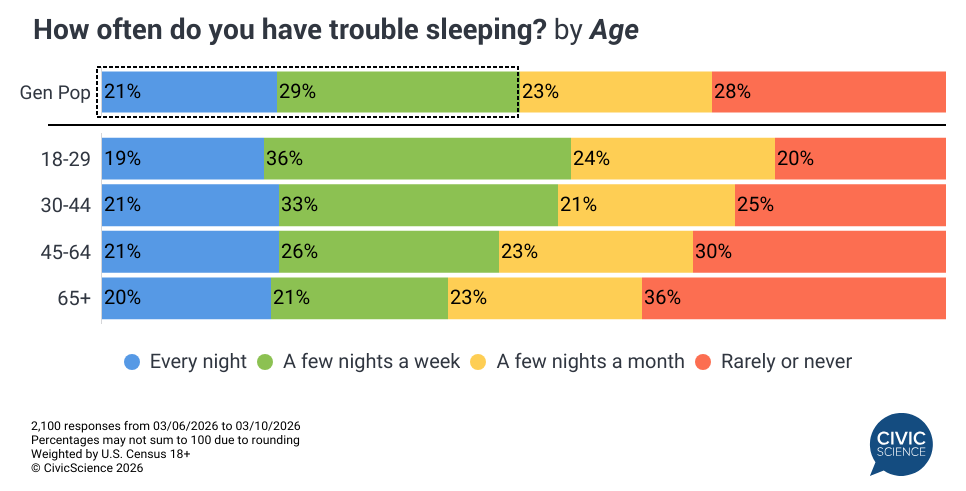
Maybe it’s because we watch so much TV, but a lot of Americans are struggling to sleep. In our latest study on sleep habits in the U.S., we found that an even 50% of adults report difficulty sleeping at least a few nights a week. Over one in five struggle every night – a notably consistent ratio across age groups, although older Americans are less likely to report sleep troubles overall. No surprise, a lot of bad sleepers claim to be in the market for a new mattress and if you’re in that general field of retail, we provided some helpful clues on how to find and win them.
More awesomeness from the InsightStore this week:
- Our Emotional Well-Being Index improved slightly in February, but it preceded the conflict in Iran, so take it with a grain of salt;
- We released a new episode of our Dumbest Guy in the Room podcast this week, where I was joined by business media wunderkind, Ed Elson, from ProfG Markets. We talked a lot about the challenges facing government economic data and why AI is basically the most hated technology of all time.
The most popular questions this week:
Would you wait in line for more than an hour to try a new coffee shop?
To what extent do you prioritize health and wellness in your life?
How important do you think food security is for individual success in life?
How open are you about sharing your personal story with others?
Answer Key: Absolutely not; A lot; Never, I’ve always been a silver-colored jewelry guy; It’s hard to think of anything more important; If you’re reading this, you already know the answer to that.
Get more questions like these delivered to your inbox every day, with results from each poll — based on nationally representative data — shared on our social channels within 24 hours. Receive our Poll of the Day email and start answering today. Subscribe here.
Hoping you’re well.
JD
Not on the list to receive this weekly email? Subscribe by clicking here.