CivicScience has the world’s largest proprietary database of real-time declared intent, allowing brands to activate high-performing advertising that drives up to 80% better performance. See how CivicScience partners achieve superior marketing outcomes here.
1. Big-box retailers remain the preferred choice for Halloween shopping, but online-only stores are gaining popularity.
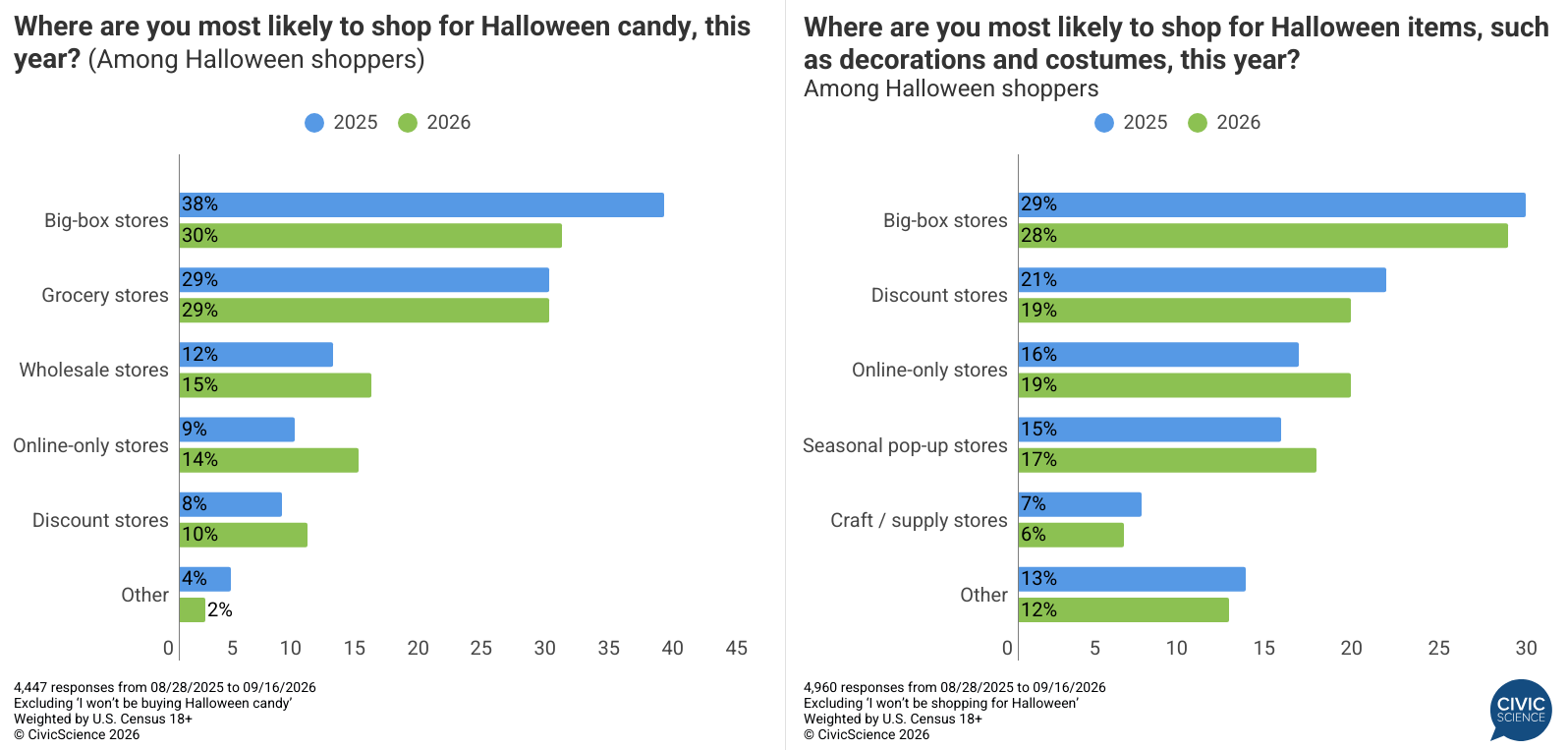
Halloween is creeping closer, and plans to celebrate are slightly down from last year, with 63% of U.S. adults planning to celebrate in 2026, down from 67% in 2025. Among celebrators, the usual festive activities remain widely popular. Half (50%) intend to pass out candy this year, 41% plan to watch scary movies, and 40% will decorate their homes. The share planning to dress up in a costume held steady at 30%. However, interest in attending a Halloween party dipped to 24%, and interest in going trick-or-treating dropped to 20%, each down three percentage points from 2025.
Despite a significant drop in candy purchases, big-box stores remain the top choice for Halloween candy (30%) and decorations (28%) among shoppers. Grocery stores follow closely among candy buyers at 29%. However, alternative channels are trending upward in 2026. Online candy purchases jumped by five percentage points to 14%, while wholesale and discount stores also saw upticks. For costumes and decor, discount stores take 19%, while online-only (19%) and seasonal pop-ups (17%) gained ground with shoppers compared to 2025
Let Us Know: Do you generally make an effort to buy holiday-themed merchandise?
2. American spending at dollar stores continues to rise, and these stores are playing a growing role in holiday shopping.
With grocery prices rising and Americans increasingly feeling pessimistic about the economy, it’s no surprise that dollar store shopping is on the rise in 2026. The latest consumer-reported data from CivicScience show that among those who shop at dollar stores, nearly half (47%) report spending more at them over the past six months — up from 38% in 2024. The growth is strongest among households earning under $50K, with 52% reporting spending more at these stores than in years past. Higher-income shoppers are spending more, too: 33% of those in households earning over $150K report increased spending, up from 28% in 2024.
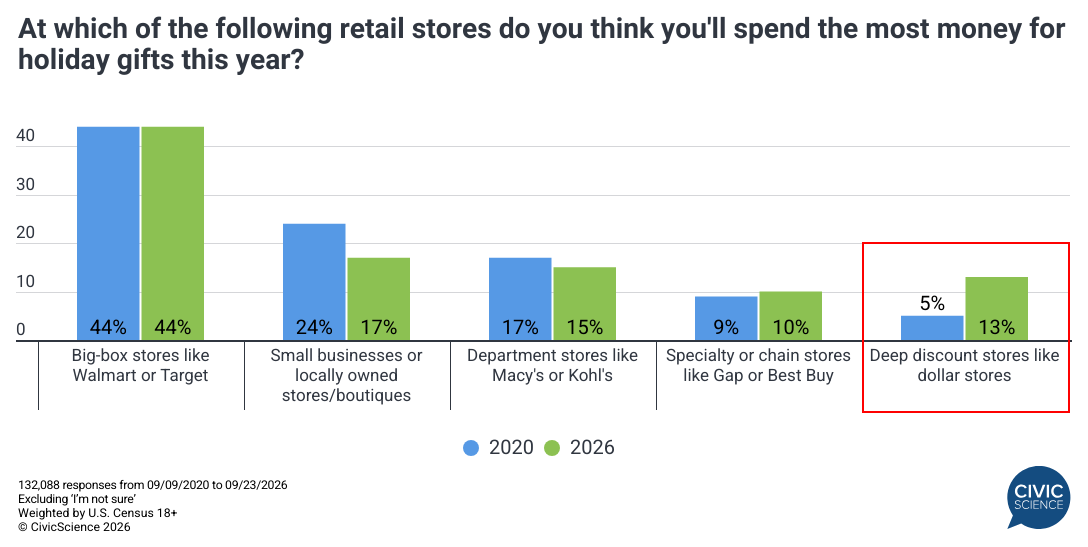
As the holiday shopping season ramps up ahead of Thanksgiving, dollar stores have carved out a growing niche. The share of U.S. adults who expect to spend the most on holiday gifts at these stores rose to 13% in 2026, up from 5% in 2020, beating specialty/chain stores (10%). Despite this growth, big-box stores remain the most common shopping destination (44%), followed by small/locally owned businesses (17%) and department stores (15%).
Take Our Poll: How often do you shop at a dollar store?
3. Younger adults are less reluctant to fly compared to their older counterparts, but are more worried about what happens when on board.
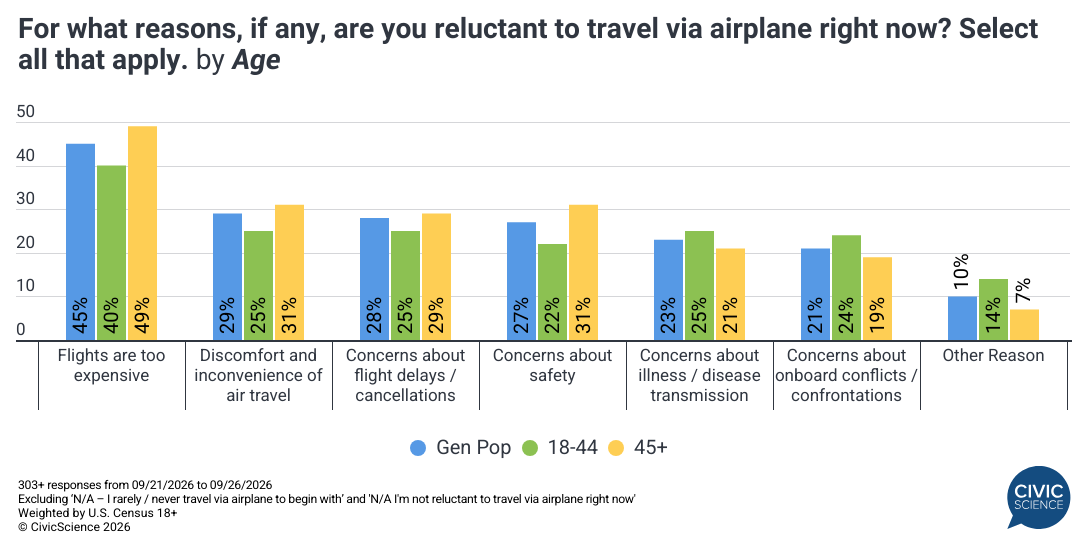
Geopolitical conflicts continue to have a meaningful impact on the cost of flying. As expected, this has led to heightened consumer reluctance to travel, with high ticket prices cementing their status as the primary barrier. Since March, the percentage of fliers citing cost as a reason for hesitation has risen to 45%, a 10-percentage-point spike. Meanwhile, secondary concerns have either increased by a single percentage point or slightly decreased since March. Discomfort and inconvenience (29%) and delays or cancellations (28%) round out the top three drivers of hesitation.
The drivers of reluctance split along distinct demographic lines. Adults ages 18 to 44 are less likely to report reluctance overall (11%) than adults 45 and older (26%) and Gen Pop (20%). Older adults are more likely to cite ticket prices (49% vs. 40%) and safety concerns (31% vs. 22%), while 18- to 44-year-olds are more concerned about what happens on board, including onboard conflicts (24% vs. 19%) and illness transmission (25% vs. 21%).