CivicScience has the world’s largest proprietary database of real-time declared intent, allowing brands to activate high-performing advertising that drives up to 80% better performance. See how our partners achieve superior marketing outcomes here.
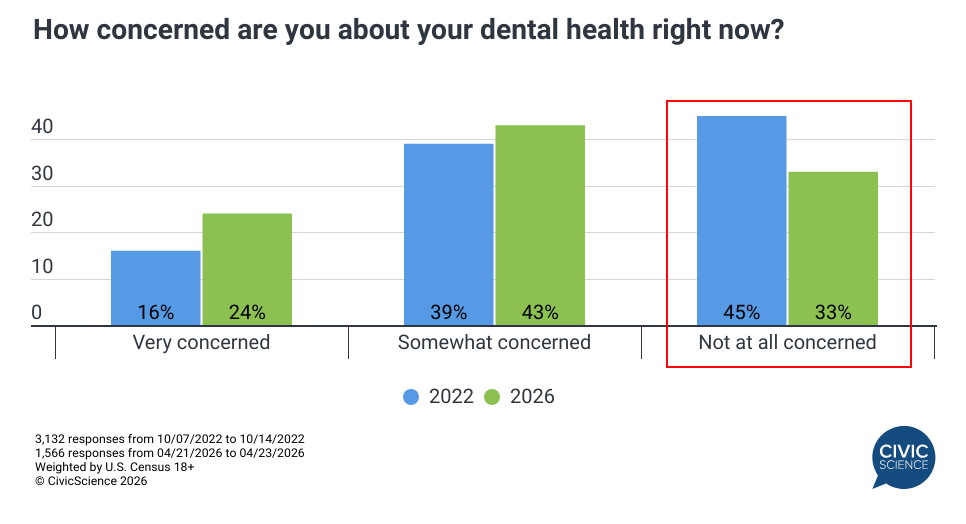
1. Americans are significantly more concerned about their dental health now compared to four years ago, and it’s driving electric toothbrush usage.
Building on previous CivicScience data recently cited by the U.S. Chamber of Commerce concerning oral health, we examined the broader state of oral health concerns among U.S. adults today. According to the latest data, two-thirds (67%) of U.S. adults are at least ‘somewhat’ concerned about their dental health right now, up significantly from 55% in 2022. Notably, the percentage who are ‘very’ concerned has jumped 50% in four years. This concern appears closely tied to financial barriers: 41% of those who are ‘very’ concerned report an instance in the past year when they were unable to see a doctor due to cost, compared to just 10% of those who are not concerned about their oral health.
Additional consumer-declared data show that oral health anxiety correlates with electric toothbrush use: 65% of those who are at least somewhat concerned say they use an electric toothbrush, compared to 52% of those not concerned at all.
Take Our Poll: Do you brush your teeth in the shower?
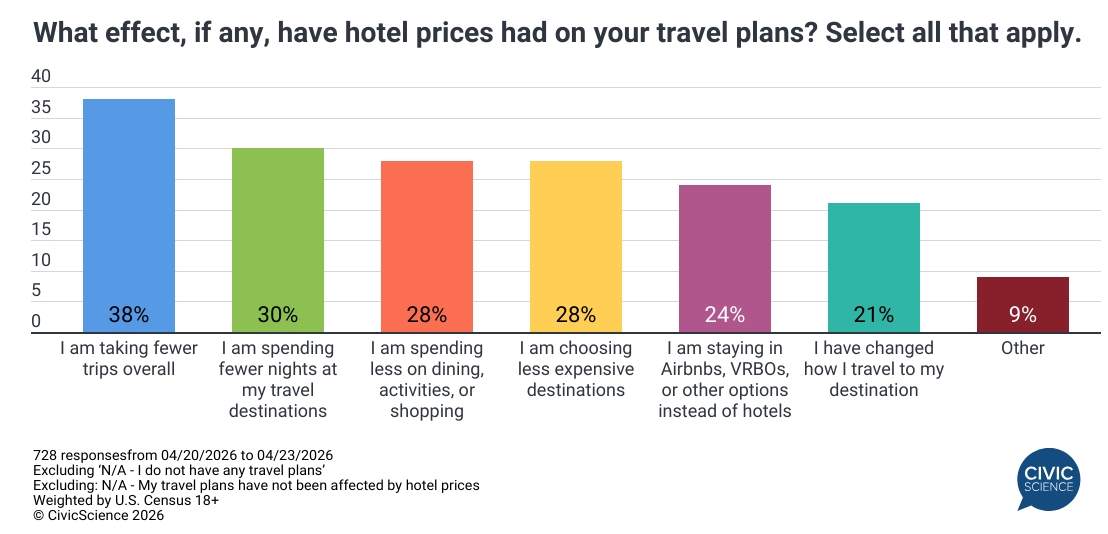
2. Rising hotel costs trigger a domino effect across the travel industry, driving travelers toward fewer trips, shorter stays, and more rental bookings.
Rising costs are reshaping how Americans approach leisure, as the majority of U.S. adults report that fluctuating hotel prices have directly affected their travel plans. Among those who say their plans have been affected, nearly four in ten are taking fewer trips overall, while around 30% are either shortening their stays or choosing less expensive locales. Travelers are also offsetting higher room rates by cutting back on dining and entertainment, with nearly one-quarter opting for alternative lodging like Airbnbs or VRBOs.
Notably, these concessions vary based on where travelers live. City dwellers are the most likely to reduce the number of nights spent at a destination, while suburban residents tend to prioritize saving money on food and activities. Meanwhile, those living in rural areas are most likely to choose less expensive travel destinations.
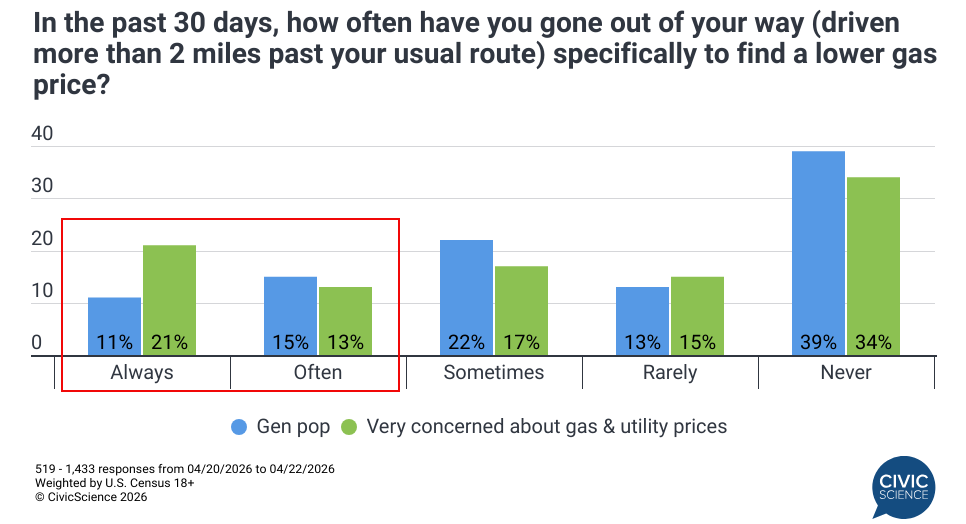
3. More than one-quarter of Americans say they frequently drive more than two miles out of their way to find affordable fuel as gas price anxiety reaches new highs amid the Iran war.
Ongoing CivicScience tracking data shows that concern over gas and energy prices has intensified sharply since the start of the Iran war, climbing from a range of 36% to 40% for much of the year to 48% in March and 53% in April. That anxiety is showing up at the pump: in the past 30 days, 26% of Americans say they have driven more than two miles out of their way to find cheaper gas either every time or often. Among those who say they are ‘very’ concerned about gas and utility prices, that figure rises to 34%, and they are nearly twice as likely as the general population to say they ‘always’ go out of their way for a lower price.
Let Us Know: At what point do you usually decide to fill up your gas tank?