CivicScience has the world’s largest proprietary database of real-time declared intent, allowing brands to activate high-performing advertising that drives up to 80% better performance. See how our partners achieve superior marketing outcomes here.
1. Fifty-six percent of non-retired American adults say they’ve yet to take any concrete action toward retirement planning, and it’s shaping near-term spending when it comes to tax returns.
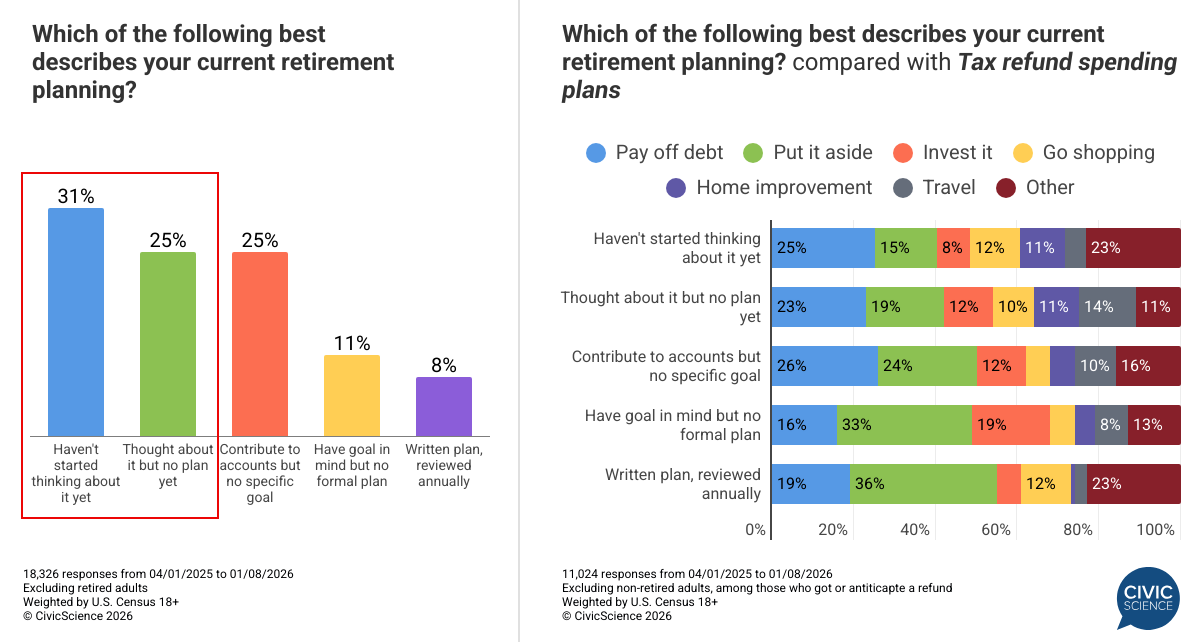
New CivicScience data reveal a staggering lack of progress in retirement planning: 56% of non-retired U.S. adults currently have no goal or plan in place, including 31% who have not even begun to think about retirement. This widespread lack of action is the rule rather than the exception, as just 8% of non-retired adults maintain a formal, annually reviewed written plan, which is likely more common among those closer to retirement age.
Notably, this lack of planning bleeds directly into immediate spending; individuals who have taken no action on retirement are significantly less likely to save their tax refund and more likely to use it for debt or immediate spending. This suggests that the absence of a long-term roadmap leaves the majority of consumers in a cycle of reactive, short-term financial management.
Take Our Poll: Do you feel you have enough saved for retirement at this point in your life?
2. While most Americans rate their attention spans as above average, Gen Z and Millennials are most likely to feel they are falling short.
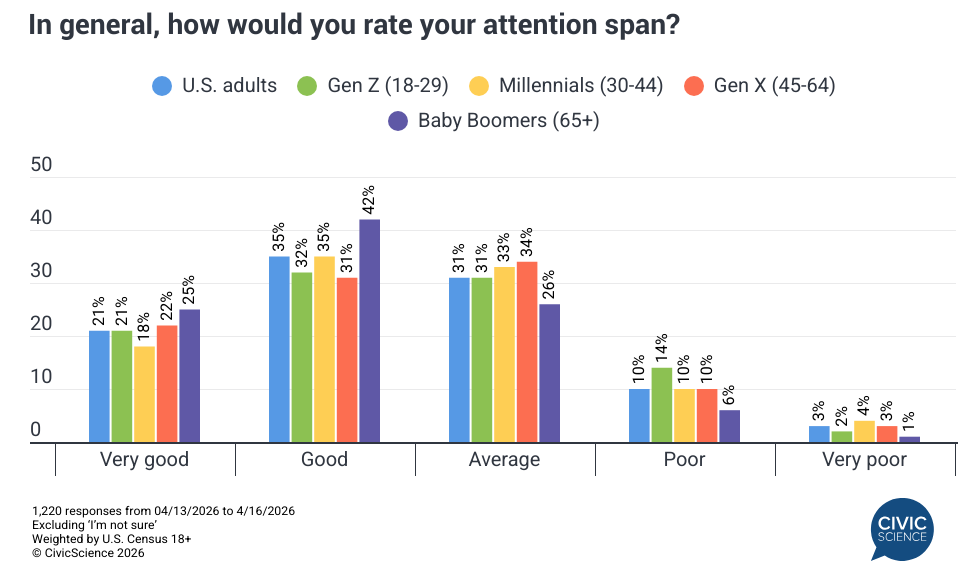
The topic of attention spans has become increasingly relevant across industries, shaping how people engage with content in various formats. New CivicScience data show most Americans rate their attention spans positively, with 56% describing theirs as ‘very’ good or ‘good,’ while about a third say ‘average’ and 13% report theirs as ‘poor’ or ‘very’ poor. Generationally, baby boomers (65+) are more likely to report above-average attention spans, whereas Gen Z adults are most likely to say theirs is ‘poor.’ Millennials are the most likely to say ‘very poor’ and the least likely to report ‘average,’ while Gen X most often lands in the middle.
Attention spans also appear fairly stable in the last ten years: about four in ten say theirs hasn’t changed over the past decade, and more report improvement than decline, though a notable share (26%) still feel their attention span has worsened.
CivicScience clients and media partners have access to the full Weekly Pulse Report, which dives deeper into how attention span may or may not affect how consumers engage with content online, including social media videos and reading online articles. Get in touch with us now to learn more.
Let Us Know: Would you say you have a better or worse attention span than other people?
3. More than one-third of respondents express interest in premium social media subscriptions for exclusive content.
As social media platforms experiment with premium tiers, 36% of U.S. adults say they would be at least ‘somewhat’ likely to use a paid subscription if it offered exclusive features not available to free users, including 11% who are ‘very’ likely (excluding those unsure). As expected, younger Americans are most receptive to premium social media subscriptions, with nearly two-thirds (63%) of Gen Z respondents reporting they would be likely to opt into a paid model, compared to 26% among Gen X and just 8% among those 65+.
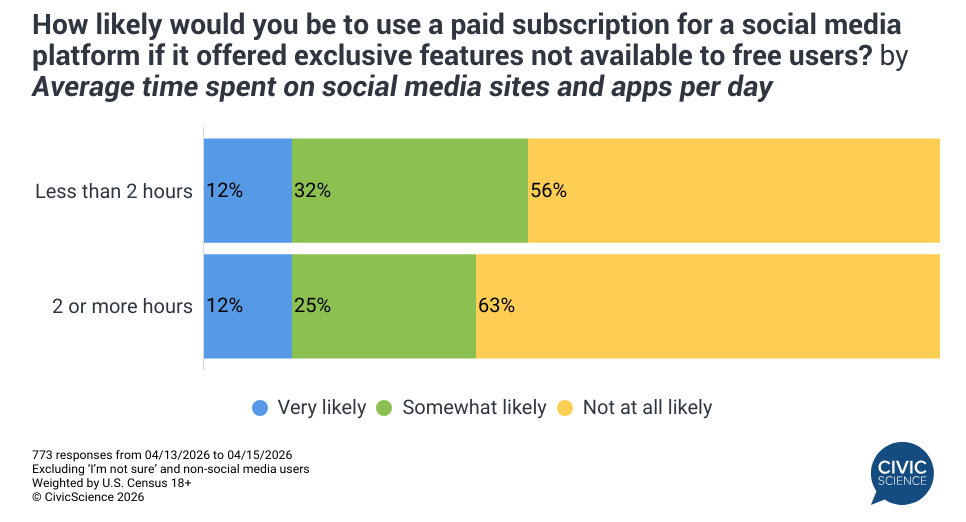
Interestingly, however, the most frequent social media users (2+ hours per day) are not the ones with the strongest overall interest in premium social media subscriptions. Instead, those spending less than two hours a day on these platforms show higher interest (44%) than heavy users (37%). This suggests that for lighter users, a subscription may be seen as a way to enhance a more limited, intentional experience with exclusive features, whereas heavy users may be more accustomed to the existing free, ad-supported model despite their high daily usage volume.