CivicScience has the world’s largest proprietary database of real-time declared intent, allowing brands to activate high-performing advertising that drives up to 80% better performance. See how CivicScience partners achieve superior marketing outcomes here.
1. Americans plan to use their remaining FSA balances on vision and dental care.
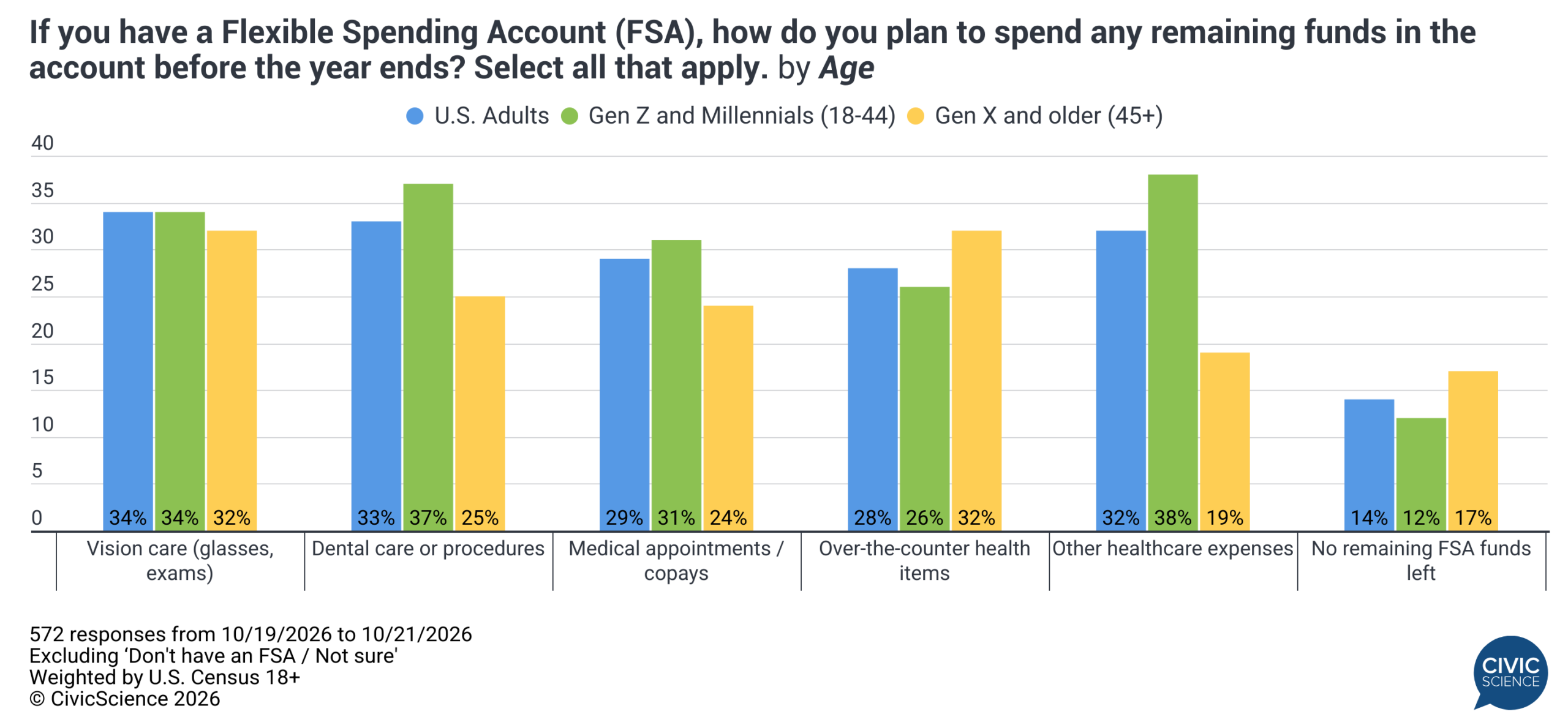
With the year-end deadline for many Flexible Spending Accounts (FSAs) approaching, account holders are busy planning how to spend their remaining balances before they expire. Consumer-reported data from CivicScience show that many Americans still have funds left to use, as just 14% report they have no remaining FSA balance to spend. The data also find that vision (34%) and dental (33%) care are the top priorities, followed narrowly by ‘other’ healthcare expenses (32%).
Gen Z (18-29) and Millennials (30-44) are twice as likely as adults 45+ to put their remaining funds toward ‘other’ healthcare expenses (38% vs. 19%). They also over-index in allocating remaining funds to dental care, four points ahead of Gen Pop and 12 points ahead of their older counterparts. Adults 45+, however, are more likely to zero out their FSA balance on over-the-counter items (32% vs. 26% of Gen Z and Millennials).
2. Anime is growing in popularity among Americans, but most K-pop exposure is passive.
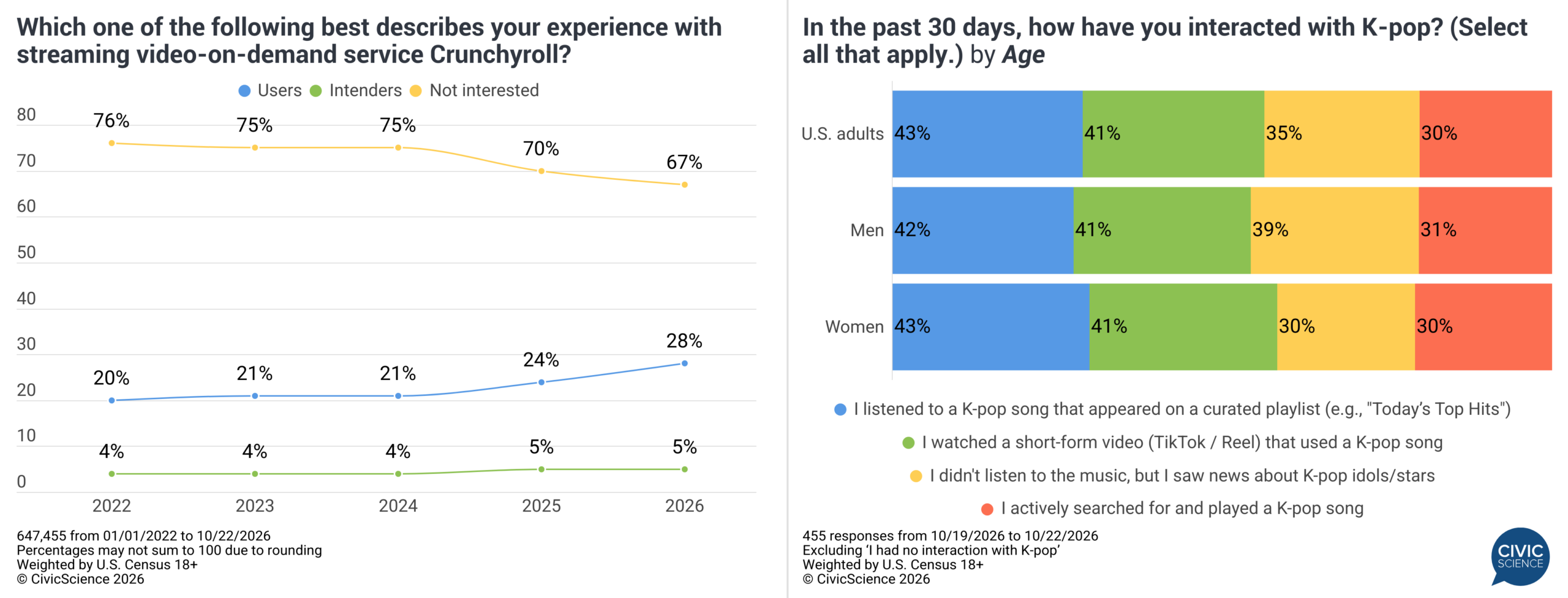
It’s been a landmark year for both anime and K-pop. With the share of adults watching climbing three percentage points from last year and BTS’s comeback album ‘Arirang’ selling 3.98 million copies on its first day, the rise of both industries is shaping major parts of American popular culture. After holding steady around 20% from 2022 to 2024, usage of the anime streaming platform Crunchyroll is up to 28% so far in 2026. The share of Americans ‘not interested’ in the platform is also down from 76% to 67% since 2022. Usage of the platform is largely driven by younger Americans — Gen Zers lead the way, with 50% having used the platform, followed by 39% of Millennials. Crunchyroll also overlaps heavily with other streaming platforms. Nearly half of Disney+ (48%) and Peacock (47%) users have also used Crunchyroll, as have 45% of Hulu users, 39% of Amazon Prime Video users, and 38% of Netflix users.
K-pop has been taking over the charts this year, and while nearly 2 in 5 (38%) U.S. adults report having interacted with the genre in the past 30 days, much of that exposure is passive. Among those who interacted, the most common ways were hearing a K-pop song on a curated playlist (43%) or in a short-form video. Fewer sought out the genre, with only 30% actively searching for and playing a song. Men and women engage almost identically, with one exception: men were more likely to have seen news about K-pop idols without listening to the music (39% vs. 30%).
Take Our Poll: In general, how much do you like to watch anime (Japanese animation)?
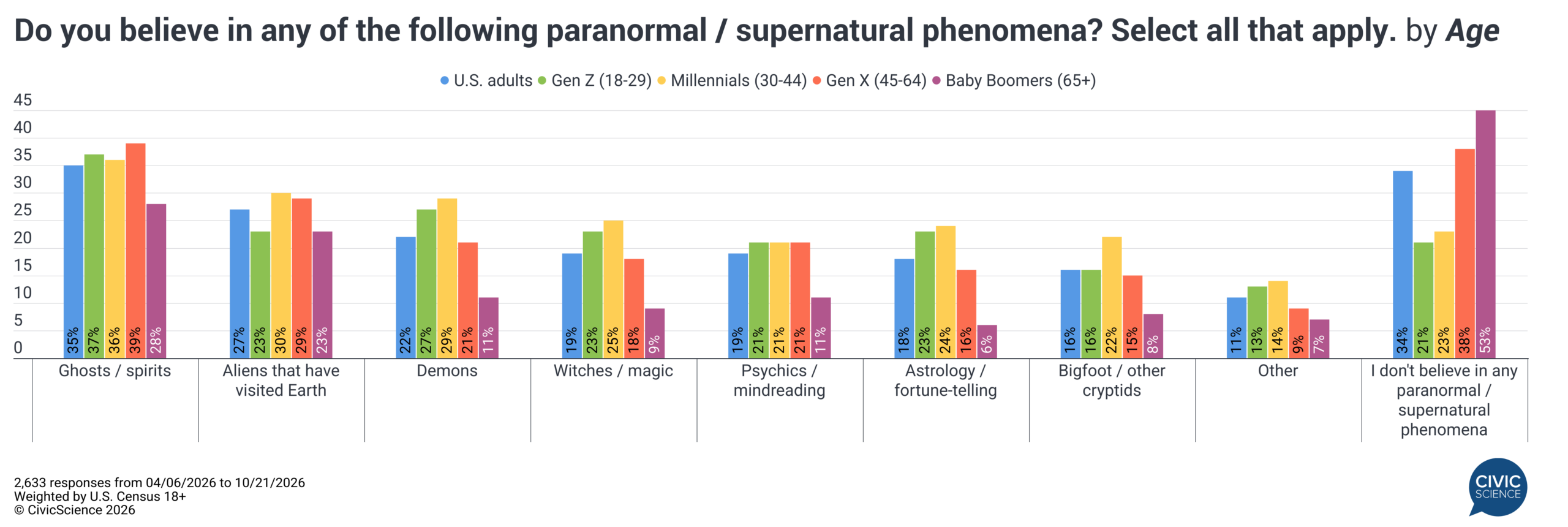
3. Belief in the paranormal is widespread but varies by generation ahead of Halloween weekend.
As Halloween approaches this weekend, the latest CivicScience data show most Americans believe in something paranormal, with only about a third (34%) being skeptics. Ghosts and spirits are the most common at 35%, followed by aliens (with the stipulation that they’ve visited Earth) at 27%, and demons (22%). Bigfoot and other cryptids are the least believable to Americans at 16%.
Gen X (45-64) is the generation most likely to believe in ghosts (39%), but only by a small margin. Gen Z and Millennials stand out for their belief in demons (27% and 29%), witches/magic (23% and 25%), and astrology/fortune-telling (23% and 24%). Millennials are also the most likely generation to believe in cryptids like Bigfoot or Mothman, six points above both Gen Pop and Gen Z. Boomers (65+) are the only generation in which skeptics are the majority: 53% reject the paranormal entirely, compared with just 21% of Gen Z.
Let Us Know: Do you generally believe in ghosts?