CivicScience has the world’s largest proprietary database of real-time declared intent, allowing brands to activate high-performing advertising that drives up to 80% better performance. See how CivicScience partners achieve superior marketing outcomes here.
The holiday party season is fast approaching. While some Americans host family and friends every week, others rarely open their doors. CivicScience data show that 60% of U.S. adults hold gatherings at least occasionally, and their habits vary widely in how often they entertain, how far ahead they plan, and what they buy.
Most of that entertaining is occasional. Over one-third of U.S. adults (35%) host ‘once a month or less,’ 17% ‘once a week to twice a month,’ and just 9% ‘twice a week or more.’ The remaining 40% ‘never’ do.
The most frequent hosts skew young. Gen Z (18-29) and Millennials (30-44) are equally likely to entertain twice a week or more (16% each), compared with 9% of all U.S. adults. Nearly half of Gen X (45-64) and more than half of Boomers (65+) never have people over. Men are also more likely than women to host twice a week or more (11% vs. 7%).
Frequent Hosts Are Entertaining More Often in 2026
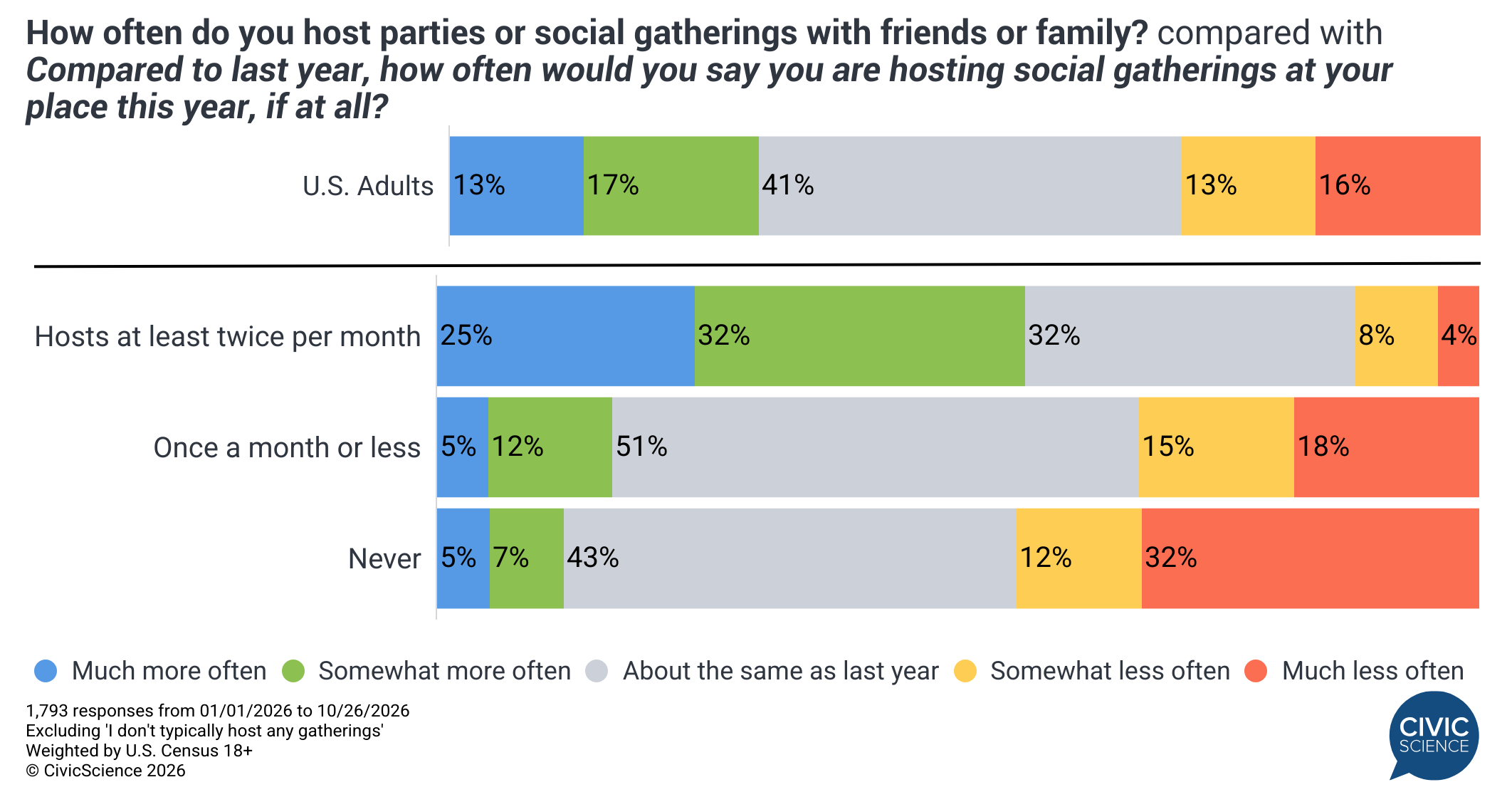
Overall, about as many hosts say they’re entertaining more often this year (30%) as less often (29%). Frequent event planners are the exception. One-quarter (25%) of those holding events twice a month or more say they’re having people over ‘much more’ often than last year, five times those hosting ‘monthly or less’ and ‘never’ (5%). Only 12% of those entertaining ‘once a month or less’ say they’re hosting somewhat more often than in 2025.
Financial considerations also appear to influence how often Americans entertain. Hosts who have become ‘less’ price-sensitive over the past 12 months are nearly three times as likely as those who are more price-sensitive to be entertaining more often (56% vs. 20%).
Holidays and Informal Hangouts Are the Most Common Events
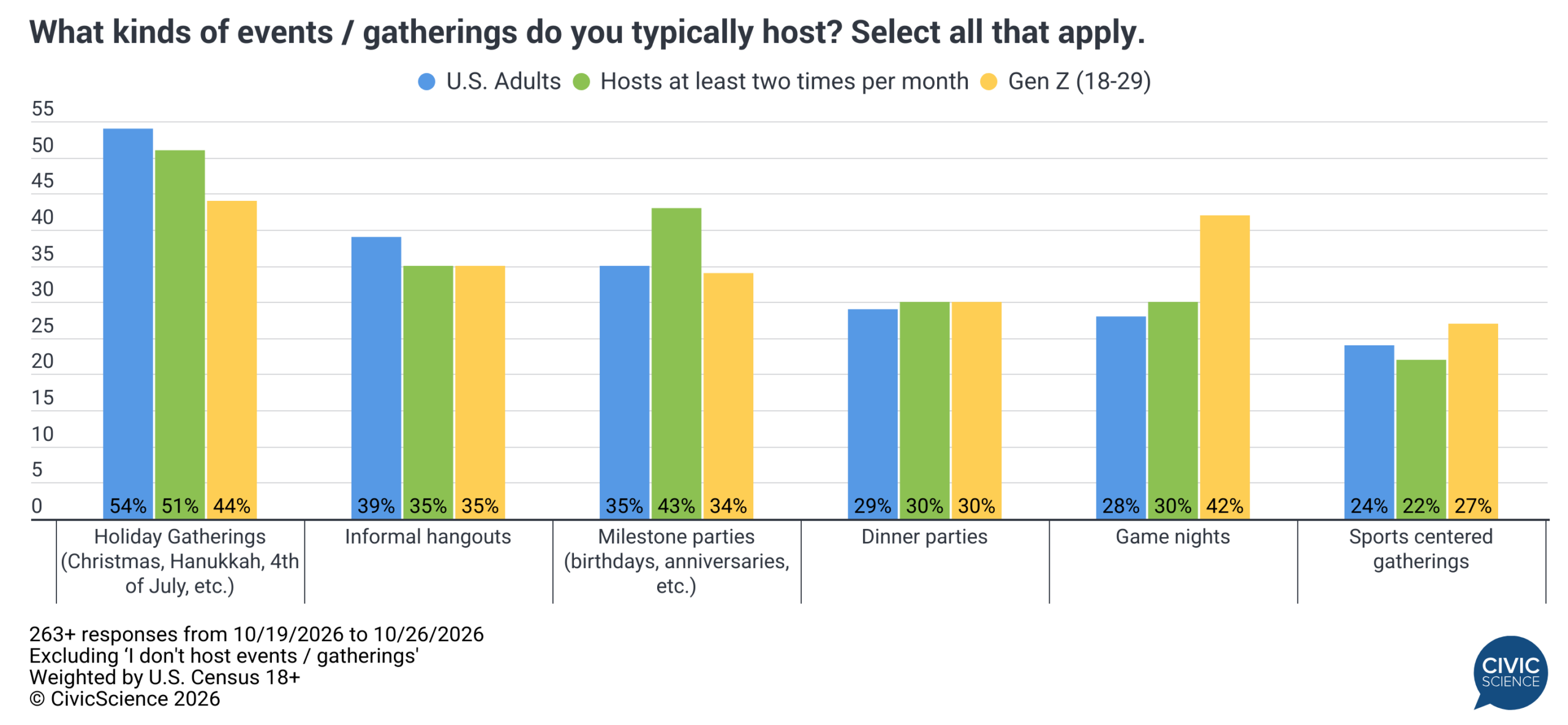
Among hosts, holiday gatherings are the most common events (54%), followed by informal hangouts (39%) and milestone events such as birthdays or anniversaries (35%). Frequent hosts and Gen Z, however, are less tied to the holiday calendar. Those who host at least twice a month are notably more likely than average to celebrate milestones, while Gen Z are far more likely to hold game nights (42% vs. 28%). For brands, that makes younger and more frequent hosts a year-round audience rather than a seasonal one.
Short Planning Windows Are the Norm
To accommodate busy schedules, over one-third of hosts (36%) schedule their events two to three weeks in advance, while 28% schedule up to a month ahead. Prep, including choosing a menu or decorations, most often begins two to three weeks out (29%) or one week before (25%). Only about 1 in 8 (12%) begin planning more than a month in advance.
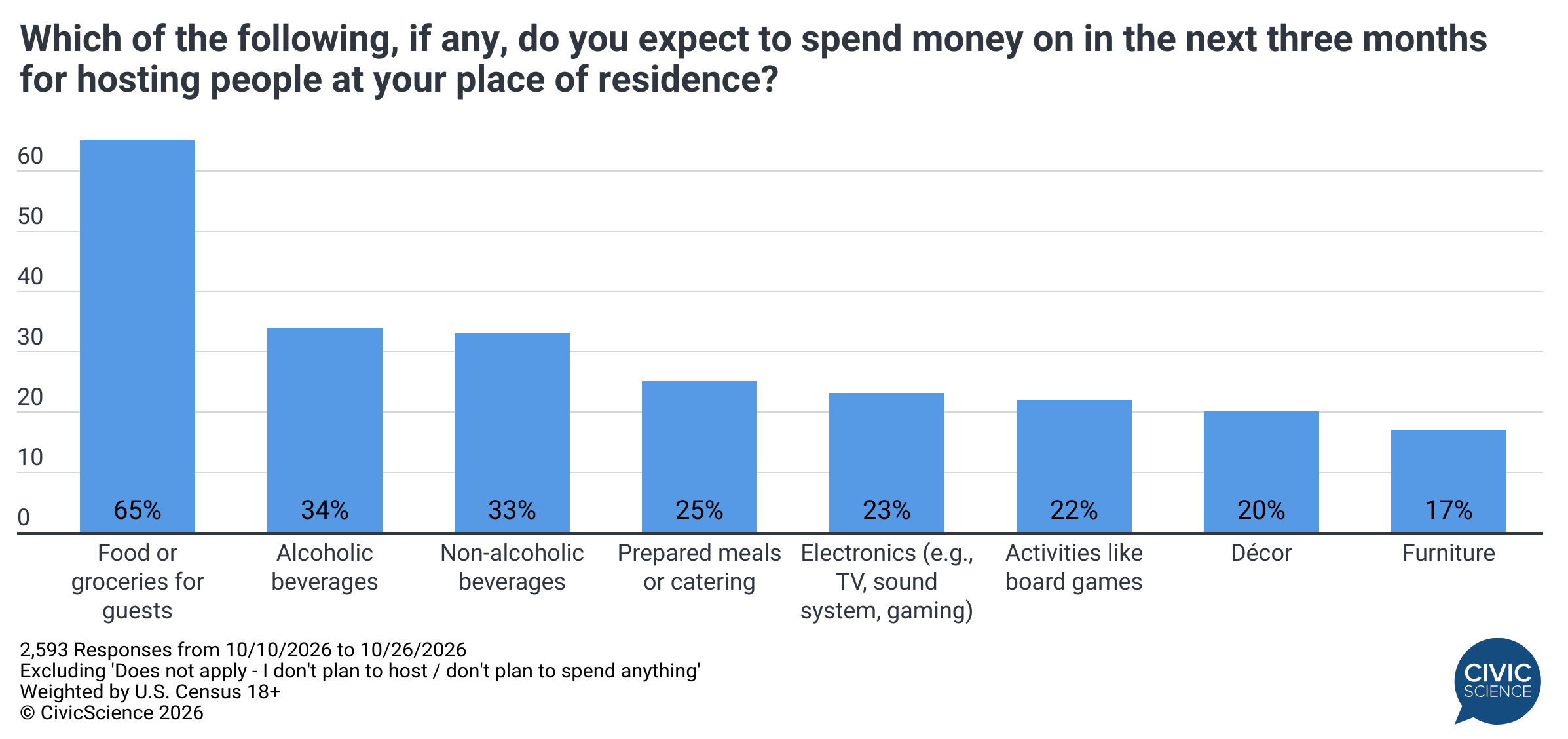
When it comes to preparing for these gatherings, food is the top expected expense, with 65% of hosts planning to spend on food or groceries for guests in the next three months. Alcoholic beverages (34%) and non-alcoholic beverages (33%) follow, and 25% plan to spend on prepared meals or catering.
For menu, decoration, and theme inspiration, hosts turn most often to friends and family (57%) and social media (40%). Women are more likely than men to find inspiration on social media (44% vs. 35%), while men and women are about equally likely to look to friends and family (58% vs. 56%).
Frequent Hosts Tend to Be AI Shoppers, Too
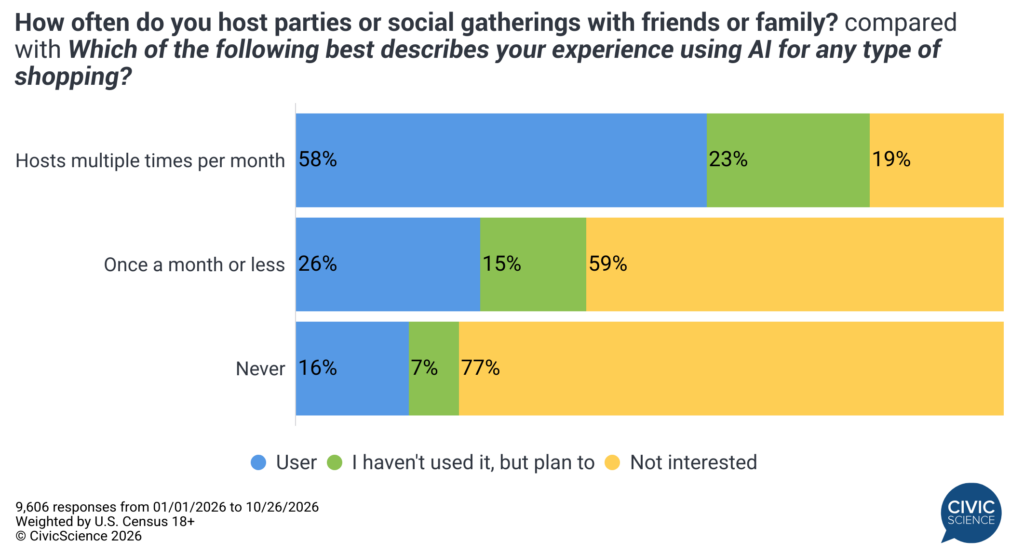
Frequent hosts are far more likely than others to shop with AI. Among those who host at least twice a month, 21% say they turn to an AI assistant first when researching any product, compared with just 5% of non-hosts. A majority (58%) use AI for any type of shopping, compared with 25% of less frequent hosts and 16% of non-hosts. Much of this gap likely reflects age, as younger adults make up a large share of both frequent hosts and AI users. Still, for brands trying to reach active party planners, AI is a meaningful part of the path to purchase.
The most frequent hosts are younger, entertaining more than last year, and far more likely to shop with AI, while more price-sensitive hosts are the most likely to be cutting back. Across all hosts, short planning windows and food-first budgets highlight the importance of reaching consumers as they prepare for gatherings. For brands targeting younger and more frequent party planners, AI may also offer an increasingly valuable way to connect with shoppers.