CivicScience has the world’s largest proprietary database of real-time declared intent, allowing brands to activate high-performing advertising that drives up to 80% better performance. See how CivicScience partners achieve superior marketing outcomes here.
As you scroll through an online shop, your cart steadily fills up with items. How often do you close the page without checking out, leaving your cart full? If you do so often, you’re not alone.
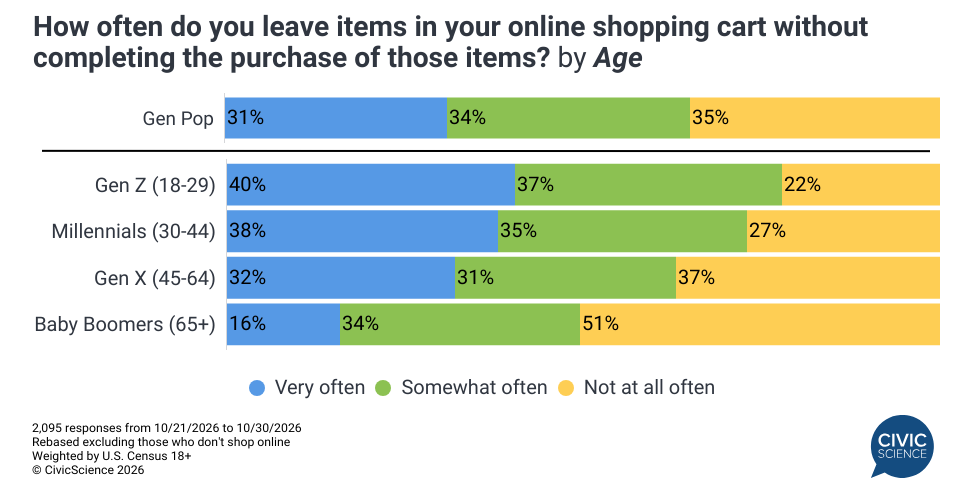
New consumer-reported data from CivicScience show that nearly two-thirds (65%) of U.S. online shoppers at least ‘somewhat’ often abandon their carts before checking out, and more than 3 in 10 do so ‘very’ often. Although Gen Z adults (18-29) abandon their carts most frequently, the habit spans generations. A majority of each generation under 65 leave items in their carts at least ‘somewhat’ often, and about half of Baby Boomers (65+) do the same.
The practice is common across genders but more pronounced among women: 73% of women report leaving items in their online carts ‘somewhat’ (36%) or ‘very’ (37%) often, compared with 57% of men (27% and 30%, respectively).
Cart abandonment also varies by brand. Among the thousands of brands CivicScience tracks, a few stand out as having shoppers who abandon carts more often than average. Lululemon (40%), The Vitamin Shoppe (39%), and Dick’s Sporting Goods (36%) shoppers outpace the general population (31%) in leaving items in their carts ‘very’ often. Walmart shoppers, on the other hand, are less likely than average to do so (26%).
Why shoppers aren’t completing purchases
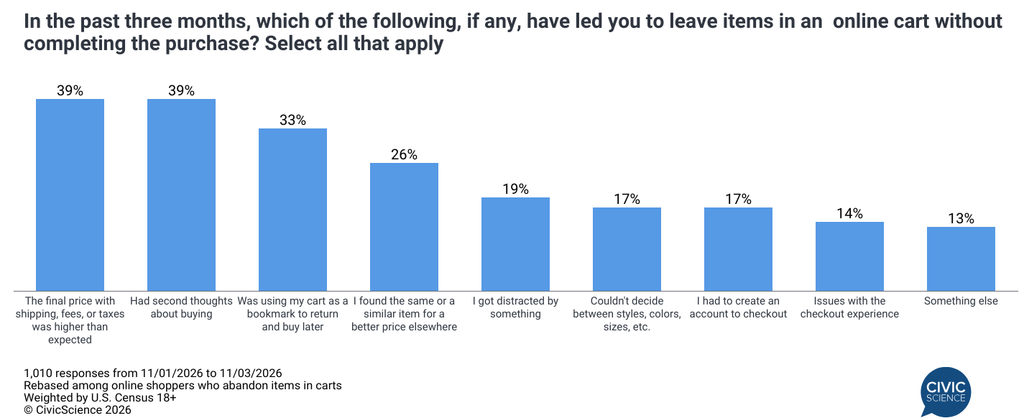
Consumer-reported data offer a deeper understanding of the “why” behind Americans leaving their digital carts behind. Unexpected shipping, fees, or taxes (39%) and second thoughts (39%) tie as the most common reasons for cart abandonment. A third of cart abandoners (33%) use their carts as temporary bookmarks or wishlists to revisit later, while roughly 1 in 6 (17%) can’t decide between colors, styles, or sizes. Direct checkout friction, including mandatory account creation (17%) and technical checkout issues (14%), is less common.
These findings point to several operational opportunities for retailers. Displaying transparent cost estimates early in the shopping funnel may help reduce price shock. Interactive fit, color, and sizing guides could address hesitation about product selection before shoppers stall out. And with 33% using carts as bookmarks and 19% getting distracted, timely re-engagement may be worth a closer look.
A little nudge may go a long way, as long as it’s not overwhelming
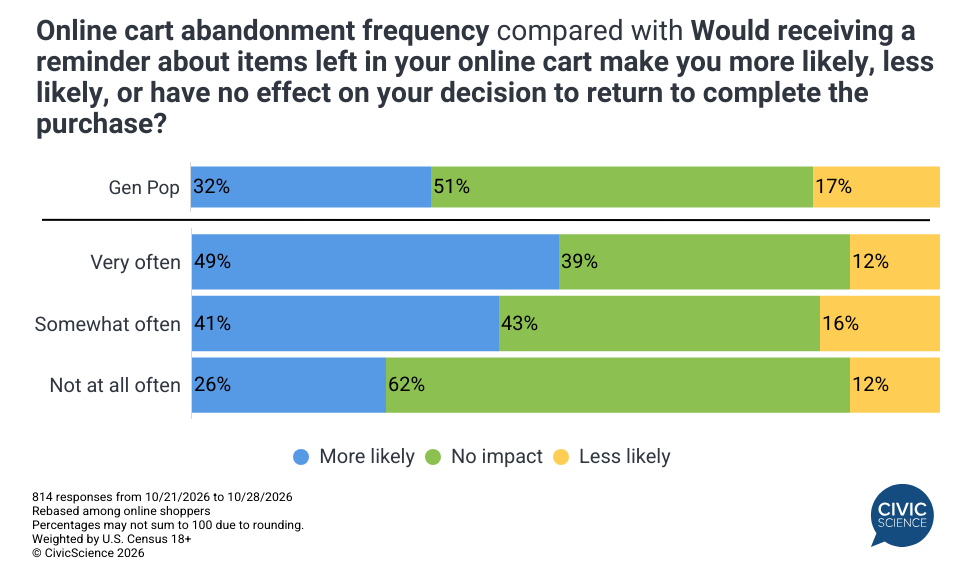
Additional data show that re-engagement can be effective under the right conditions. About a third of online shoppers (32%) say a reminder about items left in their carts would make them ‘more’ likely to return and complete the purchase, while 51% say it would have no impact and 17% say they’d be ‘less’ likely to return. Reminders carry the most weight among frequent cart abandoners: 49% of those who leave items behind ‘very’ often say a reminder would make them ‘more’ likely to return and complete the purchase.
These reminders come with important caveats, however. Twenty-four percent of online shoppers say they don’t want to receive any reminders at all, and 16% say multiple notifications would become annoying. Still, 31% say they would be OK receiving a single reminder, compared with just 11% who are fine with multiple reminders. Asked how they’d prefer to be reminded, shoppers favor email (35%) and text message (23%), followed by a website notification on their next visit (16%), with less interest in reminders via social or other digital advertising.
Shoppers who leave items in a cart haven’t necessarily changed their minds. They may be comparing prices, saving items for later, or simply getting distracted. Heading into the busiest shopping stretch of the year, retailers may benefit from a more targeted approach to cart reminders: who to reach, how often, and through which channel.