CivicScience has the world’s largest proprietary database of real-time declared intent, allowing brands to activate high-performing advertising that drives up to 80% better performance. See how CivicScience partners achieve superior marketing outcomes here.
Aside from the big feast, Thanksgiving weekend is most commonly associated with sales thanks to Black Friday and Cyber Monday. But there’s another sales event geared specifically for travel deals: Travel Tuesday. The event, which falls on December 1 this year, serves as an early indicator for 2027 as consumers assemble travel plans for the year ahead. Here’s what new consumer-reported data from CivicScience reveal about who is planning to partake and the travel they’re looking for in 2027.
Americans Under 45 and Living in the South Drive Travel Tuesday Demand
Most Americans have heard of Travel Tuesday by now. Sixty-three percent of U.S. adults say they’re aware of it, nearly identical to last year’s 62%. What’s shifting is how many plan to act on it: 47% of those aware are at least ‘somewhat’ likely to take part this year, a modest gain over 2025 (45%) but a sizable jump from 2023 (34%), when CivicScience began tracking the event.
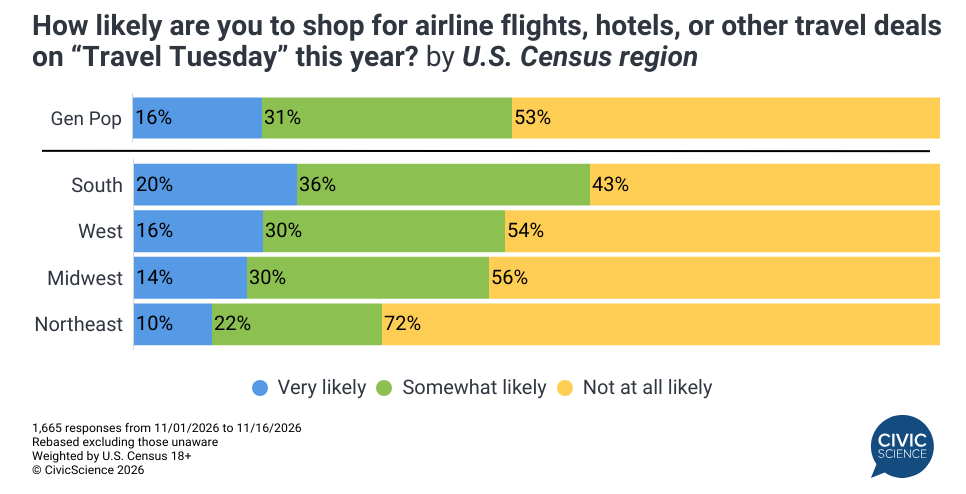
As for who is most interested, Gen Z aged 18-29 (68%) and Millennials aged 30-44 (61%) are by far the most likely generations to participate, outpacing their older counterparts by at least 25 points each. Other noteworthy demographics driving Travel Tuesday intent include women (49% vs. 46% among men) and Republicans (53% vs. 49% among Democrats). Additionally, interest in Travel Tuesday is particularly strong among Americans living in the South, with more than half likely to shop for travel deals, followed by those living in the West. Meanwhile, those living in the Northeast are by far the least likely to participate.
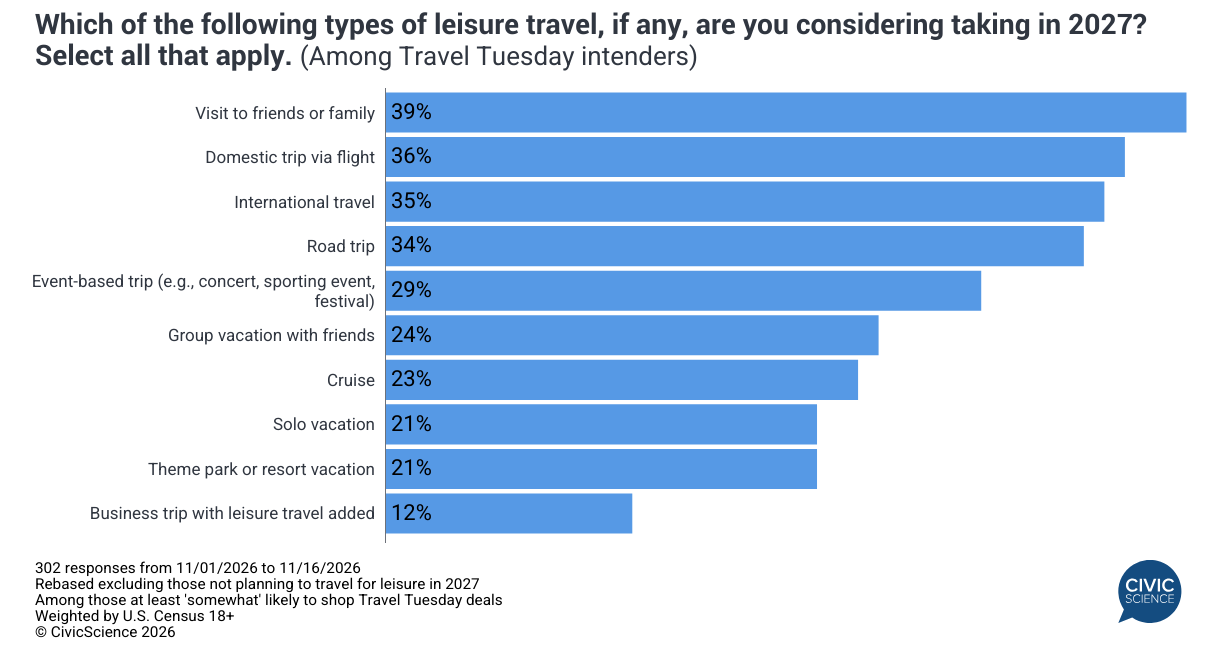
Knowing who plans to participate is only part of the story. The types of trips these intenders are weighing for 2027 provide a clearer read on where demand might be headed, not just on Travel Tuesday but in the coming months as well.
For airlines, the opportunity is broad: Domestic flights (36%) and international travel (35%) both rank near the top among likely Travel Tuesday participants. Hotels and rental car companies have a strong audience in road trippers (34%) and those planning visits to friends or family (39%). Event-based trips (29%) give ticketing platforms and destination marketers a stake in Travel Tuesday as well, while cruise lines (23%) and theme parks and resorts (21%) are competing for a smaller but still sizable share. Business trips with leisure added (12%) remain a niche.
Why Travel Tuesday Matters
The data suggest that Travel Tuesday intenders are poised to be “power travelers” in 2027. Nearly two-thirds of Travel Tuesday intenders (65%) plan to take more than one leisure trip next year, including 34% who plan to take three or more. Each of those trips is another set of booking decisions, and another opportunity for brands to reach them well beyond December 1. Additional consumer-declared data from CivicScience reveal how to stay in front of this audience and engage them as their plans take shape:
- Women’s Sports Interest: Travel Tuesday intenders are nearly twice as likely as the average American to be ‘very’ interested in watching women’s sports (28% vs. 15%).
- Weekly Podcast Listeners: Nearly 6 in 10 (58%) intenders say they listen to podcasts weekly or more, far higher than the 34% of Gen Pop who say the same.
- Streaming with Ads: Intenders are more likely to watch on several major streaming platforms that offer ad-supported tiers. Notably, they’re nine percentage points more likely than Gen Pop to watch Disney+ with ads (35% vs. 26%).
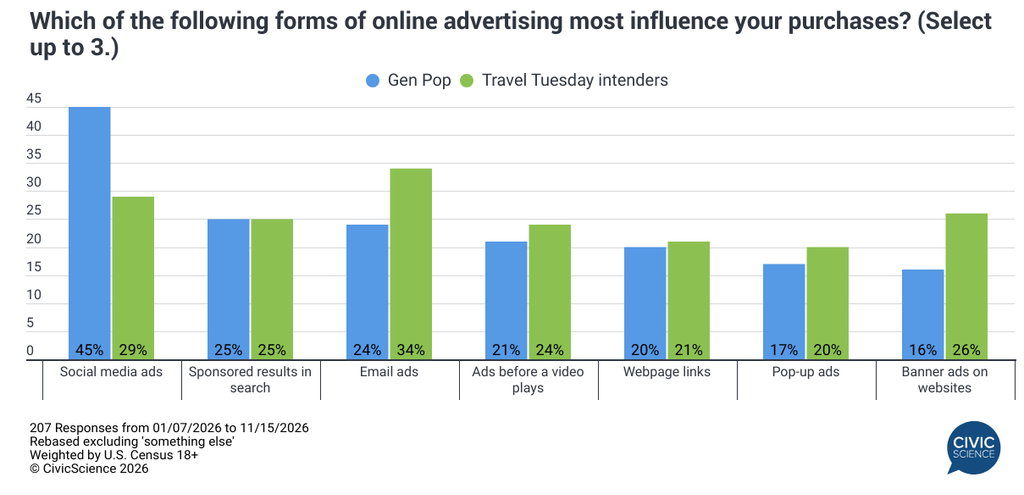
- Influence of Digital Ads: Zooming out to digital ads in general, intenders are notably less likely than average to be swayed by social media ads. Instead, their purchases are more likely to be shaped by email and banner ads on websites. Pre-roll video and pop-up ads also carry more weight with intenders than with Gen Pop.
Travel Tuesday might not get as much attention as Black Friday, but it, too, is a key signal of where consumer spending may be headed in the coming year. Intenders aren’t chasing just one kind of getaway; they’re planning visits with family and friends, international adventures, road trips, and event-driven outings. Tailoring messages to each of those motivations and delivering them through podcasts, ad-supported streaming, and women’s sports programming can help travel brands stay relevant at every stage of intenders’ 2027 planning.