CivicScience engages directly with consumers, collecting over one million survey responses daily, to turn real-time insights into high-performing advertising campaigns. See how leading brands use CivicScience to drive campaign performance here.
As content consumption habits evolve – and AI-powered search increasingly redirects eyes away from publisher sites – the challenge isn’t just attracting audiences, but maintaining their attention. As a result, understanding what keeps readers engaged has never been more critical.
New CivicScience data shows that, despite these challenges, most Americans remain willing to engage further. Nearly two-thirds of U.S. adults 18+ say they typically stay on a site and explore additional content after reading an article. Younger audiences are especially likely to continue browsing, with 77% of Gen Z adults (18-29) and 71% of millennials (30-44) saying they go beyond the initial article. While that behavior declines with age, falling to 64% among Gen X (45-64) and 55% among Baby Boomers (65+), it still represents a clear majority.
What’s actually driving continued engagement?
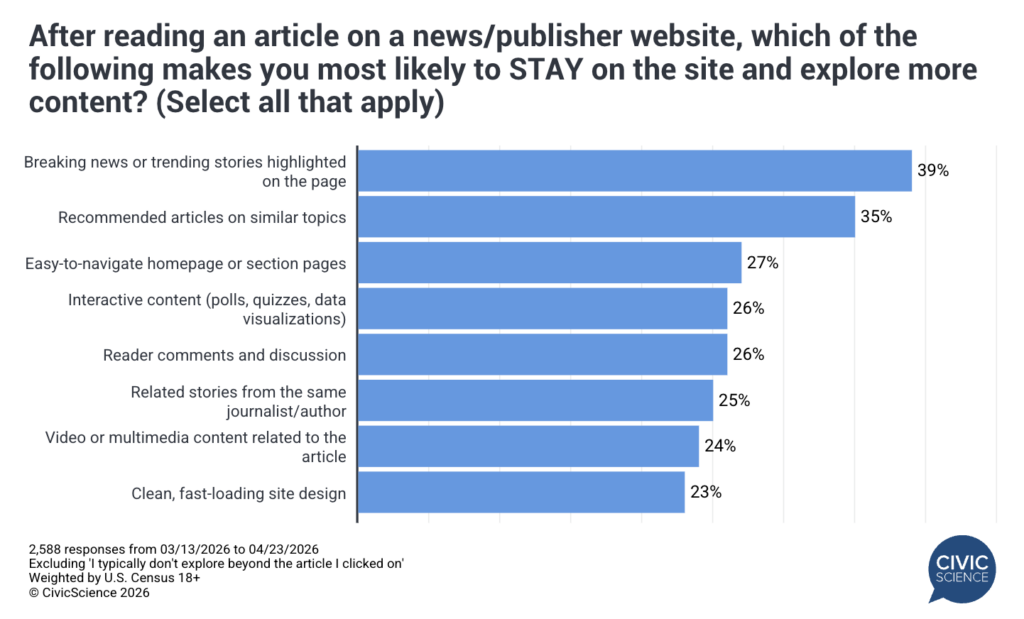
Among those who explore a news/publisher site beyond an initial article, timely and relevant content is the strongest driver of further engagement. Breaking or trending news articles highlighted on the page rank as the leading factor, cited by 39% of U.S. adults, followed closely by recommended articles on similar topics (35%) – highlighting the importance of surfacing content that aligns with readers’ immediate interests. While these core drivers lead, features like interactive elements such as polls (26%), video (24%), and site experience factors such as ease of navigation (27%) play a secondary but still meaningful role, reinforcing that both content strategy and presentation influence whether users stay on-site.
Americans 45+ are far more likely to stay for trending or breaking news (49% vs. 30% of those 18-44), making it the dominant driver of engagement for older audiences and underscoring the importance of visibility and timeliness for this group. In contrast, younger audiences show a clear preference for more dynamic experiences, over-indexing on interactive content (34% vs. 19%) and video (30% vs. 17%) – a nearly twofold difference in both cases.
Gender differences are more subtle but still notable. Women are more likely than men to cite breaking news (43% vs. 36%) and user experience as factors in continued engagement, including ease of navigation (30% vs. 23%) and a clean, fast-loading design (25% vs. 21%). Men, on the other hand, are slightly more likely to point to video content (25% vs. 22%) and related stories from the same author (26% vs. 24%) as drivers of further clicks.
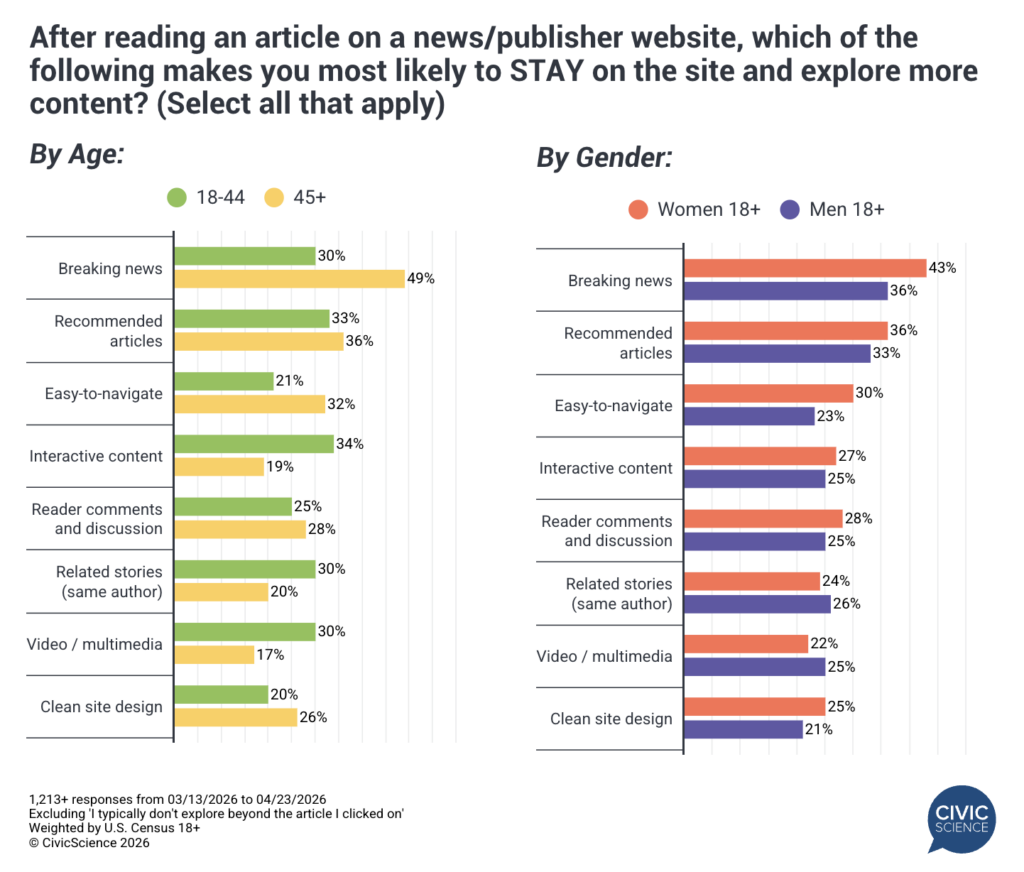
The path to stronger engagement is not one-size-fits-all. Trending content and relevant recommendations move the needle most broadly, but younger audiences are raising the bar with expectations for dynamic, multi-format experiences – while older audiences remain highly responsive to timely, visible content. For publishers, the opportunity lies in aligning strategy with both dimensions: pairing what readers want to see with how they prefer to experience it.