CivicScience engages directly with consumers, collecting over one million survey responses daily, to turn real-time insights into high-performing advertising campaigns. See how leading brands use CivicScience to drive campaign performance here.
Winning over the trust of American consumers is not an easy feat, particularly during a turbulent and stressful time for many Americans. From tariffs to holiday spending to government shutdowns, there is no shortage of behavioral influences for advertisers and media publishers to navigate. Knowing who consumers trust and how that bond affects their decision-making before they take any action is what CivicScience does best. Here is what Americans are telling CivicScience about how much they trust the media and where they get their news.
Those Who Watch the News Are Sharply Divided on How They Feel About It
How do people who follow the news feel about the coverage they have seen recently? Survey data indicate that viewers’ perceptions of the coverage of current events have shifted significantly over the past year. More than one-third say they ‘wish there was more news coverage of current events,’ up from 25% in 2024. Meanwhile, those who ‘like the amount’ of news coverage they’ve been seeing is up from 26% last year to 33% today. Perhaps most notably, the percentage who are ‘tired of all the news coverage’ they’ve been seeing had dropped 18 points year-over-year from 50% last year to 32% in late October.
The State of Media Trust Today as Americans Watch More News
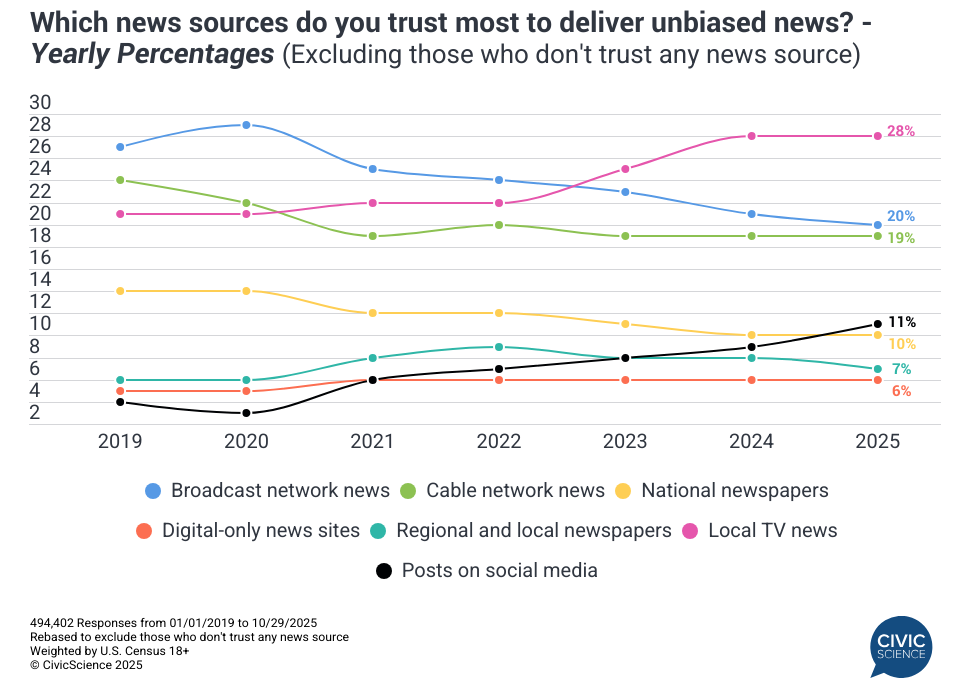
Given the constant flow of news amid an already changing media landscape, it’s important to examine how Americans feel about the news sources available to them. Zooming in on the news Americans trust to deliver unbiased news, local TV news remains at the top, holding steady throughout the past year (among those who trust at least one source). The percentage of people who say they trust social media posts as an unbiased news source, while smaller at 11%, has been steadily rising for the past five years, up from just 3% in 2020. This growth has enabled it to surpass national newspapers in terms of consumer trust. Meanwhile, once serving as the most-trusted source, broadcast network news has trended in the opposite direction over the same period and may soon fall below cable network news.
Let Us Know: When thinking about the past few weeks, how would you describe the amount of news you have been reading?
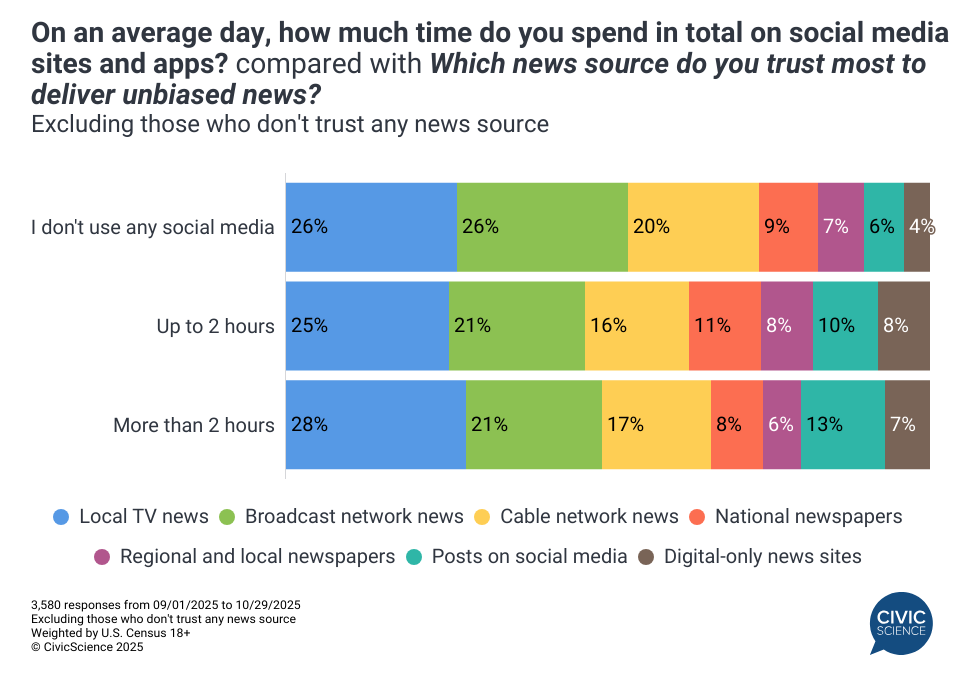
Respondents under 45 unsurprisingly lead their 45+ counterparts in trusting social media posts by a considerable margin. They are also more likely to trust national newspapers. In contrast, adults ages 45 and older over-index in trust across most other sources, especially local TV, broadcast network news, and cable news. Social media habits further influence these views: frequent users are most likely to trust local TV news, while non-users are more inclined to trust traditional broadcast and cable outlets.
Weigh In: Do you think social media is a trustworthy source for news?
Breaking news may be playing a role in shifting views on news bias. Additional CivicScience polling finds Americans who believe breaking news is important are increasingly turning to national cable news channels (e.g., CNN, Fox News) as their first source for breaking news and are slightly less likely to turn to national news channels (e.g., NBC, ABC, CBS). A possible connection to this increase is that more Americans report watching five or more hours of TV news programming each week. The percentage of people watching zero hours is declining at the same rate, suggesting that TV news may attract new viewers rather than existing audiences simply watching more. National news websites also appear to be gaining steam as the initial source for breaking news.
Institutional Trust in Media Among Gen Z Adults
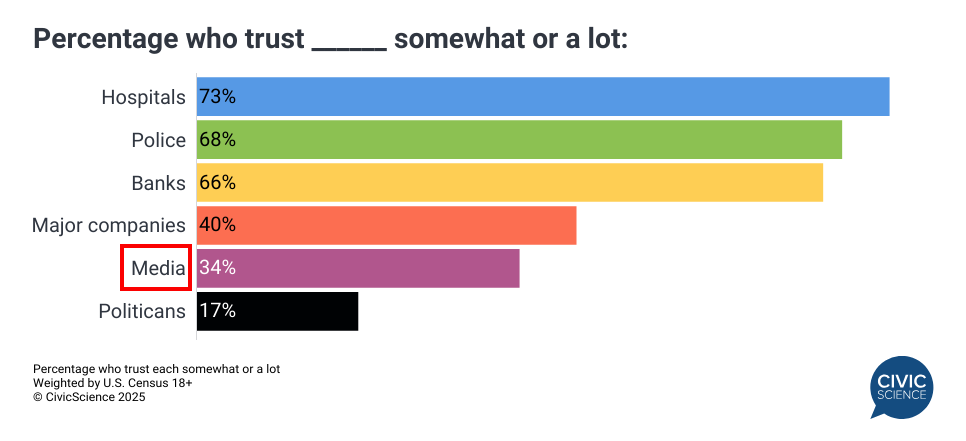
While trust in media has historically been on the lower end of the spectrum, CivicScience data indicate the percentage who trust media ‘somewhat’ or ‘a lot’ has grown over the past year, rising from 31% in 2024 to 34% so far this year. Americans between 18-29 are possibly influencing that rise in trust: 12% of Americans between 18 and 29 years old tell CivicScience they trust the media as an institution ‘a lot,’ which is double the Gen Pop and more than any other age group. The youngest age group is also the most trusting of social media posts for unbiased reporting, and 30% report they go to social media first for breaking news. Still, even with the growth and rising news viewership, the media remains firmly on the lower end of consumer trust compared to other major institutions.
The data reveals that consumer trust in media continues to actively evolve. The drop in news fatigue and growing appetite for coverage suggest Americans are open to re-engaging in media after a highly polarized election year in 2024. Local TV news continues to hold a strong foothold, while cable news is gaining ground for breaking news, proving that traditional outlets still matter even as social media slowly rises in influence. Understanding these generational and platform-driven differences is key for advertisers and publishers aiming to connect with consumers in an increasingly complex media landscape.
Turn Real-Time Insights into Real Engagement and Action
CivicScience consumer-declared intent data reveals what’s driving consumers’ decisions in real time, allowing CivicScience clients to reach the right consumers at the right time on the right channels.