CivicScience has the world’s largest proprietary database of real-time declared intent, allowing brands to activate high-performing advertising that drives up to 80% better performance. See how our partners achieve superior marketing outcomes here.
“Obsession” and “Backrooms” are not the films Hollywood would have predicted to dominate 2026. Both rooted in YouTube creator culture and indie filmmaking, the two films have found outsized success, particularly among Gen Z moviegoers, and their rise offers a timely lens for examining what Americans want from movies right now.
It’s a moment worth examining closely. Last year, we took stock of what was keeping audiences away. Now, new CivicScience data offer a deeper look at what’s driving Americans to watch movies today and why it matters.
Moviegoing Is on a Slow, but Steady Post-Pandemic Rebound
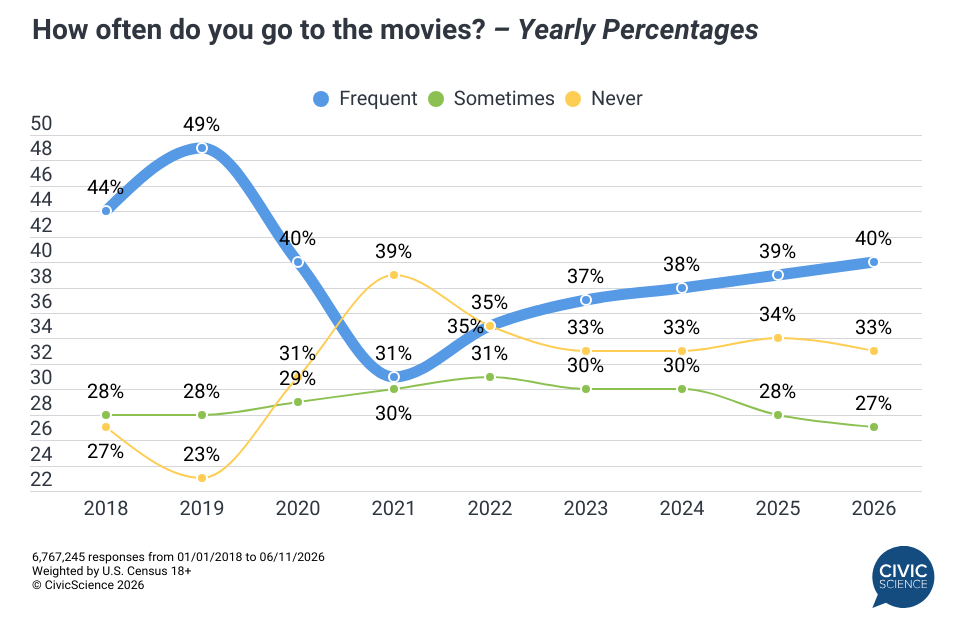
To understand what’s fueling that interest, it helps to start with the broader trend. Moviegoing overall has slowly but steadily regained its place in the American cultural lifestyle following pandemic-era lows. In 2021, the percentage of Americans who said they went to the movies frequently (multiple times per year or more) had fallen to 31%. So far in 2026, after a gradual increase, this share is now up to 40%, nine points below the 2019 high of 49%. It remains to be seen if there will ever be a full rebound, but the upward momentum is evident.
Why Do Americans Watch Movies?
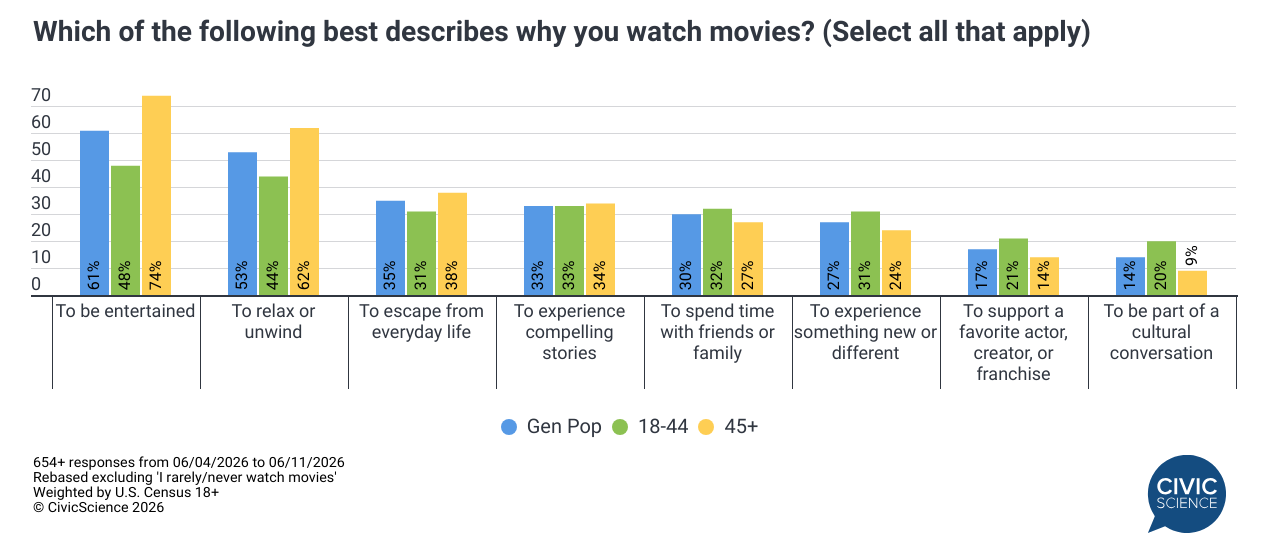
Amid this ongoing recovery, it’s important to examine why Americans say they watch movies. New consumer-declared data show that while entertainment and relaxation unsurprisingly top the list across the board, a starker story emerges by age. Adults 45 and older are significantly more likely to watch movies for comfort and escape, while 18-to-44-year-olds skew toward social and cultural motivations – they’re more than twice as likely as their older counterparts to say they watch to be part of a cultural conversation. They are also notably more interested in something original or different than those aged 45+.
When it comes to the factors Americans MOST consider when deciding whether to see a movie, CivicScience data show the top three drivers are the story/plot, ticket cost, and cast/director/producer. Meanwhile, social media buzz and its connection to an existing franchise are the least common factors.
Americans Increasingly Cite Horror As Their Favorite Genre
In 2020, just 7% of U.S. adults said horror was their favorite movie genre. So far in 2026, that percentage has now doubled to 14% (and stands at 19% among Gen Z aged 18-29). While that climb has been gradual, rather than drastic, it’s a trend that’s hard to ignore. Comedy (27%), action (21%), and drama (16%) make up the top three genres among Gen Pop.
The Path to the Theater Starts Long Before Opening Night
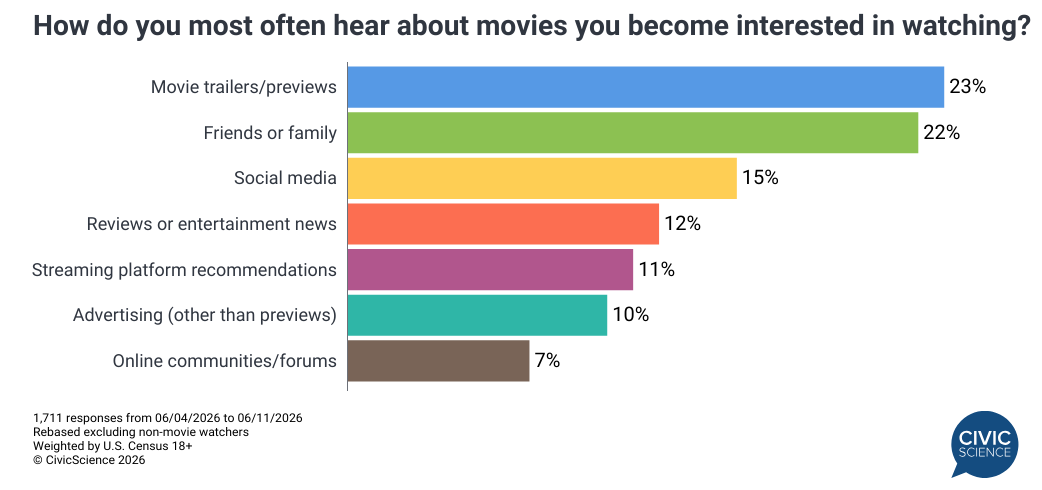
The way Americans discover movies reflects a mix of old and new. Trailers remain the top driver, barely beating out word of mouth from friends or family, while social media and reviews play a meaningful but secondary role. Algorithmic and advertising channels round out the list, suggesting that attention still has to be earned before it can be bought.
Why Moviegoing Matters
Looking closer at frequent moviegoers reveals why publishers, brands, and advertisers across industries should be watching them closely. Not only are they more likely than the average U.S. adult to report overall feelings of happiness (64% feel some level of happiness compared to 53% of the Gen Pop), but they also outpace the average in these three key areas:
- Paid publisher subscriptions: 6 in 10 frequent moviegoers have at least one paid subscription to a publisher website (e.g. WSJ, ESPN, NYT), for regular content (about news, sports, pop culture, etc.), 23 points higher than the Gen Pop.
- Bullish outlook for major purchases: Frequent moviegoers are nearly twice as likely as average to believe that now is a good time to make a major purchase.
- Responsive to digital ads: Just 22% say they ‘rarely’ click on digital ads, well below the average U.S. adult at 43%.
The data paint a clear picture of an audience that is growing, engaged, and willing to show up for the right film. Younger viewers want something new and culturally relevant, older viewers want comfort, and frequent moviegoers of all ages are among the most valuable consumers brands can reach. “Obsession” and “Backrooms” may be this year’s proof of concept, but the underlying trends suggest the opportunity is much bigger.