CivicScience engages directly with consumers, collecting over one million survey responses daily, to turn real-time insights into high-performing advertising campaigns. See how leading brands use CivicScience to drive campaign performance here.
Over the past several years, the sober-curious movement has been picking up steam. What was more of a niche trend back in 2019, with just 7% of drinking-age adults saying they were ‘very’ curious about cutting alcohol, has now more than doubled to 19% in 2025. Over that time period, a variety of alcohol-free beverages have come onto the market, making it even easier for the sober curious to explore a buzz-free lifestyle.
As interests have evolved, so too have opportunities to test out a life without alcohol. While many are familiar with Dry January, a more recent addition is Sober October–a similar concept where participants choose to be alcohol-free for the month.
So, who is participating in Sober October this year? And what insights does the data reveal about how Sober October participants are feeling as we head into the holiday season? Here’s what the data say:
Weigh In: Have you ever participated in Sober October?
Sober October Participation Holds Steady, Led by Adults 21-45
Currently, 16% of those aged 21+ say they are participating in Sober October (among those aware of Sober October), roughly on par with the 15% who participated last year. Participants skew slightly more toward men than women, though it’s worth noting that women are more likely to say they already abstain from alcohol. Meanwhile, Gen Z (aged 21-29) leads in Sober October participation, with Millennials (aged 30-44) following closely behind (24% vs. 22%). In terms of income, those making $50K or less per year edge out other income groups with alcohol-free intent–this demographic is also the most likely to already say they already skip alcohol.

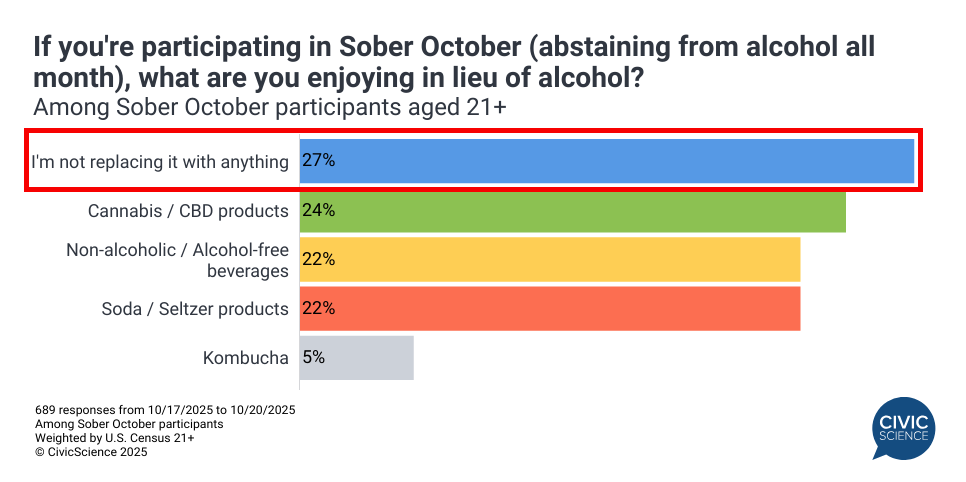
Given that alcohol can be so seamlessly integrated into social plans, it’s worth noting what Sober October participants are replacing it with as they attempt a full month sans drinking. Fresh data show that the largest group (27%) is simply cutting out alcohol and not replacing it with anything. Cannabis and CBD lead in terms of actual alternative products (24%), coming in just ahead of non-alcoholic beverages and soda or seltzer beverages (22%). Gen Z and Millennials are equally as likely to swap in cannabis, while Gen Z leads for non-alcoholic beverages. Soda and seltzer brands would also be wise to keep the under-45 demographic in mind as they look for alcohol alternatives.
Participants Anticipate More Debt, Earn Side Income
There are a wide range of reasons why someone who typically drinks may choose to put down the glass for a month. One of those reasons could be financial, as those who are exploring Sober October are more than twice as likely as those who are not to expect to have more debt in the next six months. This demographic is also about three times as likely as non-participants to have a consistent source of additional income outside of their main job. So while drinking may be temporarily out, these consumers will be filling their time in other ways.
How Sober October Participants Will Shape Holiday Shopping
Although the winter holidays are weeks away, those participating in Sober October display signs of what is to come. As it stands, 58% of Sober October participants have already begun their holiday shopping, as compared to 51% of non-participants (rebased by usual drinkers only). They’re also about five times as likely to say they’ll be buying ‘more’ gifts this year as those who are not taking a break from alcohol this month.
With Black Friday on the horizon, it’s worth noting that a majority of Sober October participants plan to do ‘most’ or ‘all’ of their Black Friday shopping in-store this year, outpacing non-participants by 25 percentage points (among those shopping on Black Friday).

Answer our Poll: Do you think the ‘sober curious’ movement is leading to greater acceptance of non-drinkers in social settings?
Not only is Sober October alive and well, but participants are distinguishing themselves from the pack in ways that extend beyond the glass or can. Those giving up alcohol this month have a unique relationship to their finances–anticipating increased gift buying and debt–as the holiday season approaches. So while they may be abstaining from alcohol in October, a mindset of lack does not seem to be following them into their spending for the rest of the year.
Connect Where it Counts
Powered by real-time consumer intent insights, CivicScience helps brands understand what drives decision-making—so they can reach the right people, at the right time, on the right platforms.