CivicScience has the world’s largest proprietary database of real-time declared intent, allowing brands to activate high-performing advertising that drives up to 80% better performance. See how our partners achieve superior marketing outcomes here.
As we prepare to close the book on H1 2026 and head deeper into summer, one key consumer trend continues to gain prominence: the influence of nostalgia on consumer purchasing decisions.
Influence of Nostalgia Continues to Trend Up
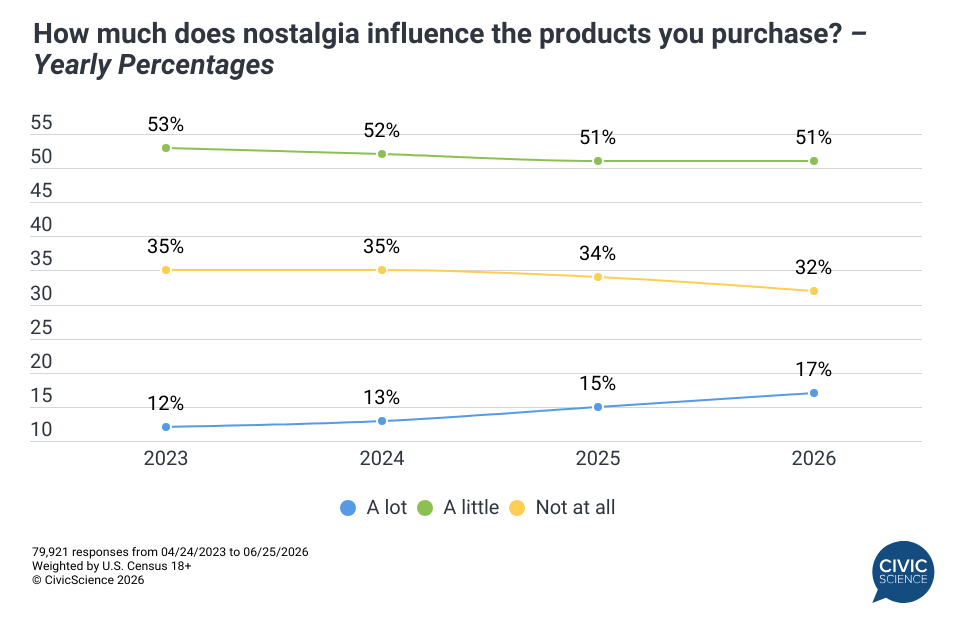
The latest real-time tracking data from CivicScience shows a growing majority of consumers report nostalgia holds at least some influence over their purchasing – 68% of U.S. adults now say nostalgia factors into their purchases at least ‘a little,’ with the percentage reporting it has ‘a lot’ of influence rising more than 40% since 2023 to an annual high of 17%.
Nostalgia’s pull unsurprisingly skews heavily toward younger demographics, yet it commands a majority across every single age bracket. Nearly a quarter of adults under 45 report that nostalgia impacts their purchases ‘a lot’ (26% of the 18–29 group and 25% of the 30–44 group), dropping to 11% for the 45–64 Gen X bracket and 6% for those 65 and older. However, among consumers who feel at least some influence, a clear majority holds firm across age groups, ranging from 54% to 79%.
Looking at the specific experiences that spark these feelings, music is the clear frontrunner. Nearly half (46%) of consumers report that ‘listening to old music’ triggers nostalgia ‘extremely,’ outperforming ‘visiting places from the past’ (38%) and ‘watching old videos or movies’ (33%). Familiar items and faces also play a significant role, though with slightly less intensity. ‘Eating an old favorite food’ sits at 30%, followed closely by ‘seeing an old toy or game’ at 29% and ‘seeing characters or celebrities of the past’ at 22%.
Why the Growing Influence of Nostalgia Matters for Consumer Brands
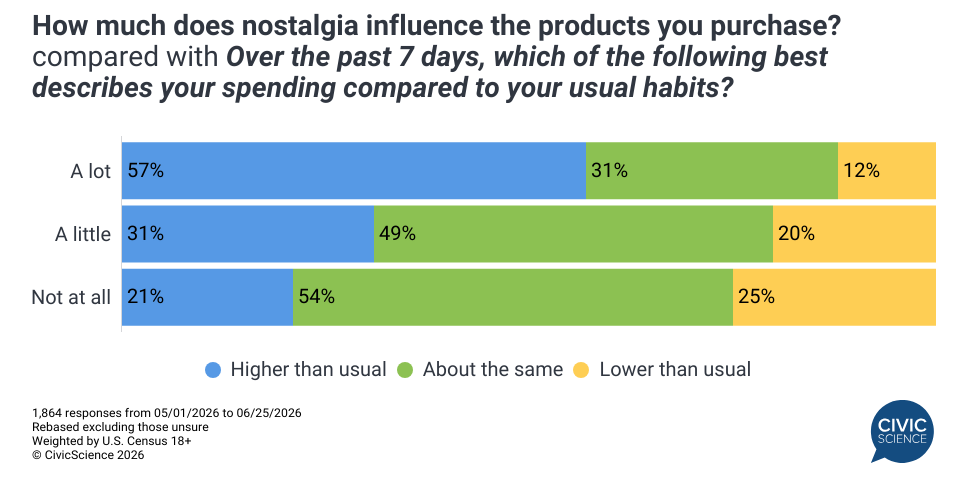
This growing trend is particularly noteworthy for brands navigating today’s inflation-weary marketplace. Additional CivicScience data reveals that those whose purchases are heavily influenced by nostalgia are significantly more likely to be spending more right now – 57% of consumers who say nostalgia influences them ‘a lot’ report that their recent weekly spending is ‘higher than usual,’ nearly three times the rate among those not influenced at all (excluding those unsure). It’s also more than 20 points higher than Gen Pop, who say the same (35%). In an economic environment where budgets are generally tightening, this segment represents a uniquely active and valuable audience. For advertisers, tapping into trusted familiarity is a powerful lever to lower the purchase barrier and capture resilient discretionary dollars.
But nostalgia may also be a critical tool for newly launched brands to gain ground. Additional data shows that 49% of consumers influenced ‘a lot’ by nostalgia are ‘very open’ to trying newly launched brands, nearly double the Gen Pop average of 28%, and vastly outstripping those not influenced by nostalgia at all (10%). This reveals a compelling paradox: looking backward does not equal consumer stagnation. Instead, emerging players can strategically use comforting, nostalgic branding as a lower-friction gateway to capture these highly active, brand-open spenders.
Top Spend Categories Among Nostalgia-Driven Consumers
Consumer-declared data outlines the primary categories in which a nostalgic campaign narrative may have the strongest impact for brands and advertisers. Marketing initiatives that tap into fond memories will be most advantageous for Travel and Home Improvement brands and advertisers, given that both sectors command the highest projected spending increases at 33% each, while Clothing and Wellness closely follow at 28% each. Looking at high-intent categories, the data show these nostalgia-driven buyers are prioritizing tangible lifestyle upgrades and purchases that support/maintain mental well-being. For brands mapping out upcoming initiatives, the data indicates that positioning products through a lens of trusted familiarity will find a highly receptive audience.
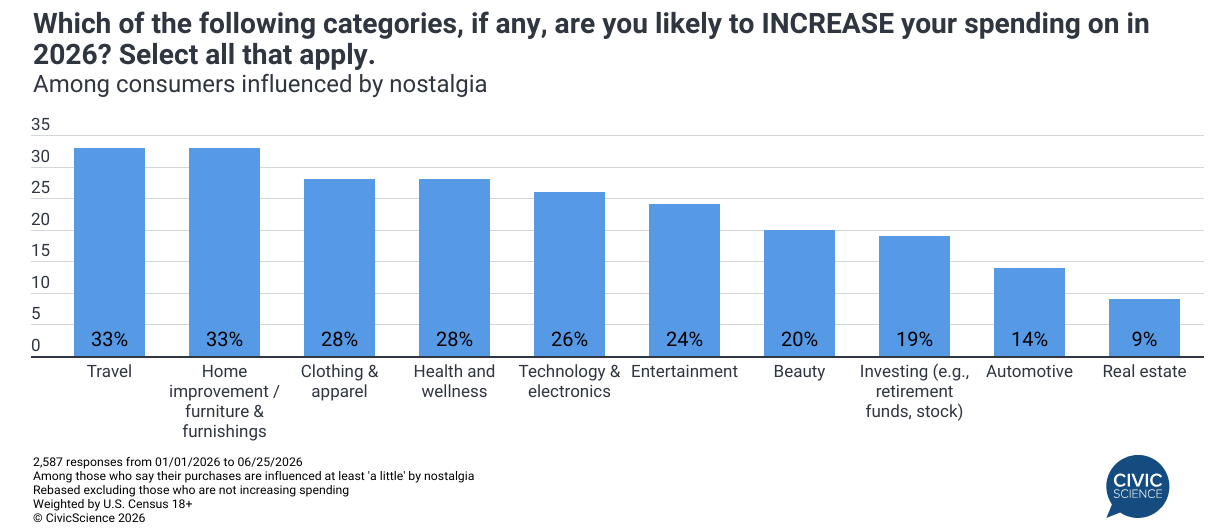
The data reinforces that nostalgia is a powerful motivator for where people choose to spend their money right now. By pairing strong spending habits with an openness to try new things, this nostalgia-driven audience offers a high-value target for both established companies and new startups. For the rest of the year, the biggest wins will go to brands that use authentic, comforting themes in high-interest areas like travel and home improvement. Tapping into these familiar feelings is a smart, proven way to connect with shoppers who are otherwise tightening their budgets.