CivicScience has the world’s largest proprietary database of real-time declared intent, allowing brands to activate high-performing advertising that drives up to 80% better performance. See how CivicScience partners achieve superior marketing outcomes here.
Despite a recent dip, inflation remains elevated, and it’s altering how consumers approach purchasing new items, from clothes to electronics. But buying new isn’t the only path forward for cost-conscious consumers. Recent self-reported consumer data from CivicScience indicate that secondhand shopping is a key consumer trend to watch throughout the rest of H2.
More Than 8 in 10 Americans Are Open to Buying Secondhand Items
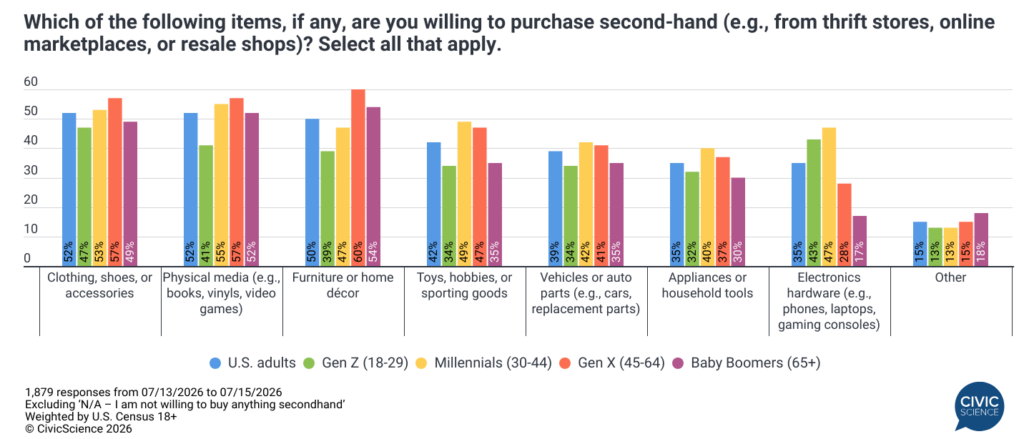
Interest in secondhand shopping is strong: 83% of U.S. adults express a willingness to purchase secondhand items, with clothing, shoes, and accessories (52%) and physical media, such as books or video games (52%), leading as the most popular categories. On the other hand, consumers are comparatively less open to secondhand appliances, tools, or electronics.
When broken down by generation, different priorities emerge: Gen X leads the charge in secondhand clothing (57%) and physical media (57%), while Millennials are the most likely to seek out secondhand toys and sporting goods (49%). Gen Z adults and Millennials represent the most eager age groups for secondhand electronics and hardware (43% and 47%, respectively), whereas Baby Boomers are the least inclined to buy used electronics (17%) but remain highly open to pre-owned furniture (54%).
There’s More to Secondhand Clothing Demand Than Saving Money
Given that buying secondhand clothing is of most interest, it’s worth exploring what may be driving consumers to go the secondhand route in this category. When asked to choose their top two motivations for going the secondhand route for clothing, ‘price’ (52%) is the unsurprising and convincing leader. This is followed by ‘to find unique/vintage styles’ (28%), narrowly outpacing ‘it’s more sustainable/environmentally friendly’ (25%), and ‘because it’s fun’ (21%). Meanwhile, ‘selection of sizes’ (13%) and ‘other’ (9%) are much less commonly cited. So while Americans undoubtedly care about saving money, other key factors likely drive interest, such as the rising influence of nostalgia and growing environmental concerns.
Secondhand Luxury Fashion Items Garner Growing Near-Term Interest
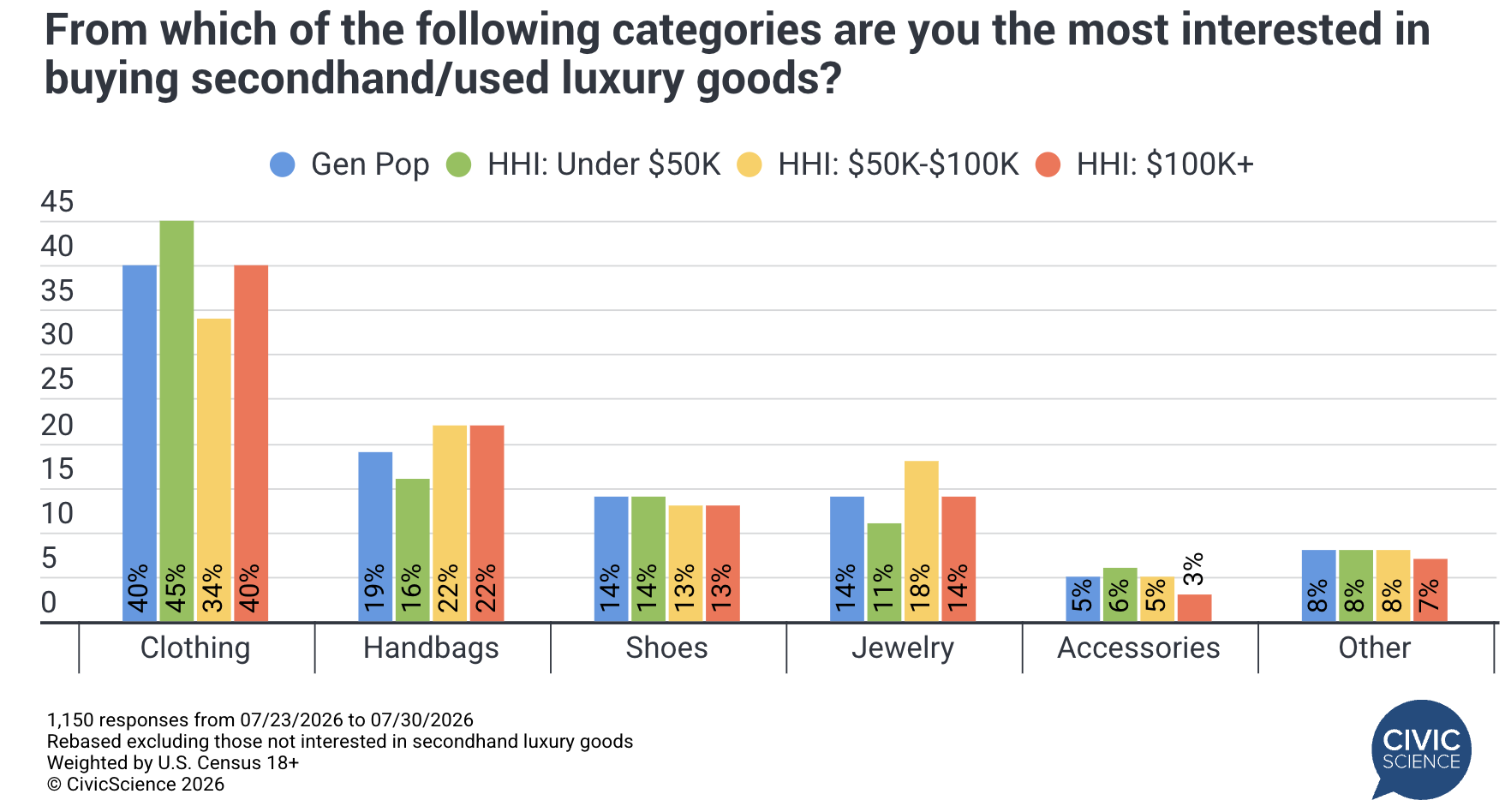
A deeper examination of consumer-declared intent data reveal shoppers are increasingly interested in buying secondhand luxury fashion items and accessories — 40% of U.S. adults tell CivicScience they are either ‘very’ (14%) or ‘somewhat’ (26%) likely to purchase a secondhand luxury fashion item in the next 30 days. This share is up five percentage points from the same period last year, when 35% were at least ‘somewhat’ likely to buy in July of 2025. And while it may be unsurprising to note that low-income Americans (making less than $50K), who are likely younger, have the most interest overall, high-income Americans (earning $100K+) represent the strongest share who are ‘very’ likely to buy (16%).
As expected, clothing is the clear leader among interested secondhand luxury fashion shoppers across the board, with lower-income shoppers setting the pace there. While middle-income consumers ($50K-$100K) are comparatively less likely to buy used clothing, they are more likely than their counterparts to buy jewelry. Middle- and high-income buyers also show a slightly stronger preference for secondhand handbags than Gen Pop and low-income shoppers.
Secondhand Holiday Gifts Could Be More Prominent This Year
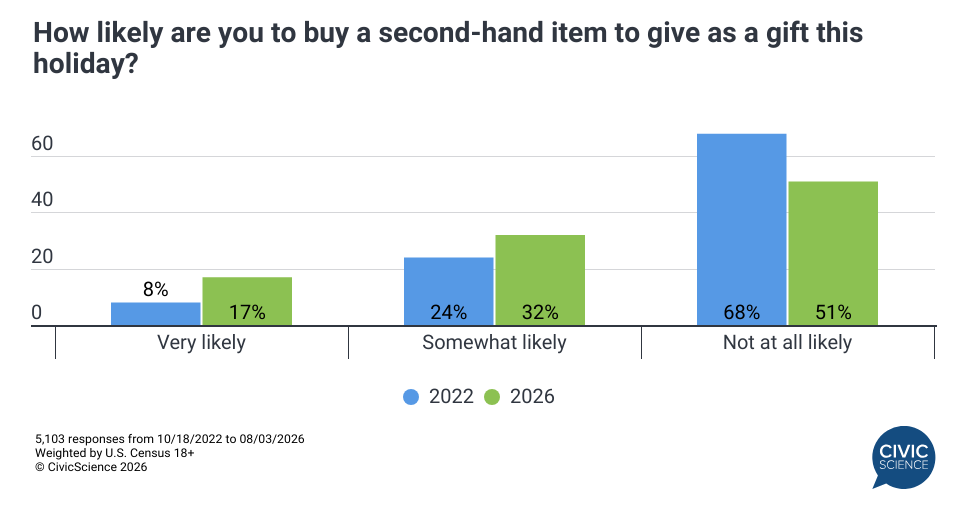
Additional data suggest secondhand interest is likely to have a significant impact on winter holiday shopping this year. In fact, 49% of U.S. adult respondents say they are at least ‘somewhat’ likely to buy a secondhand item for a holiday gift this year, a 53% increase from 2022 data. The share of those who are ‘very’ likely to do this has more than doubled over the same period. Parents (28%), Millennials aged 30-44 (30%), and, notably, high-income shoppers (20%) lead their respective demographic peers and the average American in likelihood of buying a secondhand holiday gift this year.
The Opportunity Is There for Retailers
As major retailers test in-store secondhand departments, new self-reported consumer data reveal that 39% of U.S. adults would be ‘more’ likely to shop at their preferred retailer if it introduced a secondhand section (45% report it would have no effect on their likelihood of shopping there). That self-reported interest rises to 67% among consumers planning to buy secondhand holiday gifts, suggesting secondhand departments may be a particularly powerful seasonal driver for brick-and-mortar stores.
Whether shopping for vintage looks, saving on luxury fashion, or seeking holiday gifting flexibility, the data point to a consumer who is increasingly embracing the pre-owned/secondhand market. Leaning into the secondhand market offers brands, advertisers, and retailers a thoughtful way to align with shifting shopper priorities and provide added value without forcing a major change in consumer habits.