CivicScience has the world’s largest proprietary database of real-time declared intent, allowing brands to activate high-performing advertising that drives up to 80% better performance. See how our partners achieve superior marketing outcomes here.
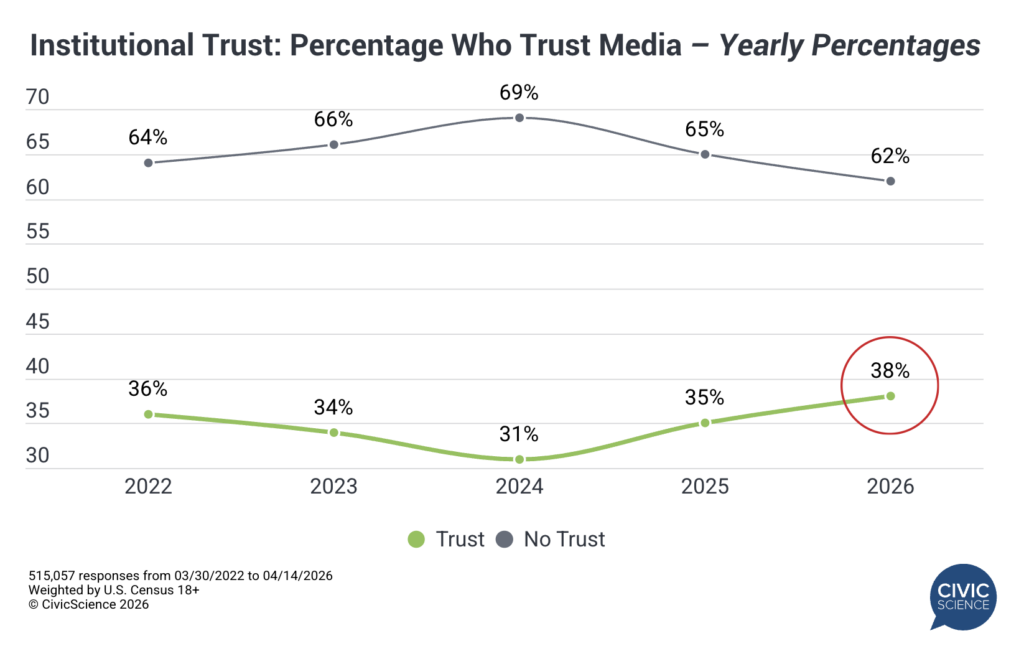
At a time when trust in institutions remains fragile, new consumer-declared data from CivicScience show that trust in media specifically has climbed to a yearly high of 38%, representing the highest level recorded since tracking began in 2022 (n=515,057). While a majority of Americans still express skepticism, the upward movement is notable in an era of uncertainty and always-on news cycles – suggesting audiences are becoming more selective about which publishers earn their trust.
So what actually builds trust in media today?
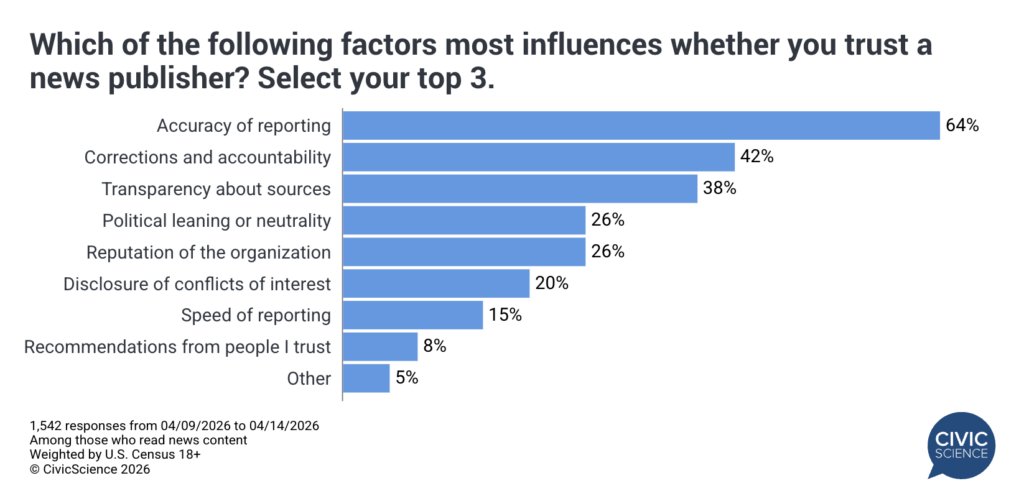
According to additional CivicScience data, the answer is both clear and somewhat traditional. Accuracy of reporting stands far above all other factors, cited by 64% of respondents who read online news content as a top reason for trusting a news source. But accuracy alone isn’t enough; audiences also prioritize corrections and accountability (42%) and transparency about sources (38%). This suggests that trust today is a matter of earned credibility, built as much on a publisher’s integrity after a story breaks as on the initial report itself.
Beyond these top drivers, trust becomes more nuanced. About one in four consumers say a publisher’s political leaning or neutrality, as well as its overall reputation, shapes their trust. Meanwhile, 20% point to disclosure of conflicts of interest. Notably, some factors carry far less weight: the speed of reporting and recommendations from others rank near the bottom, reinforcing that speed often comes secondary to a desire for accuracy, transparency, and long-term reliability.
That said, what defines trust is not universal, especially across generations.
- Gen Z (18-29): Less likely to prioritize accuracy (42% vs. 64% of the Gen Pop) or reputation, and more likely to value speed.
- Millennials (30-44): Also under-index the Gen Pop on accuracy and place relatively more importance on speed, but stand out for placing the highest importance on disclosure of conflicts of interest compared to other age demographics.
- Gen X (45-64): More aligned with traditional trust drivers, with 74% prioritizing accuracy and the highest share considering political leaning or neutrality (32%).
- Baby Boomers (65+): Most traditional overall: 85% say accuracy is most important, and they are also the most likely age group to prioritize the reputation of the organization.
There’s a clear shift underway: trust in media isn’t gone, it’s becoming more deliberate. While traditional factors like accuracy still anchor credibility, younger audiences are beginning to reshape what it takes to earn it.
The publishers winning today are the ones adapting to the latest consumer attitudes.
CivicScience gives our media and publisher partners the real-time consumer intelligence to do exactly that.