CivicScience engages directly with consumers, collecting over one million survey responses daily, to turn real-time insights into high-performing advertising campaigns. See how leading brands use CivicScience to drive campaign performance here.
Early holiday shopping has reached a six-year high, and consumers tell CivicScience they plan to hold steady or even increase holiday spending despite economic uncertainty. While advertisers and media companies often rely on historical data, CivicScience reveals in real time what consumers plan to buy – and this season, jewelry stands out as a key opportunity, with many shoppers still in the decision-making process.
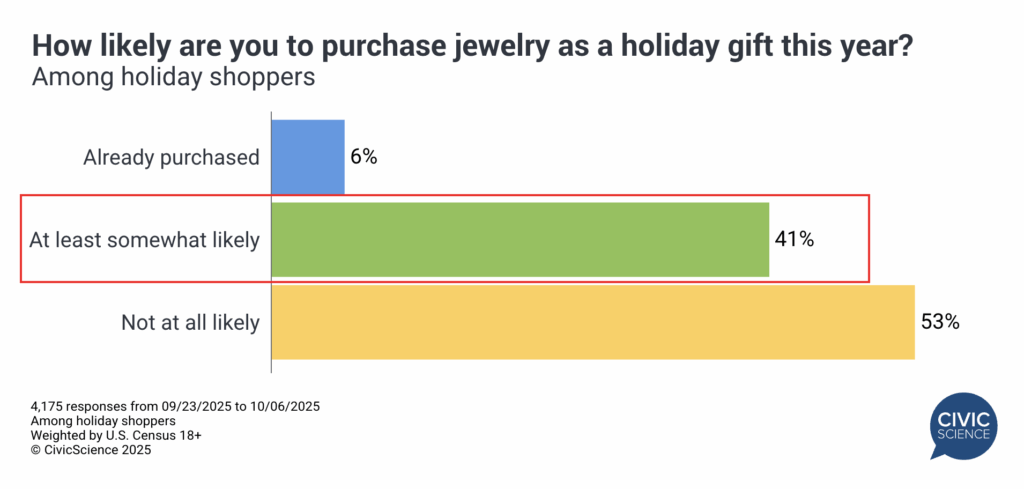
New CivicScience data show that just 6% of holiday gift buyers have already purchased jewelry, while another 4 in 10 say they’re at least somewhat likely to do so this year. This signals a prime window for brands to reach them before holiday shopping ramps up in the coming months.
Weigh In: Do you typically give jewelry as a gift?
What You Need to Know: Targeting Holiday Jewelry Buyers
Beyond purchasing intent alone, CivicScience’s real-time surveys reveal key demographics and unexpected traits about holiday jewelry buyers. For instance, compared to non-buyers, they are more likely to follow home improvement trends, use mindfulness and astrology apps, watch e-sports frequently, and be professional men’s golf fans.
They also have distinct shopping behaviors and motivations that can guide how brands reach them this season. Here’s what consumers are telling CivicScience (excluding non-holiday shoppers and those who’ve already made a purchase):
- Holiday shopping habits: Jewelry buyers are the most likely to holiday shop online, but they tend to keep their online spending under 50% of total gift purchases, unlike non-buyers, who are more likely to do over 50% online, suggesting the need for targeting strategies that blend digital and in-store experiences. They also show a stronger preference toward options that emphasize convenience, like Buy Now, Pay Later, curbside pickup, and expedited shipping.
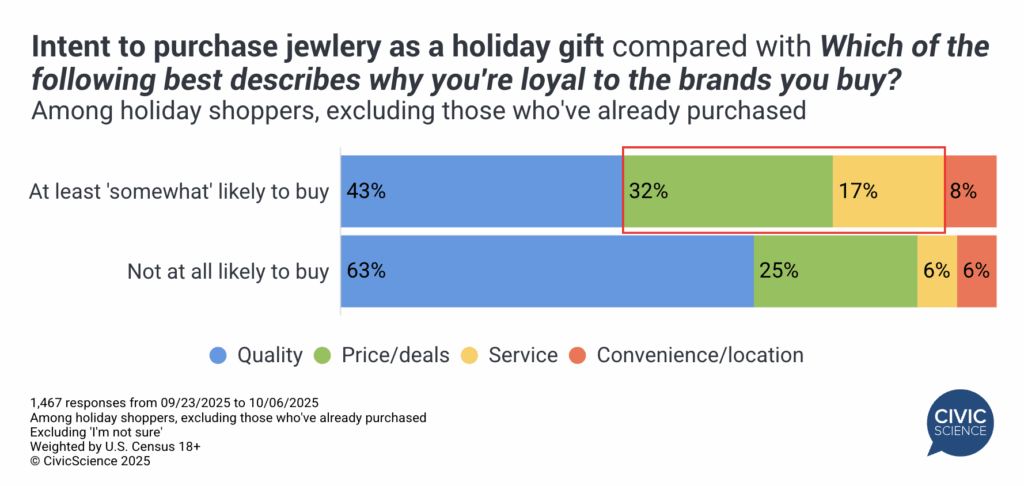
- Deal-driven mindset: While quality drives brand loyalty among jewelry buyers, they’re much more likely than non-buyers to value price/deals and service. Half say they ‘always’ compare prices before buying, and they’re nearly three times more likely to spend ‘more’ this holiday season, making discounts and targeted offers especially effective.
- Self-gifting behavior: Nearly 9 in 10 jewelry buyers say they splurge on themselves, and they’re significantly more likely than non-buyers to use shopping as a form of self-care. About 30% already plan to buy themselves a holiday gift, and another 30% are undecided, signaling that brands can sway decisions.
- Influence factors: Holiday jewelry buyers are twice as likely to be influenced ‘a lot’ by nostalgia when purchasing products – echoing broader trends of nostalgia’s strong pull. They are also six times more likely to be persuaded by friends on social media, underscoring how much their choices are shaped by what they see online.
- Where they shop: While big-box stores remain popular across all holiday shoppers, those buying jewelry this holiday over-index in saying they will spend the most at department stores and are also nearly twice as likely to shop at small businesses compared to big-brand retailers.
Jewelry buyers represent a strong opportunity for advertisers in the near term, as many are still in the decision-making process. But the clock is ticking, and the decision stage won’t last forever. Understanding what drives their choices – from deals and promotions to convenience features and brand loyalty – not only helps convert them as they prepare to buy this holiday season, but also creates lasting touchpoints with these consumers.
Answer our Poll: Do you consider yourself a “jewelry person”?
Reach Jewelry Buyers Where They Are
CivicScience consumer-reported intent data reveals what’s driving consumers’ decisions. In addition, we capture the platforms and content they use every day – from streaming services (ad-supported vs. ad-free), to paid online content subscriptions, to the publisher and media sites they visit most often. This allows CivicScience clients to reach the right customers at the right time, on the right channels.