CivicScience engages directly with consumers, collecting over one million survey responses daily, to turn real-time insights into high-performing advertising campaigns. See how leading brands use CivicScience to drive campaign performance here.
The U.S. consumer landscape is increasingly diverse, yet decision-makers risk missing critical opportunities when not all voices are heard and represented. This is always important, but takes on added significance as we enter Black History Month and prepare for the Winter Olympic Games Milano Cortina, slated to feature a Team USA roster that’s becoming increasingly diverse. CivicScience is centering the self-reported insights from consumers who identify as Black Americans (non-Hispanic) to understand the distinct motivations and values that define this key audience as they engage with the world’s premier cultural and sporting events.
Intent and the “Why” Behind Olympic Viewership
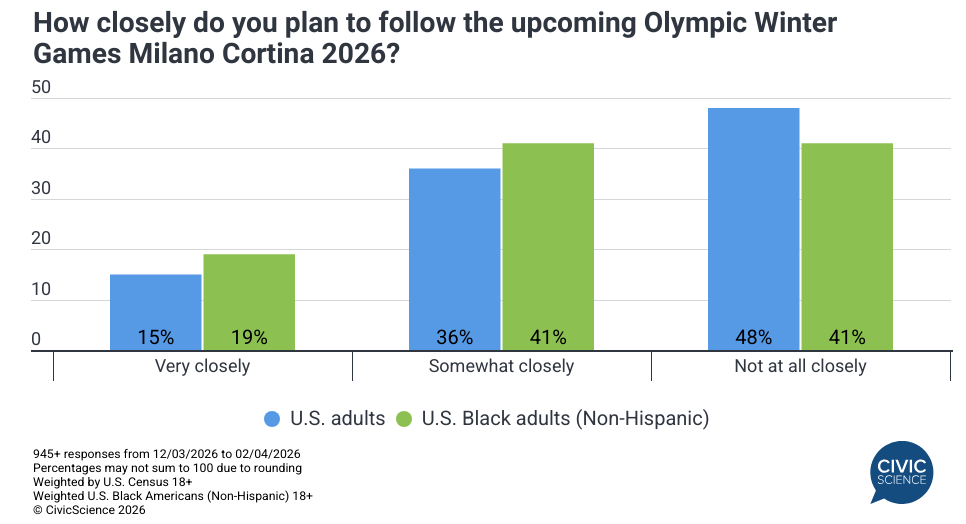
The latest CivicScience consumer-reported data finds 52% of U.S. adults say they will follow the Olympics at least ‘somewhat’ closely, a percentage that rises to 59% among Black Americans, including 19% who will follow ‘very’ closely. Like the Gen Pop, Black Americans are most interested in watching figure skating, while sliding events (e.g., luge, bobsleigh, skeleton) are their second-most-common Olympic sports of interest this year.
Data also show this interest is likely to spur action beyond simply tuning in, as the streaming platform Peacock offers more live Olympic event coverage. Twenty-eight percent of the Gen Pop and 31% of Black Americans report they are at least ‘somewhat’ likely to subscribe to Peacock to watch the Olympics this year (among those not currently subscribed to Peacock). This is a noteworthy opportunity for a long-term connection, as 53% of Black Americans who subscribe to streaming services specifically to watch sports say they keep those subscriptions even after the sport they want to watch ends for the season.
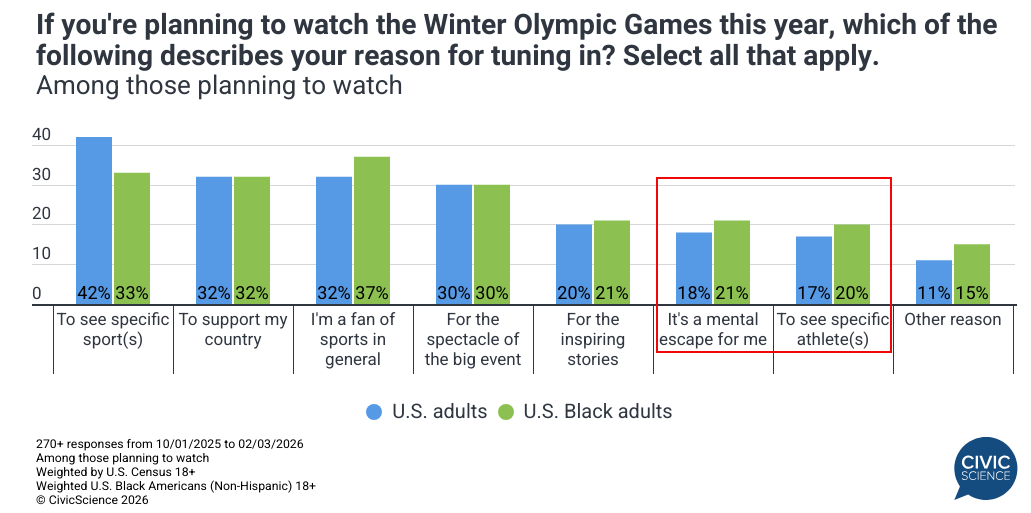
While Black Americans lead the Gen Pop by five points in citing a love of sports as their top reason for watching this year’s games, motivations run deeper. They are also notably more likely to say the Winter Olympics offer a form of mental escape and a chance to follow specific athletes, outpacing the Gen Pop by three points.
What Black American Olympic Viewers Are Telling CivicScience:
Representation matters, and that means hearing from consumers who are often underrepresented in research. The following data moves beyond broad generalizations to capture the self-reported mindset, characteristics, and behaviors that define the Black American Olympic viewer, and how they compare with those of Black Americans who won’t be watching.
- One in five say they have felt ‘very’ strong feelings of stress in the past week or so, nearly twice as likely as Black Americans not watching.
- The majority (55%) switch to brands that align with their personal values, more than 20 points higher than non-viewers (32%).
- More than three-quarters (76%) have plans to travel in the near future, over 30 points higher than non-viewers (44%).
- Reviews and recommendations are most likely to shape their final purchase decision, but they are twice as likely as non-viewers to say website ads most often lead them to finalize a purchase.
Early 2026 will be defined by major sporting moments, including the Winter Olympics, and Black Americans will be a critical part of Olympic viewership. Overlooking their perspectives risks missing not only immediate moments of engagement, but also year-round opportunities to build relevance and loyalty. Recognizing and elevating these voices isn’t a seasonal priority; it’s a necessary step toward creating lasting, authentic connections.