It feels like this is the moment we’ve been building for.
The long-held investment thesis at CivicScience hinged on our explicit ownership of the data we collect. Most research companies serve as middlemen between a buyer and a survey taker. Because respondents are typically paid for answering lengthy questionnaires, most research providers need to line up paying customers to front the cost. The customer owns the data, while the vendors make their profits from the additional tools and services they provide. Many are fine businesses, but they own very little.
We took another route. Since we don’t pay our respondents – because the intrinsic benefits are enough – we don’t have that cost to cover. We can ask 1,000 people about Nike every day, even though Nike isn’t a customer of ours. And, since we own the data, we can sell it to Nike’s competitors, the retailers who peddle their apparel, and the investors who trade in their stock. I can even publish it for you to read.
It was a hard business to build – and even harder to convince early investors. For our strategy to work, we needed A LOT of data, while forgoing easy money from running quick custom surveys. It explains why it took so long to get here and why nobody had done it before.
Today, we’re sitting on nearly 7 billion owned survey responses (which we can model into hundreds of billions more), trended continuously over 14 years, adding millions of new data points every day. Our long list of clients all have logos that my mom and kids would easily recognize. We do allow our customers to own proprietary questions on our platform today, but they amount to a tiny fraction of our total.
Then, along came AI.
Soon, the big LLM platforms will have scraped the final shreds of publicly available data from the internet. Their models are already nearly indistinguishable, merely leapfrogging one another from week to week, each with its bells and whistles.
In the next phase of the AI land rush, the platforms will be vying for non-public data to differentiate their models from the rest. Premiums will be placed on the largest, freshest, unique datasets with the longest trended history. We have all that covered.
But we have something else, something more important.
Our data is truly human.
One of the scariest things about AI is its potential to drift too far from human reality, relying too much on old, skewed, or purely “synthetic” data. To be reliable – to be responsible – AI will require a continuous accounting of the hopes, fears, wants, needs, and emotions of the largest and smallest groups of us. It shouldn’t know anything about us, individually, that we haven’t willingly shared. Those are all things we stand for.
Surely, some of the big combatants in AI won’t care about those ideals. I’d like to believe the winners will. God help humanity if they don’t.
I can’t say I foresaw any of this when we started CivicScience many years ago.
But it’s better to be lucky than good.
Here’s what we’re seeing:
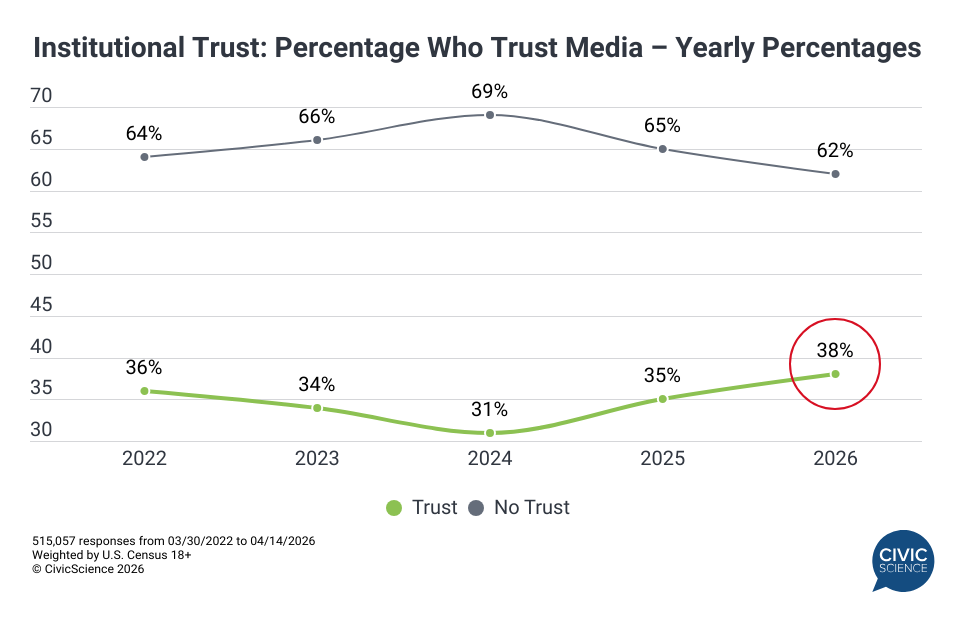
Trust in media is rebounding. We still have a long way to go, but the group of Americans who trust the media has increased by over 20% since a 2024 low point. Unfortunately, the explanation isn’t the most satisfying one – depending on your side of the fence. The gains were driven almost entirely by Republicans, among whom trust has increased from 19% to 29% since 2022 (perhaps because they believe the President is suing the media into compliance). Trust among Dems fell 5 points during the same period (perhaps for the same reason), though it has improved slightly so far this year. The more valuable takeaways from the study are the findings on what drives trust in media – most notably, accuracy is way more important than speed.
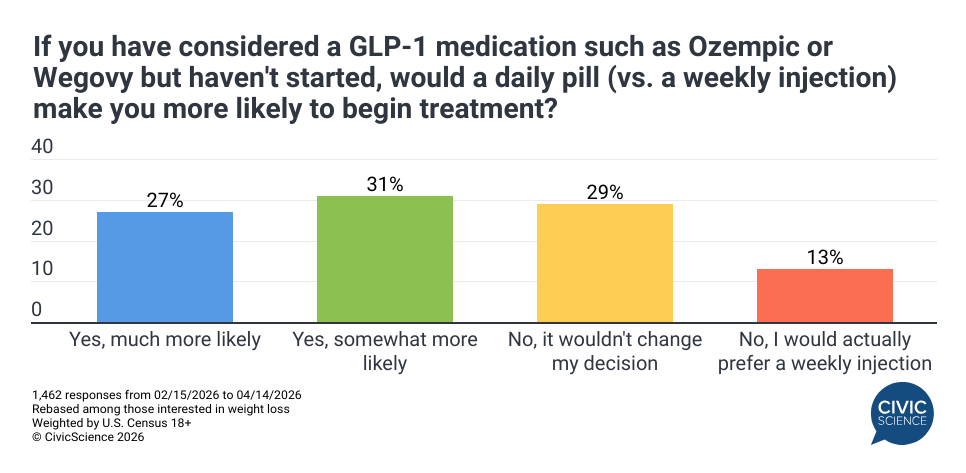
We could be nearing the next big step change in GLP-1 use. While cost and insurance coverage remain the biggest deterrents for people who would otherwise use GLP-1s for weight loss, the new pill forms of the drug – available for as little as $149/month – are likely to be a game-changer. Cost aside, 60% of people interested in weight loss say that oral medication (versus injections) makes them more likely to consider GLP-1s. In this latest snapshot of our GLP-1 Consumer Tracker, we also looked at why users dine out (for social reasons) and solo dining trends (so nobody gives them a hard time for only eating a portion of their meal, probably).
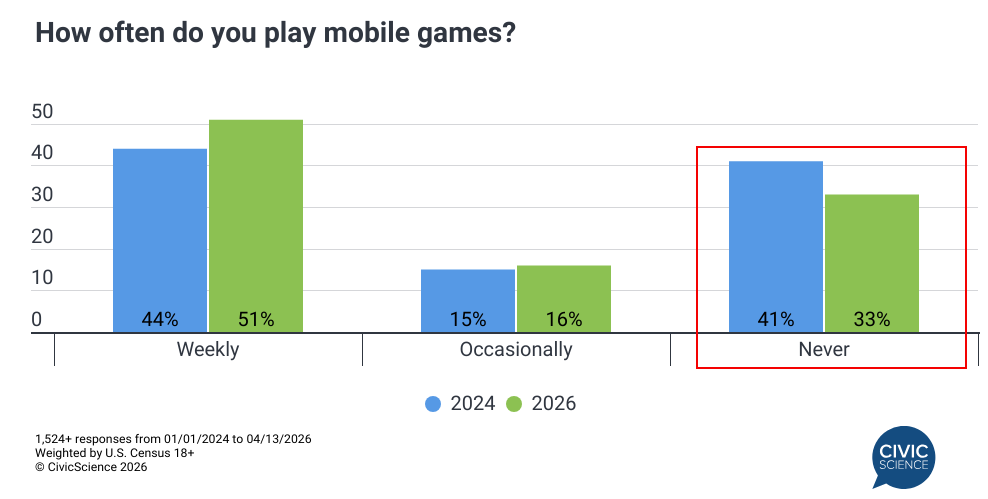
I’m addicted to the daily New York Times games, and I’m not alone. Every morning, before I even check my email, I rifle through Spelling Bee, Strands, Wordle, Connections, and both the Mini and full NY Times crossword, as I drink my coffee. In our 3 Things to Know this week, we learned that mobile games are continuing to rise in popularity, with over half of Americans now playing them at least weekly. We also found that people are very concerned about the potential insolvency of the U.S. Postal Service, including a plurality of people across political parties. Finally, we checked back on consumer sentiment toward digital shelf labels – with Walmart planning to make the full transition this year. People are warming up to the idea, but over a third can’t stand it.
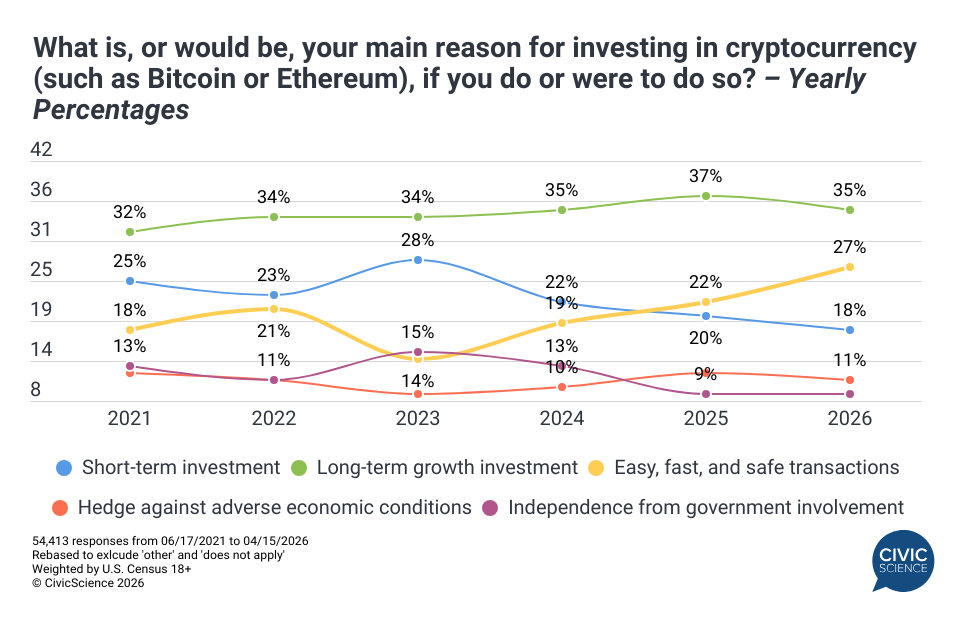
Interest in cryptocurrency is holding steady, even as the market is getting bludgeoned. Despite Bitcoin’s value falling by nearly half over the past six months, our data shows that crypto investors (and potential investors) aren’t wavering in their overall confidence. From a glass-half-empty perspective, however, interest isn’t growing either – 65% of U.S. adults have no interest in crypto, basically the same number we saw a year ago. The biggest deterrent remains a lack of trust, while the ease and speed of investing in crypto is skyrocketing as its greatest appeal.
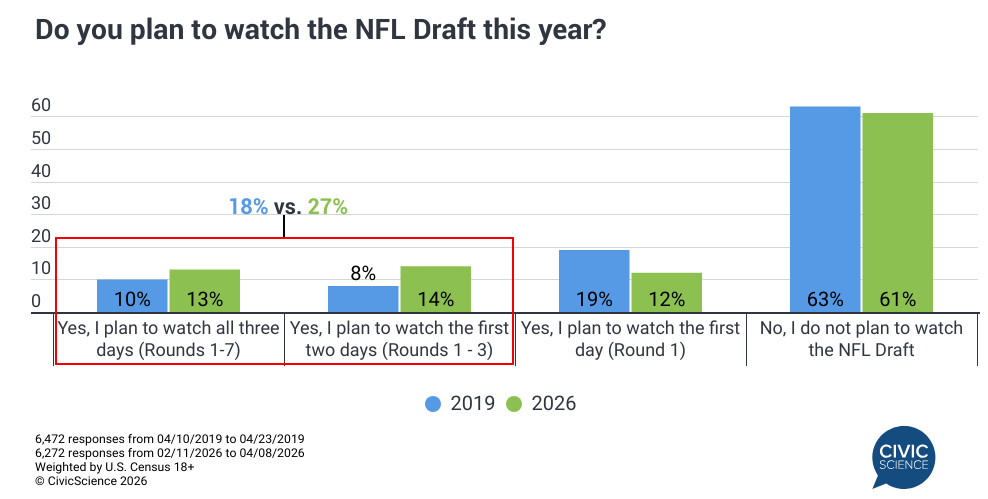
The growth of the NFL Draft is simply amazing. The NFL’s annual player selection extravaganza converges on the City of Champions next week, and viewership throughout the weekend is expected to reach new heights. While the 40% of people who plan to watch the draft is only a small increase over years past, far more people plan to watch beyond Day 1 than ever before. Many more will keep tabs via social media and other online platforms. Tara and I will be riding our bikes into the city next Saturday to witness the surrounding spectacle with our own eyes.
The most popular questions this week:
Do you think humans will ever establish a permanent base on the moon?
How concerned are you about the economic power of older generations in America?
Do you personally agree or disagree with the idea that love should be at the center of one’s life?
Do you consider yourself book smart?
Answer Key: No; Yes; Very, very much; 100%; Definitely not.
Hoping you’re well.
JD
Forwarded this email and want on the list? Subscribe here.
In case you’re wondering, I write this informal email to CivicScience clients, friends, and other VIPs every Saturday morning. If you’re getting this, you’re either one of those people or were referred to me by one of them. I always love your comments and feedback.
The Dumbest Guy in the Room Podcast | LinkedIn | X | The CivicScience Poll of the Day