Please support your local performing arts organizations, before it’s too late.
We’ve been active in Pittsburgh’s regional theater community ever since Maddie dove headfirst into it 15 years ago. Our hometown has always punched above its weight in the arts, thanks to the steel barons who graced us with hefty endowments 100 years ago.
The Pittsburgh CLO – which recently turned 80 – has long been regarded as one of America’s preeminent regional producing companies. Pittsburgh’s Benedum Theater outclasses all but a few playhouses near Times Square. The CLO Academy, where Maddie trained for her entire childhood, has a long list of famous alumni, like Shirley Jones, Billy Porter, and Jeff Goldblum, off the top of my head. At one point, when Maddie was at Michigan – arguably the top musical theater college in the US – there were more kids in her program from the CLO than there were from the entire state of Michigan. It’s that good.
Sadly, as of last month, the Pittsburgh CLO is no more.
They succumbed to the same fatal ailments devastating local theaters nationwide – irreparable financial damage from the pandemic, post-pandemic subscriber losses, rising costs for personnel, facilities, and stage materials. Nationally, over 50 regional theater companies have closed since 2021, with 2 to 3 additional closures in the news every few months. The CLO was forced to merge with another struggling non-profit, in hopes of preserving any regional productions here at all. Its blue-chip brand is gone forever.
It’s not to say musical theater is a dying art (or business), by any means. Broadway set a record this year for ticket sales. Meanwhile, the Broadway League ramped up its national touring strategy – an even more profitable venture – dramatically. No fewer than 11 Broadway Across America shows will pass through upwards of 250 U.S. cities this year.
That’s even more bad news for regional theaters. Those 11 shows (at an average of $161/seat) suck nearly all the ticket-buying oxygen out of a city like Pittsburgh. Moreover, the Broadway League protects the IP of top-tier titles, like Hamilton, with an iron fist. It all leaves local producing theaters and actors vying for scraps with a limited – often old – selection of titles to choose from.
There are exceptions, like the Guthrie Theater in Minneapolis or the Repertory in Milwaukee, that are thriving because, among other reasons, they own the facilities where they perform. Few regional theaters have that luxury. The CLO might still be here if they did.
The growing wealth gap in our country is not only afflicting our people. It hits businesses, of course, and, increasingly, the arts. The impact on regional economic development, culture, and education may take a generation to be felt – but they will be felt.
With all the big, seemingly existential, crises facing us nowadays, the survival of local performing arts likely doesn’t make your list of major worries. Unlike most of those big thorny issues, however, you can actually do something about it.
Buy a ticket.
Here’s what we’re seeing:
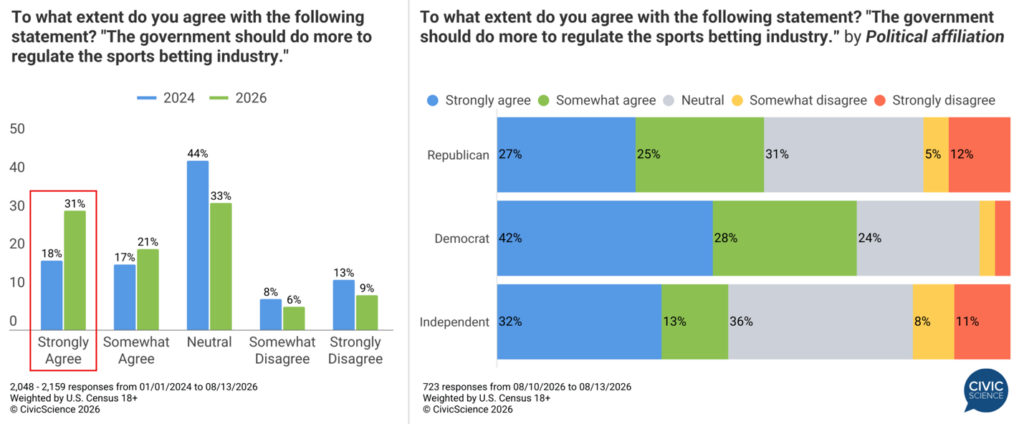
Across party lines, people want stronger regulation of the sports betting industry. In our 3 Things to Know this week, we examined rising public concerns over the brazen proliferation of sports betting in the U.S., where a majority of both Republicans and Democrats want greater government oversight. The numbers have spiked dramatically over the past two years. We also highlighted the dominance of local news outlets as the go-to source for extreme weather-related updates, though it’s shifting among younger generations. Lastly, we wrote about the impact of recent food-borne illnesses and product recalls in the restaurant industry.
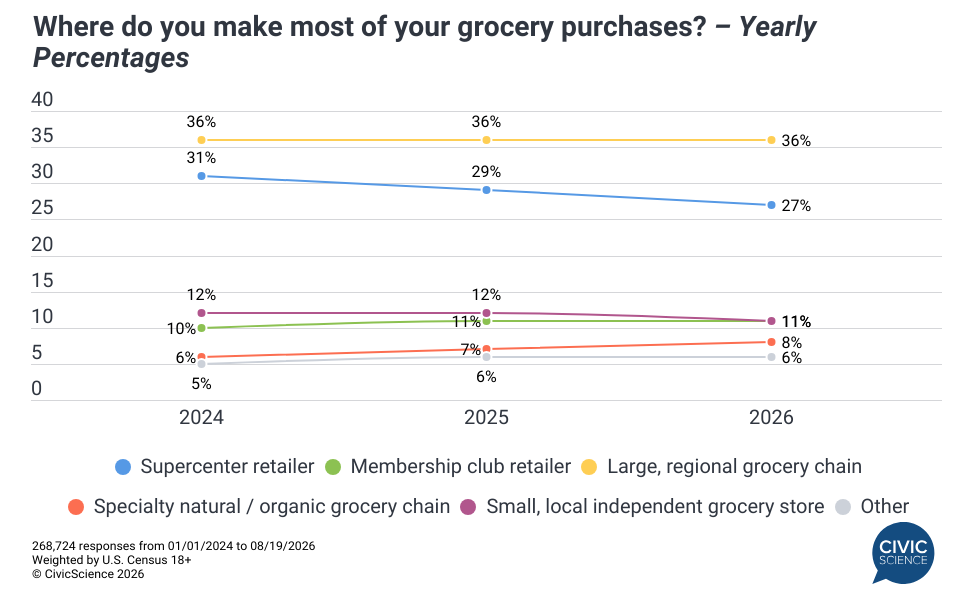
Americans are rethinking where they buy their groceries. Rising store prices and the wellness craze, relatively speaking, reveal an interesting counterbalance in recent grocery shopping trends. After years of decline, the popularity of large regional chains has held steady since 2024, holding the spot as America’s overall number one choice – driven mostly by convenience. Large super-retailers, like Walmart, have been waning as grocery destinations, even as price remains shoppers’ leading concern. Simultaneously, specialty and organic chains have seen the only appreciable growth over the past three years, as more enlightened, health-conscious consumers seek out higher-quality products.
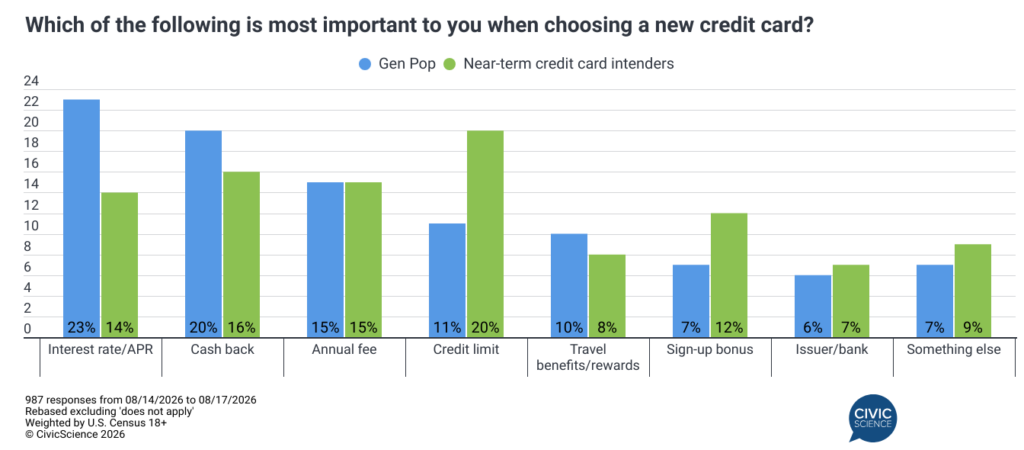
We could be on the precipice of a surge in credit card applications. Looking to preserve their resilient spending patterns heading toward the holiday retail season, 13% of U.S. adults – and 27% of Gen Z – report that they’re “very likely” to apply for a new credit card between now and Thanksgiving. While the younger likely applicants are simply looking for headroom for essential purchases (ugh), older ones are focused on building, repairing, or managing their credit. In further concerning news, near-term applicants are much more likely to prioritize a card’s credit limit over its interest rate (double-ugh). For our financial services friends reading this, we shared a handy roadmap for finding and marketing to these card seekers.
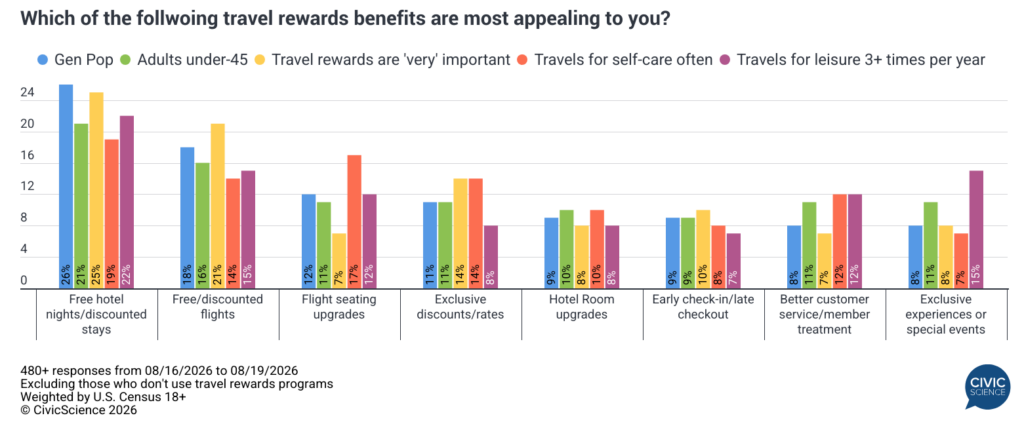
Perhaps many of those new credit cards will fund upcoming holiday travel. We’re currently seeing a slight YoY uptick in the share of Americans planning to hit the road or the skies this holiday season, highlighting the growing importance of travel rewards in the industry. Younger adults – Millennials and Gen Zs – have become particularly savvy in their use of rewards programs, creating significant customer lifetime value for the companies that can lock them in. Hotel rewards, namely free and discounted stays, are the most sought-after perks, but the most frequent leisure travelers are looking for more.
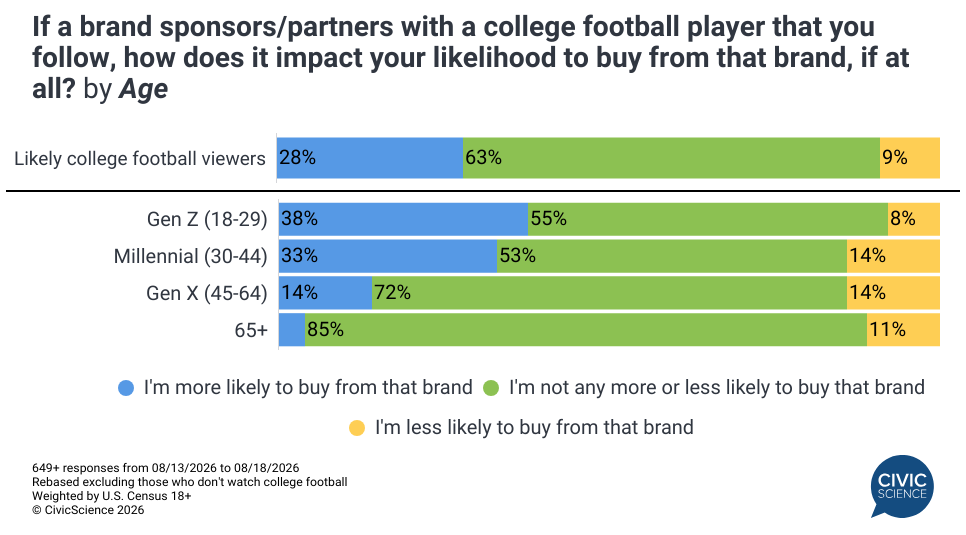
The new college football season is upon us. Anyone who predicted that NIL and transfer portals would soften fan interest in college football needs to wait at least another year, because enthusiasm for the 2026 season is up over the same period in 2025. In fact, older consumers, who are most likely to yell at the clouds about the changing face of the sport, remain the largest likely viewer audience. And, while we can debate the pros and cons of NIL’s impact on the game, it’s hard to argue against the commercial rationale. College athlete endorsements carry appreciable weight among college football fans.
More awesomeness from CivicScience this week:
- Michael Clinton, the legendary former President of Hearst Magazines, penned a poignant article in Esquire this week, calling Pittsburgh “America’s Most Dynamic City,” – including a gracious call-out for our little company. You should read it;
- We’re diving headlong into political advertising this year, bringing a more effective – and more ethical – method to the madness.
The most popular questions this week:
Did you personally feel more patriotic during the World Cup?
Would you be willing to dance in public for a discount on gas?
To what extent do you think it is acceptable to use AI tools to enhance photos?
Are you concerned about aging well?
Answer Key: Very much so, yes; No way – I can’t dance; No, that’s stupid; I couldn’t care less; Of course, who isn’t?
Hoping you’re well.
JD