CivicScience has the world’s largest proprietary database of real-time declared intent, allowing brands to activate high-performing advertising that drives up to 80% better performance. See how CivicScience partners achieve superior marketing outcomes here.
The days are getting shorter, and the leaves are changing color once again, meaning the peak holiday shopping period is growing ever closer. New consumer-declared data from CivicScience has the latest look at holiday shopping trends in the aftermath of Amazon Prime Big Deal Days and other retail sales events. Here’s what the data reveal:
Data through the first three weeks of October indicate Americans have more of a head start compared to last year — 45% of holiday shoppers say they have knocked out at least ‘a little’ of their holiday shopping, up from 40% in October 2025. Gen Z adults (aged 18-29) are the most likely generation to have already begun shopping, with 59% reporting they’ve done at least ‘a little,’ followed by Millennials aged 30-44 (46%). Just over 2 in 5 (41%) Gen Xers aged 45-64 have begun holiday shopping, while only 29% of Baby Boomers 65+ say the same. Men are slightly more likely than women to already be shopping for holiday gifts (46% vs. 43%).
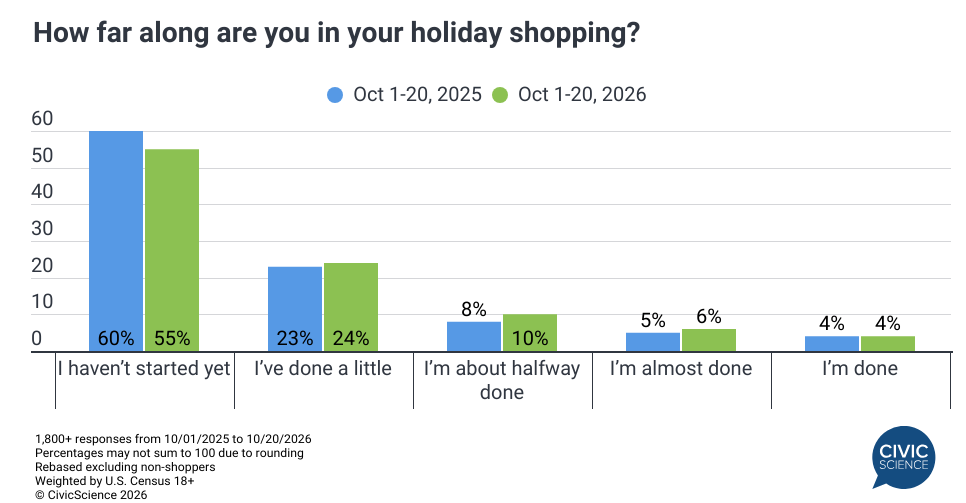
Prime Big Deal Days and competing retailer sales landed at about the same point in the month as last year. This year’s events, however, generated more total online sales revenue this October, which may help explain shoppers’ earlier start.
Slightly Fewer Americans Plan to Shop Online, Though Baby Boomers Buck the Trend
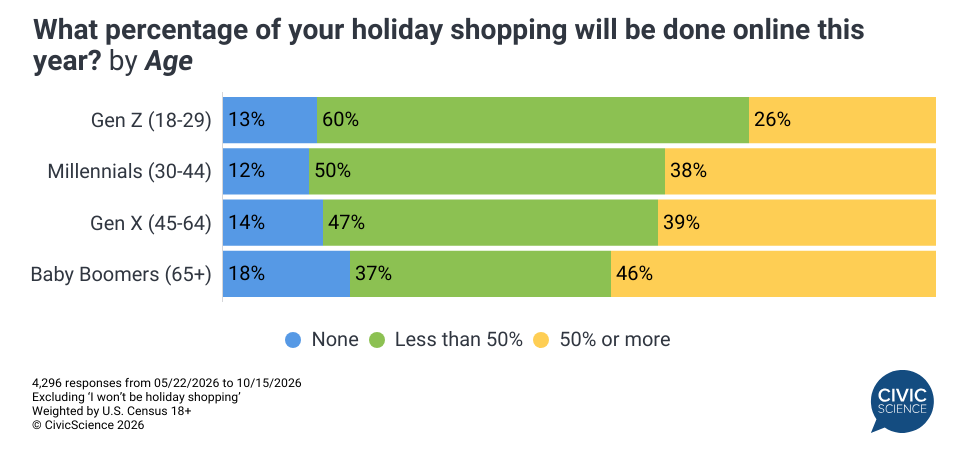
Online shopping might make up a slightly smaller share of holiday shopping this year. The percentage of shoppers who plan to do ‘50% or more’ of their holiday shopping online fell from 41% in 2025 to 37% in 2026. Those planning to do ‘less than 50%’ online rose from 46% to 49%. Baby Boomers are the most online-heavy group, as 46% plan to do at least half their shopping online, compared with just 26% of Gen Z. Price-conscious shoppers also lean digital, which may reflect a desire to compare prices and hunt for deals: 41% of those who have become more price sensitive over the past year plan to do at least half their shopping online, compared with 25% of those who have become less price sensitive. While the this is only a small dip, it’s worth noting that companion shopping is likely to drive some in-store shopping this year, particularly among younger consumers.
Younger Shoppers Turn to New Ways to Stretch Holiday Budgets
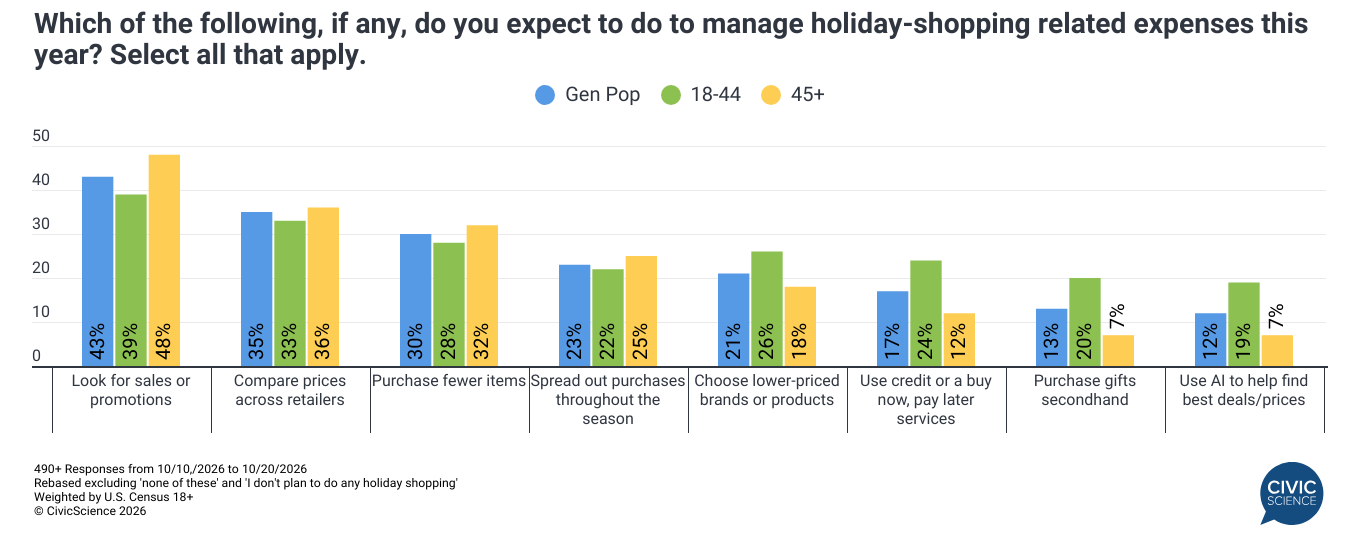
Holiday shoppers face mounting financial pressures, with inflation increasing more than expected last month and the impact of rising diesel prices hitting home. Even so, most aren’t planning to cut back. Three-quarters of holiday shoppers expect to spend about the same as last year (39%) or more (36%), while 26% plan to spend less. Instead of shrinking budgets, shoppers are adjusting how they shop, from a growing shift toward dollar stores to a range of other cost-management strategies.
Hunting for sales and promotions tops the list of ways shoppers plan to manage holiday costs, followed by comparing prices and buying fewer items. Buying secondhand gifts and using AI rank last overall, but adults under 45 are nearly three times as likely as those 45+ to do either. Younger shoppers are also more open to trading down or relying on credit and buy now, pay later services. Those 45+ are the more deal-focused group, with nearly half (48%) planning to seek out sales.
Budget-Conscious Shoppers Hold Firm on Children’s Toys
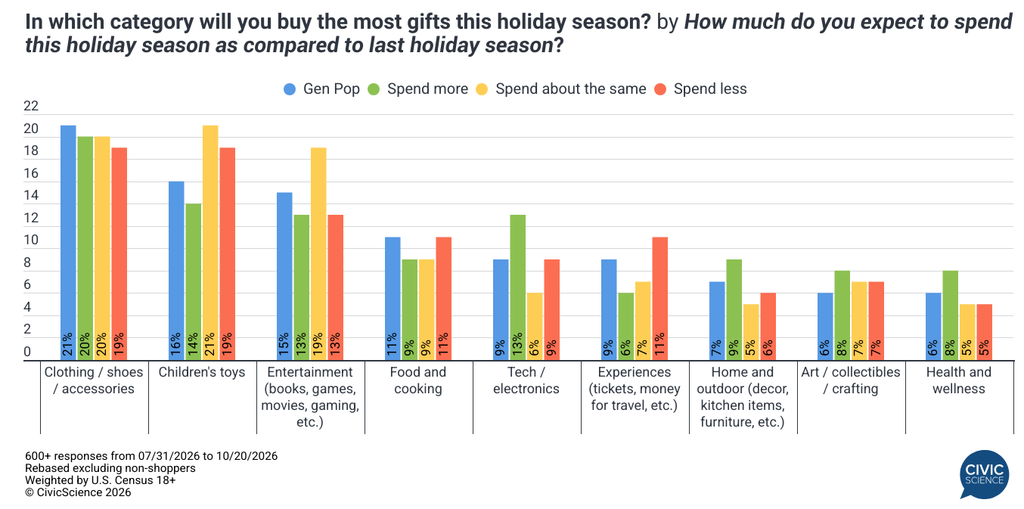
Spending expectations also shape the gift categories in which shoppers are most likely to spend. Clothing, shoes, and accessories hover around 20% across the board, regardless of whether shoppers expect to spend more, less, or about the same. Other categories show more variation. Shoppers planning to spend more are the most likely to prioritize tech and electronics (13% vs. 9% of the Gen Pop) and to lean slightly toward home/outdoor and health/wellness gifts.
Those expecting to spend about the same or less focus more of their gift-giving on children’s toys (21% and 19%, respectively, vs. 16% of the Gen Pop), suggesting gifts for kids are among the last to be scaled back. Shoppers who are spending less are also the most likely to prioritize experiences, which may reflect a preference for a single meaningful gift over several smaller ones.
Shoppers are approaching the holidays with caution but not retreat. With most holding or growing their budgets, the bigger shift is in how they shop. Older shoppers are leaning harder on sales and price comparisons, while younger shoppers are more open to secondhand gifts, AI tools, and flexible payment options. That split suggests value messaging will land differently across generations in the weeks ahead. CivicScience will continue tracking how these plans evolve as the season approaches its peak.