CivicScience has the world’s largest proprietary database of real-time declared intent, allowing brands to activate high-performing advertising that drives up to 80% better performance. See how CivicScience partners achieve superior marketing outcomes here.
AI agents are increasingly a regular stop on consumers’ path to purchase. According to CivicScience’s new Agentic Retail Report, 37% of respondents say they use AI to support their shopping, a share that has risen for eight straight months through the end of Q3 2026. The research and purchase don’t always happen in the same place either: 61% of AI shoppers research on an AI platform and buy elsewhere. Insights like these can be yours. Click here to see how you can access the full Agentic Retail Report.
For brands, that means planning for a growing AI-assisted funnel and accounting for the fact that it looks different depending on which platform a shopper uses. The categories where users of major AI platforms turn to AI for shopping highlight where those differences may lie.
AI Is the New Digital Shelf, but What Consumers Shop for Depends on the Platform.
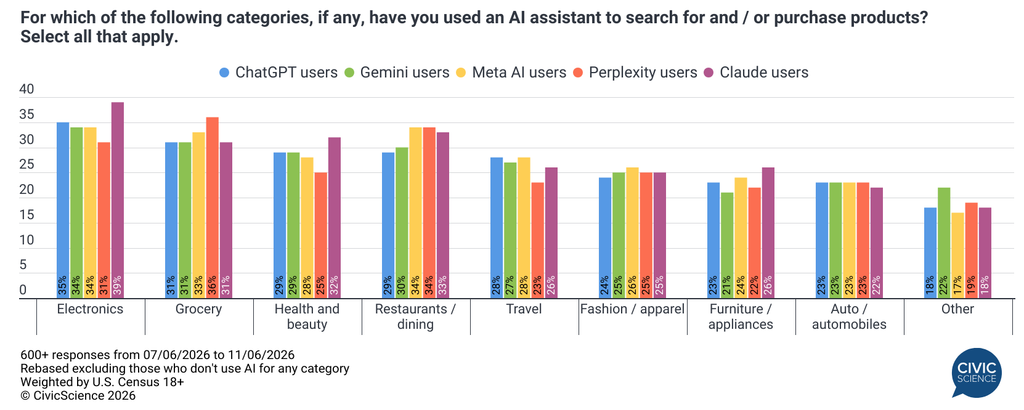
CivicScience data show ChatGPT is by far the most common (48%) AI platform for product research and discovery, followed distantly by Gemini (21%). Despite that gap in reach, users of the two platforms shop with AI in nearly identical ways. Electronics is the top category for both (35% and 34%, respectively), followed by grocery (31% each), health and beauty (29% each), restaurants and dining (29% and 30%), and travel (28% and 27%). Roughly 1 in 4 of each group use AI for fashion and apparel, furniture and appliances, and auto. Both groups land within two percentage points of each other in every category except ‘other’ (18% vs. 22%).
When it comes to platforms less commonly used for shopping support, Claude users stand out in their use of AI for electronics shopping at 39%, the highest share of any platform group in this category. Claude users also set the pace in AI-supported health/beauty shopping and furniture/appliances. Perplexity users, meanwhile, tend to use AI to support everyday purchases. They’re the most likely to use AI for grocery shopping (36%) and tie Meta AI users (before Muse was launched) for restaurants and dining (34%), but they trail every other group in both travel (23%) and health/beauty (25%).
There’s Nuance Beneath the Surface as Gender Adds Another Layer
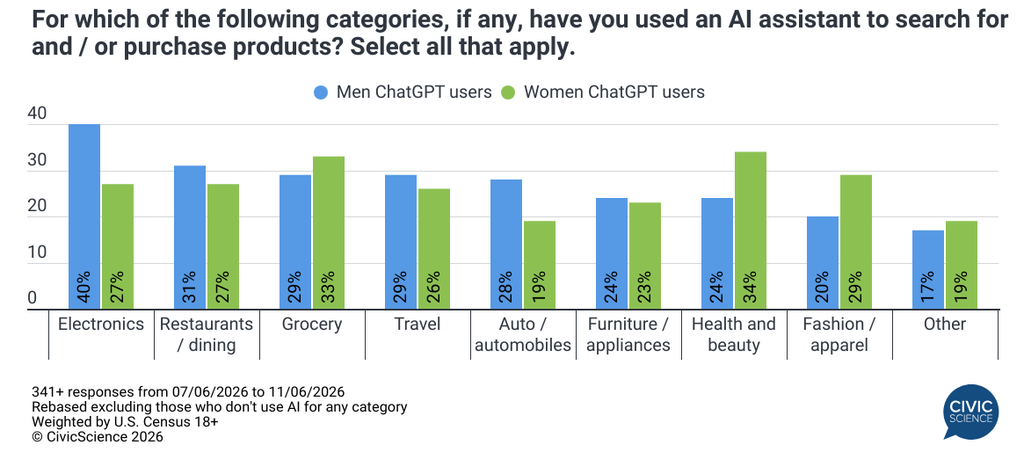
It’s also important to recognize that this categorical AI-assisted shopping varies even further by specific audience. Broken down by gender, male ChatGPT users are notably more likely than female users to turn to AI for help making decisions about their electronics and automotive purchases. Men also narrowly lead in restaurants and dining, as well as travel. However, women slightly outpace their male counterparts in turning to AI agents for health/beauty and fashion/apparel research.
AI-driven shopping is growing rapidly, creating significant ripple effects across retail and media. With changes happening fast, decision-makers need continuous insight into the usage and implications of these tools. That’s where the CivicScience Agentic Retail Report comes in. This is just the tip of the iceberg when it comes to the topics covered in the report; the full report features 20 distinct survey questions tracked continuously, along with seasonal features. Click below to learn how you can access the Agentic Retail Report.