CivicScience has the world’s largest proprietary database of real-time declared intent, allowing brands to activate high-performing advertising that drives up to 80% better performance. See how our partners achieve superior marketing outcomes here.
The return of spring also means the return of Major League Baseball. While the prospects of a Los Angeles Dodgers World Series three-peat appear high, CivicScience data points to increasing interest amid the new Automated Ball-Strike (ABS) challenge system and the continued rise of sports betting. Here’s what the latest consumer-declared data show as the season progresses through its first full week:
More Americans Will Step Up to the Plate to Watch this Year
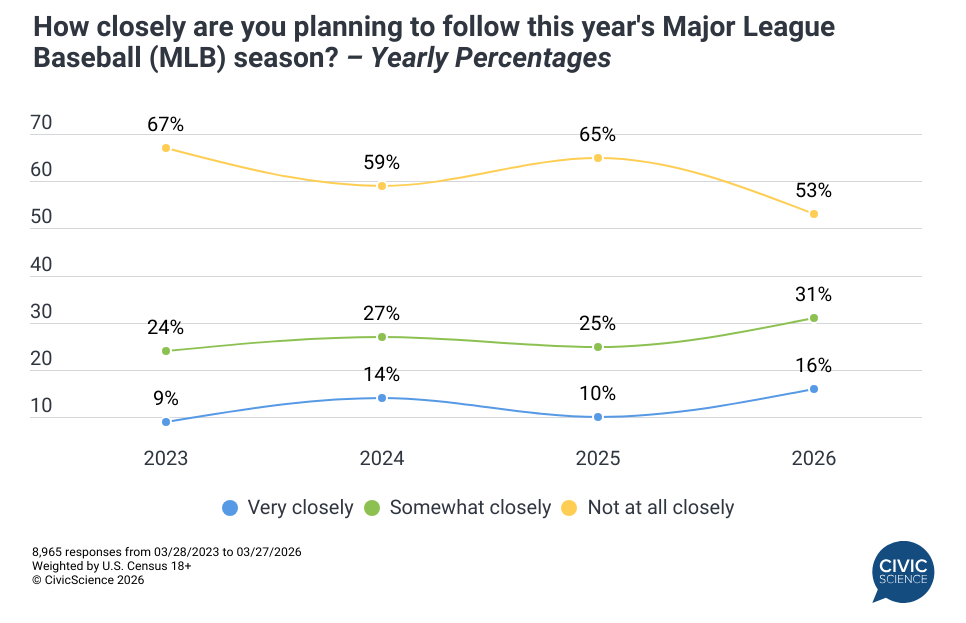
According to new data, intent to follow MLB games this season has hit its highest level yet observed by CivicScience – 47% of U.S. adult respondents report they will follow the MLB season at least ‘somewhat’ closely, up from 35% ahead of the 2025 season. Intent is strongest among Gen Z adults (18-29) and Millennials (30-44), and men are much more likely than women to plan on following at least ‘somewhat’ closely (53% to 40%, respectively).
It’s also worth noting that this season came with a preview of things to come to generate excitement: the World Baseball Classic. The international tournament was held in early March and saw Team USA fall to Team Venezuela in the final. Among those who said they were at least ‘somewhat’ likely to watch the World Baseball Classic this year, 86% also tell CivicScience they plan to follow the 2026 MLB season at least ‘somewhat’ closely.
The New ABS Challenge System Is a Home Run
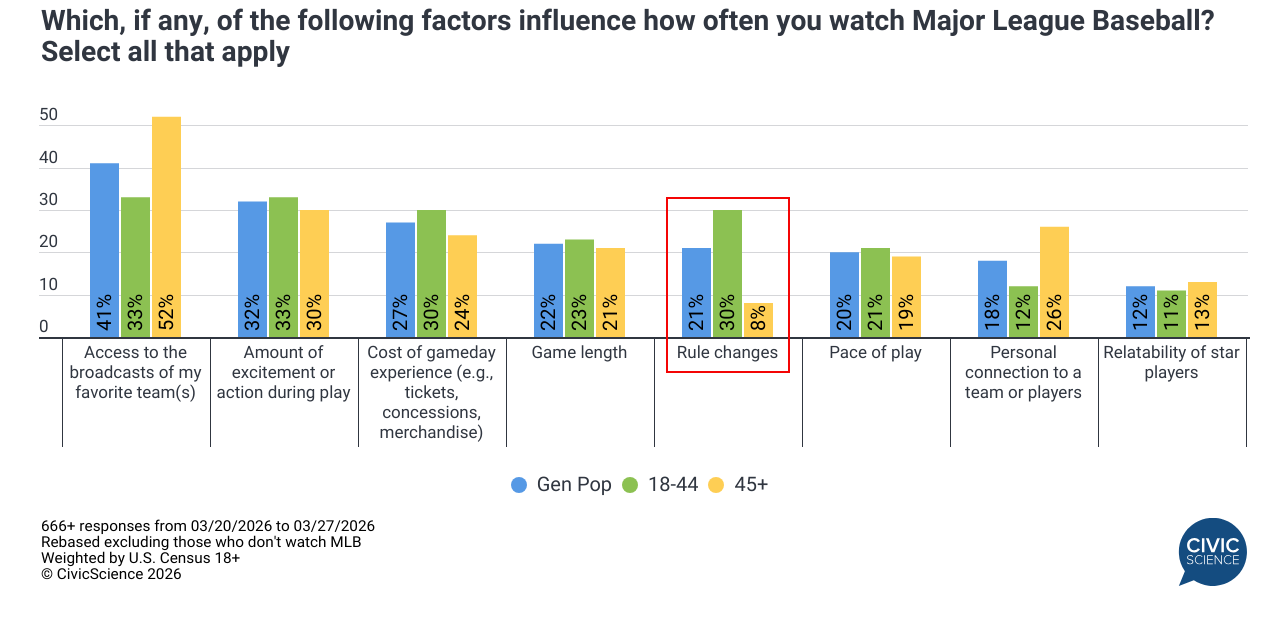
Amid this climbing interest, the ‘why’ behind the viewership is changing, too. The 2026 season introduces the new ABS challenge system, which allows batters, pitchers, and catchers to challenge individual ball-and-strike calls. This shift is reflected in consumer-reported data: the percentage of fans citing ‘rule changes’ as a primary reason for watching jumped by seven percentage points from 2025 (14% to 21%). Meanwhile, other viewership factors – notably personal connection to a team or player and access to broadcasts of favorite teams – largely declined YoY, with only in-game excitement managing a marginal one-point gain.
What matters to fans is far from universal demographically. For instance, rule changes (including ABS) are far more likely to positively affect the league’s viewers under 45, whereas broadcast access and a personal connection to teams or players are far more important among fans over 45.
Final note on ABS: When asked specifically about the impact of the implementation of ABS, 21% of those who watch MLB say they’re ‘more’ likely to watch as a result, compared to 15% who are less likely to tune in (63% say it has no impact). Intent to watch as a result of ABS rises to 47% among Americans who follow the MLB ‘very’ closely, compared to just 5% less likely to watch.
Fans Make the Jump to Streaming
Speaking of access to broadcasts, the landscape of how fans watch their favorite team continues to evolve, as evidenced by the season opening with a Netflix exclusive opening-night game and some teams moving to direct-to-consumer streaming. While this change has been a rocky start for some fans, exclusive CivicScience data cited by Sports Business Journal highlights that a noteworthy share of MLB fans (led by women) planned to subscribe to a new streaming service specifically to watch games this year.
A Major League Rebound in Betting Intent
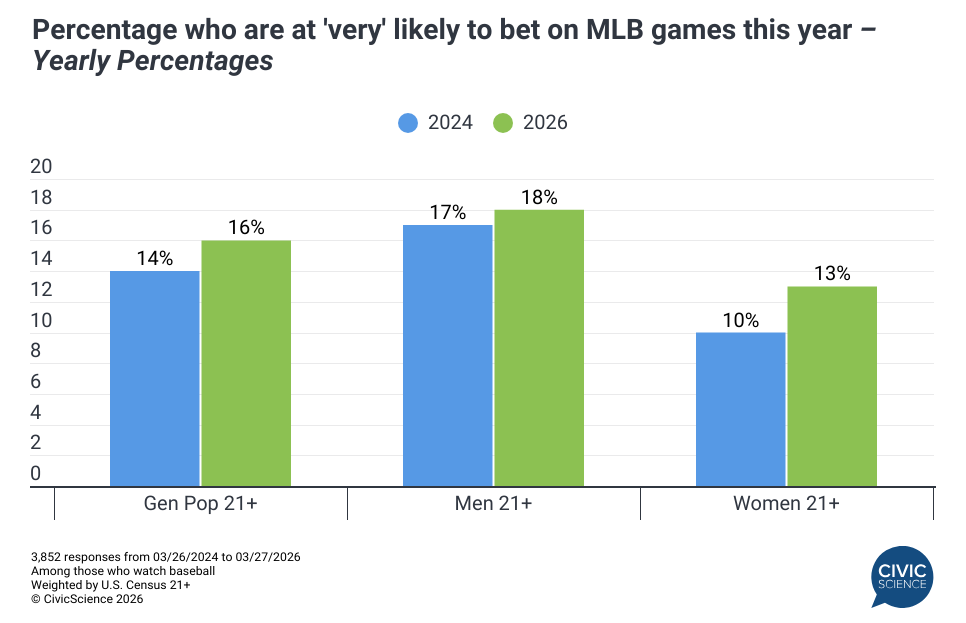
MLB betting intent is also trending upward this season. The percentage of those who watch MLB (aged 21+) who say they’re ‘very’ likely to bet on baseball games this year is now 16%, up from 14% ahead of the 2024 season. Notably, this increase in betting interest is largely driven by women fans, with a three-point jump from 2024, compared to a single-point uptick among male fans. This aligns with earlier CivicScience data showing that women are a growing force in sports betting.
Quick Hitting Data About Those Following the 2026 MLB Season
CivicScience’s first-party data empowers brands and advertisers to look beyond surface-level demographics, pinpointing forward-looking trends and consumer intentions that build precision and high-value audiences. Here’s how those who plan to follow MLB games this year stand out and compare to those who won’t:
- Mental Wellness: While those following the 2026 season report higher levels of recent stress and worry, they are actively seeking self-care regimens; notably, they are more than twice as likely as non-viewers to express a strong desire to begin practicing self-care.
- High-Value Brand Affinity: MLB season followers represent a premium segment for advertisers, as they are four times more likely than those not following to prioritize brand name over price. But they also offer the best of both worlds as they are nearly three times as likely to be ‘very’ open to trying newly launched brands.
- Looking Ahead to Spending Signals: MLB season followers show stronger optimism that their personal financial situation will improve in the next six months. Additionally, they’re roughly twice as likely as non-followers to plan on using tax refunds for shopping, and they’re nearly 30 points more likely to plan to travel this summer.
With a long season only in its early days, CivicScience data highlights an MLB audience that is not only active but responsive to a range of influences shaping how and why they engage. This creates an environment where forward-looking, real-time insights are essential for anticipating behavior rather than simply reacting to it.