AI doesn’t understand us.
How could it? Think about how it’s trained.
AI models learn a lot about humans by scraping comments and text from the internet, where people are generally younger, more tech-savvy, and disproportionately male. For the same reason, AI also thinks we’re more opinionated than we are. People with moderate opinions — i.e. the large majority of us — seldom weigh in.
AI also gobbled up the world’s corpus of literature, news, and entertainment, where caricatures and stereotypes are convenient shorthand. Some demographic groups have been written about (or represented among writers) far more than others over the past couple thousand years or so. Moreover, with lags between new model releases, AI’s understanding of the human condition can be frozen for weeks at a time.
It all leads AI to an often outdated, incomplete, imbalanced, obtuse, and even prejudiced view of humanity. Don’t take my word for it. Reams of academic research prove it.
In their defense, the frontier AI models (or the people tasked with training them) realize these limitations. When asked to answer survey questions as “digital twins” of a particular population group (say, wealthy Baby Boomer women) or to simulate the results of a survey among that group, AI is conditioned to revert to the average. It’s safe, politically correct (sort of), and almost always plausible.
Human reviewers have taught them well.
Or have they?
Raise your hand if you think you’re average. Not, like, you’re an average cook or average in bed. I mean, are all your hopes, fears, and tastes middle-of-the-road for someone your age, gender, race, income, education, or hometown? If your hand is in the air, you need a life coach.
Trust me. You’re not average. Nobody is.
In the next week or two, we’ll be publishing our own research on AI’s human understanding problem. Over six months, numerous experiments, and gobs of analysis by our academic coauthors, we found that underneath those generally accurate averages, AI models capture little of the real disagreement or nuance people exhibit relative to their peers. It’s worse among older people and minorities, per the input problems mentioned above.
Although some frontier models do better at capturing our differences than others, one of our most notable findings was that none of them are really improving over time. Most are regressing. As safe and plausible outputs are rewarded, our human edges are increasingly airbrushed, and a vicious cycle ensues.
I’ll leave the moral implications to philosophers and social scientists, but the commercial impact of AI’s human understanding problem is massive. Industries that hinge on nuance or personalization — like advertising, ecommerce, creative design, politics, or any field of consumer research — require more than “average.” They need to capture the outliers, the unexpected ideas, and, often, the “unsafe” and politically incorrect truth.
Now for the punchline. We wouldn’t be publishing all this research or even writing about it here if it were merely a public service announcement. Drum roll…
Our data uniquely solves — or at least significantly addresses — AI’s human understanding problem. Billions of real, representative human answers, collected continuously across hundreds of thousands of dimensions, provide the critical calibration and heterogeneity the frontier models are missing. It even makes them better at anticipating the immediate future. You’ll see soon.
As AI strives to become more human (whether we like it or not), we should care very deeply about what versions of us it’s trained on, its understanding of who we are.
It might be the single most important thing our data ever does.
Here’s what we’re seeing:
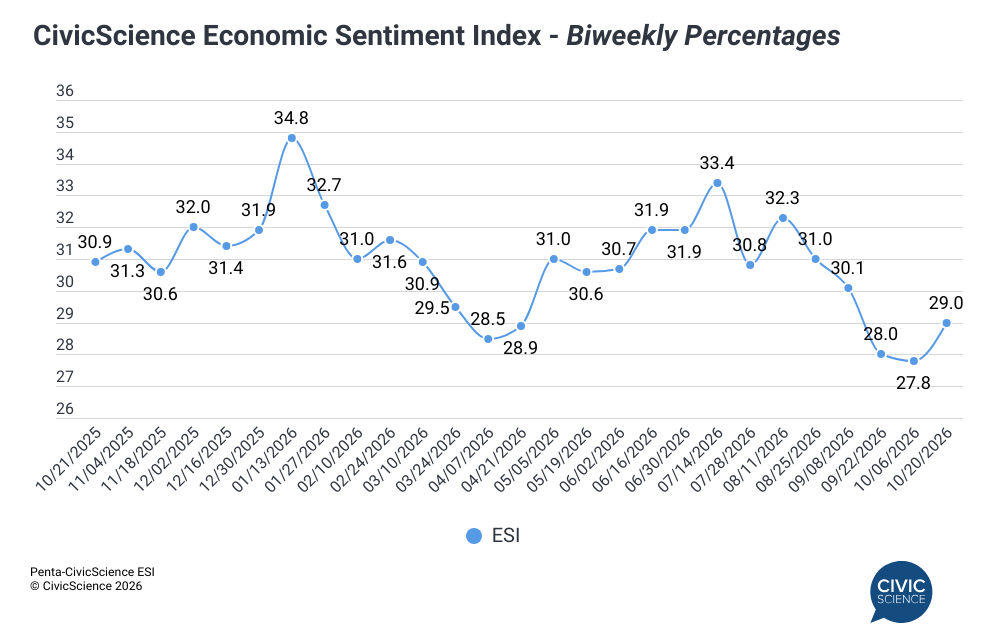
Consumer confidence rebounded in our last public reading before Election Day. After two solid months of declines, our Economic Sentiment Index improved by more than a full point this week, driven by rosier outlooks toward personal finances, the longer-term U.S. economy, and the job market. Some might see this as a glimmer of hope for Republicans before the midterm vote. Others could theorize — since the ESI is very much a forward-looking metric — that people’s hopes are pegged to large-scale political turnover, which seems increasingly inevitable. I’m one of “the others.”
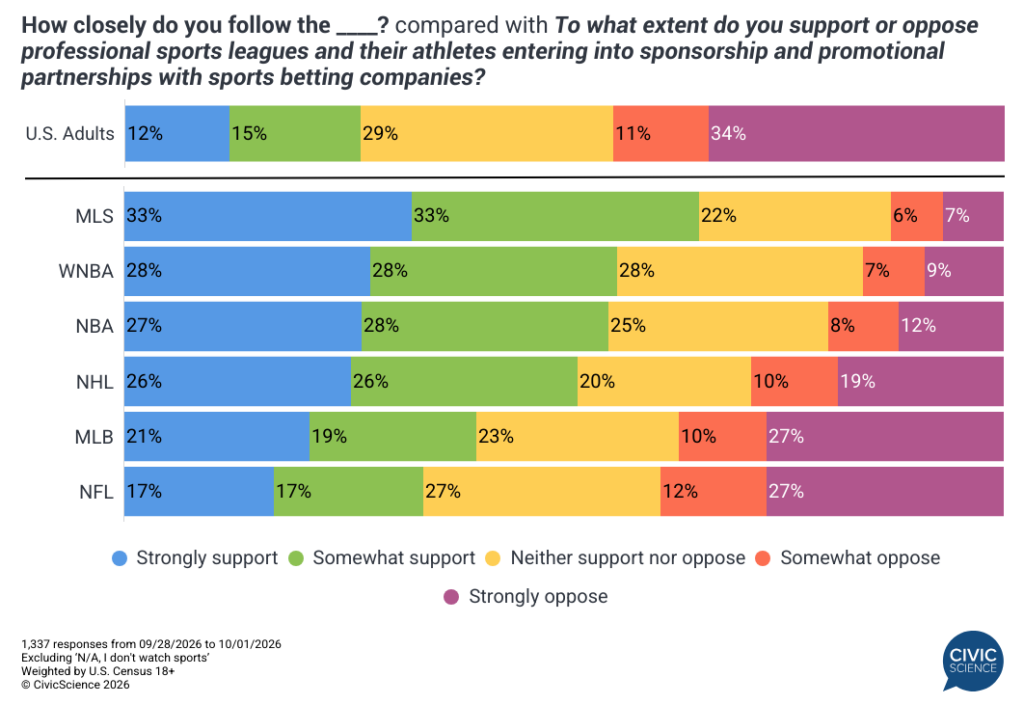
Homeowners are fretting over energy costs as sweater weather approaches. With gas prices still elevated, Americans are increasingly worried their heating bills will spike this winter. In this week’s 3 Things to Know, 50% of respondents say they’re “very concerned” about their home utility prices (specifically electric and gas), up eight percentage points from this time last year. Many report that it could weigh on their holiday spending plans. We also learned that 7 in 10 U.S. adults prepare frozen entrees at least once a week, the highest we’ve seen that number since we began tracking it in 2014. Lastly, we looked at how sports fans feel about pro leagues partnering with betting sites. A plurality is against it, except MLS, WNBA, and NBA followers, who are the youngest fans on balance.
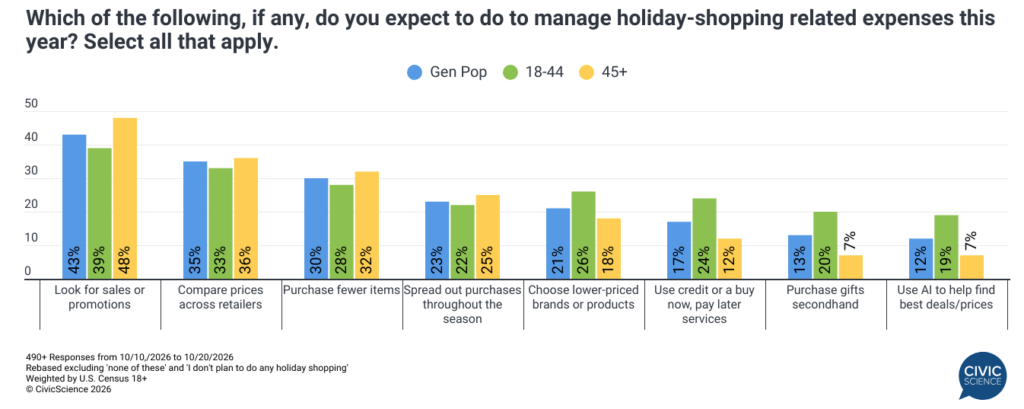
Holiday shoppers are ahead of the game this year. Driven by early deals and overall intentionality, 45% of U.S. holiday buyers have already started their gift-grabbing, up from 40% who said the same by mid-October last year. Another early finding is that a smaller share of shoppers plan to do the majority of their buying online this year, opting instead for more in-store experiences (more on this below). Also, in our first major report on the 2026 holiday retail season, we looked at how shoppers of different generations plan to stretch their dollars and which categories should see the biggest increases in sales (hint: go long on electronics, short on toys).
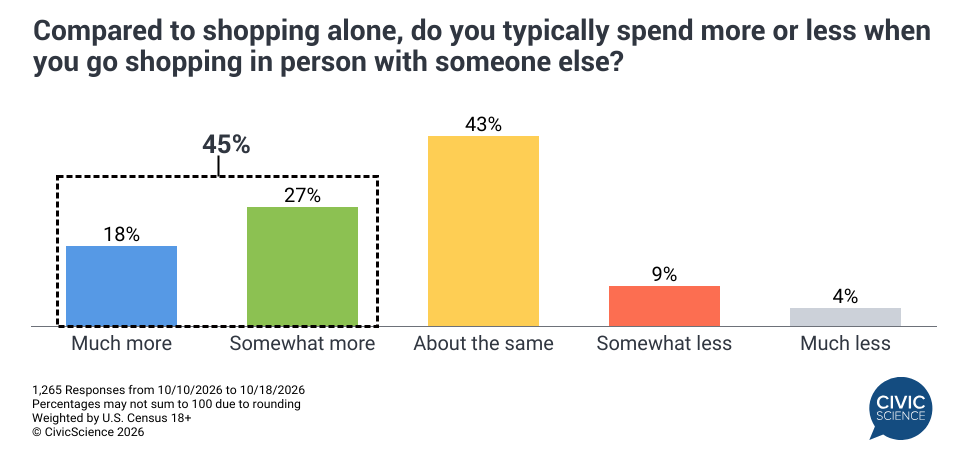
Shopping as a social endeavor is making a comeback. While the heyday of malls is long behind us, Americans are rediscovering the joys of “companion shopping,” according to our latest data on the subject. Surprisingly, the trend isn’t being driven by young people — Gen Xers and Boomers are the most likely to shop with friends or family members for quality time (perhaps nostalgic for that mall heyday). What should matter most to retailers is that these companion shoppers visit stores much more frequently and spend much more money when they do it. We can help you find them and market to them.
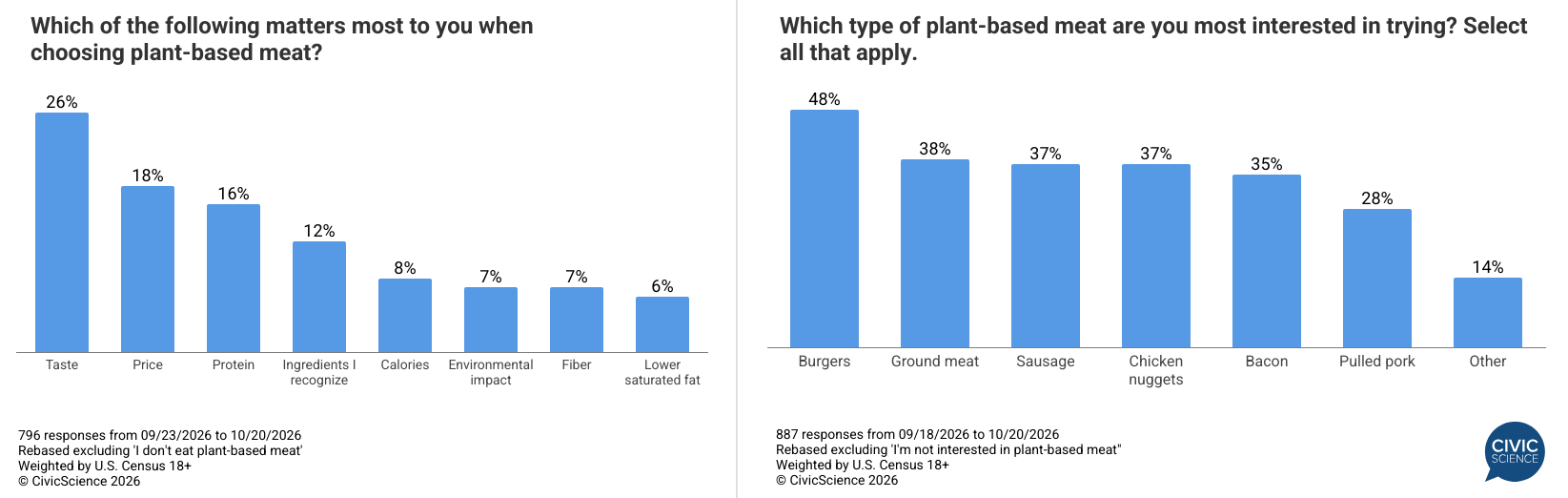
People are interested in plant-based meat again. This is one trend that always escaped me, but I guess it’s a thing. After hitting a usage plateau and waning consideration in 2024, the faux meat category is showing signs of renewed growth in 2026. 41% of U.S. adults have tried it, and another 12% are thinking about it (the highest we’ve seen that number since 2021). Taste drives purchases in the category, more than price, and burgers are clearly the number-one format. One new thing we studied this year — while people are better informed about the pros and cons of plant-based meat, their opinions on the health and environmental benefits are starkly split.
More awesomeness from the InsightStore™:
- Don’t forget about our Agentic Retail webinar next week. Sign-ups have been through the roof and you don’t want to be left behind.
The most popular questions this week:
How likely are you to go to a haunted house this fall?
Would you be willing to travel to Las Vegas to see a show at the Sphere?
Do you generally like more or less spice in your food?
Were you ever nominated to your school’s homecoming / prom court?
How involved are you in community service and volunteering?
Answer Key: I have a better chance of seeing a real ghost; Already did and it was better than advertised; The more spice the better; No, I was on the golf team and debate team; Probably more than average, but less than I’d like.
Hoping you’re well.
JD