CivicScience has the world’s largest proprietary database of real-time declared intent, allowing brands to activate high-performing advertising that drives up to 80% better performance. See how our partners achieve superior marketing outcomes here.
The knockout stage of the 2026 FIFA World Cup is well underway, with three down-to-the-wire matches that have included major upsets. The U.S. Men’s National Team (USMNT) is among the teams that have advanced through the group stage and will play Bosnia and Herzegovina on Wednesday in a win-or-go-home matchup. But where exactly does American viewership stand as the stakes of the matches begin to ramp up?
New consumer-declared data provides a glimpse into how Americans are engaging with the World Cup today:
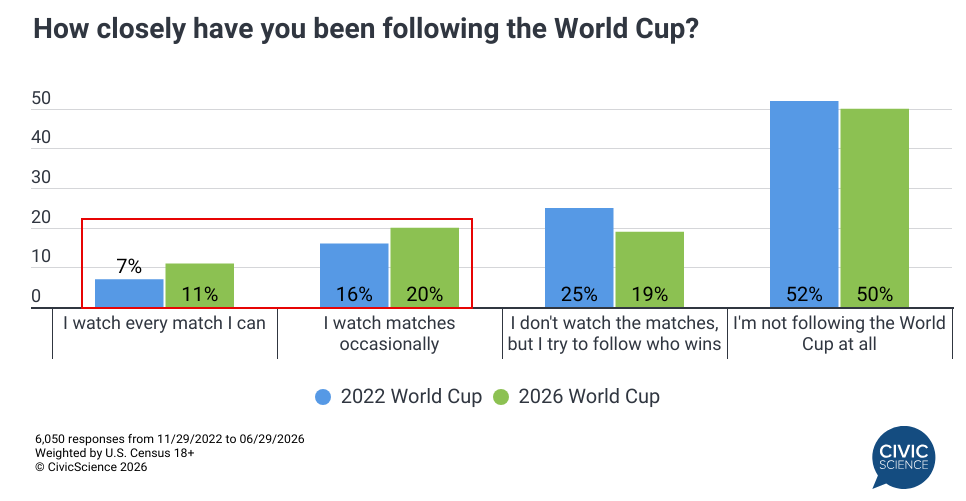
While the latest survey data indicate there hasn’t been any sort of astronomical spike in viewership overall compared to the World Cup (WC) in 2022 in Qatar, the share of Americans who make it a point to watch every match they can is up more than 50% YoY – 11% now report they’re watching every match they can, up from 7% during the Qatar World Cup four years ago. More casual viewers (those watching matches occasionally) have also trended up (from 16% to 20%), at the expense of the share who aren’t watching matches but are tracking results (19%).
While this general audience remains far below that of the Super Bowl, there are a wide variety of reasons driving Americans to tune in to World Cup games this year. Notably, this interest doesn’t entirely hinge on the USMNT’s performance – just 25% of World Cup viewers say the U.S. team’s performance has ‘a lot’ of influence over their decision to watch matches, while 35% say it has no influence at all.
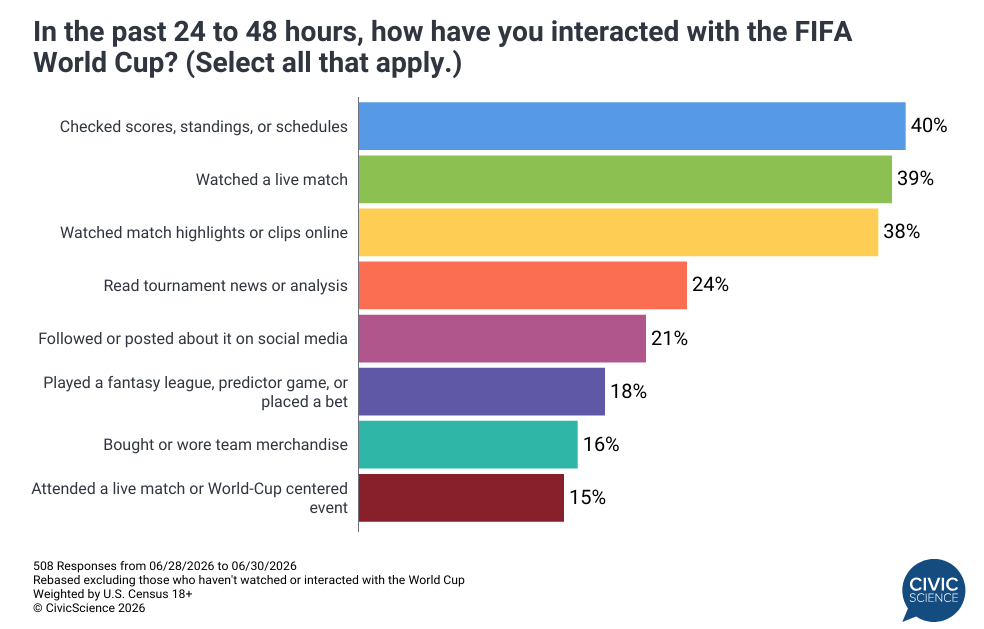
Nearly half of U.S. adults have interacted with World Cup content in some way in the past 48 hours.
A look at how Americans have engaged with the tournament over the past 24 to 48 hours specifically reveals 48% of U.S. adults have consumed World Cup content in some capacity during that period. Among them, checking scores and standings (40%), watching live match broadcasts (39%), and watching highlights online (38%) are the three most common actions, suggesting fans are not simply tuning in once but returning to the tournament repeatedly throughout the day. But engagement isn’t stopping there, as nearly one-quarter actively seek WC news and analysis, while roughly one in five are either turning to social media or playing fantasy or betting. This vast array of interaction points to an audience that is deeply engaged with the tournament and accessible across a wide range of formats and contexts throughout the tournament.
Why brands, advertisers, and media publishers should prioritize World Cup viewers even when the tournament ends:
While campaigns and activations for the World Cup are already finalized and underway, the latest first-party consumer data from CivicScience indicates that the World Cup audience will remain a high-value audience for numerous industries even after the tournament concludes. The following four key areas are just the tip of the iceberg, showing where opportunities may lie and how this audience compares with the average American.
- Stronger Summer Travel Intent: Americans engaging with WC matches at least occasionally are 30 points more likely than the average consumer to have travel plans for this summer.
- Increased Digital Content Consumption: 57% of WC viewers report their consumption of articles, videos, and podcasts has risen year-over-year, compared to just 38% of the general population (rebased among those who regularly engage with digital content).
- Superior Online Ad Recall: WC viewers show higher recall of digital marketing; 64% remember seeing online brand advertisements recently (excluding social media and video ads), whereas only 45% of the general population says the same.
- Reliance on Convenience Apps: Those watching WC matches at least occasionally are more than twice as likely as the average American to view convenience services such as DoorDash, Uber Eats, or grocery delivery as essential daily necessities.
Though soccer may rank toward the lower end of the professional sports landscape comparatively to other countries, the data show that Americans tuning in to watch the World Cup this year are highly engaged. This dynamic underscores a broader truth about today’s marquee sporting events: audience value is no longer confined to a single television window. By weaving their tournament tracking into everyday lifestyle choices and digital routines, these viewers form a sustainable segment that keeps its premium appeal for media platforms and brands well after the tournament concludes.