CivicScience has the world’s largest proprietary database of real-time declared intent, allowing brands to activate high-performing advertising that drives up to 80% better performance. See how CivicScience partners achieve superior marketing outcomes here.
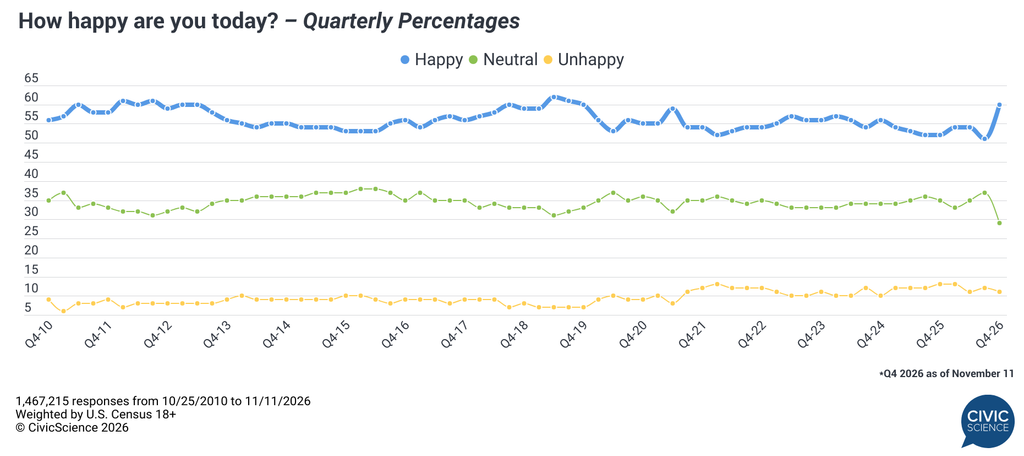
Americans’ happiness has bounced back faster than anyone might have expected. Last month, CivicScience Founder and CEO John Dick took a deep dive into self-reported happiness among Americans. His examination revealed that the quarterly share of consumers who felt ‘happy’ fell to an all-time low in CivicScience’s long-running tracking in Q3 2026 (50%). Now, a little over a month later, that percentage has not only rebounded, but it’s hit its highest mark since Q2 2021 (60%).
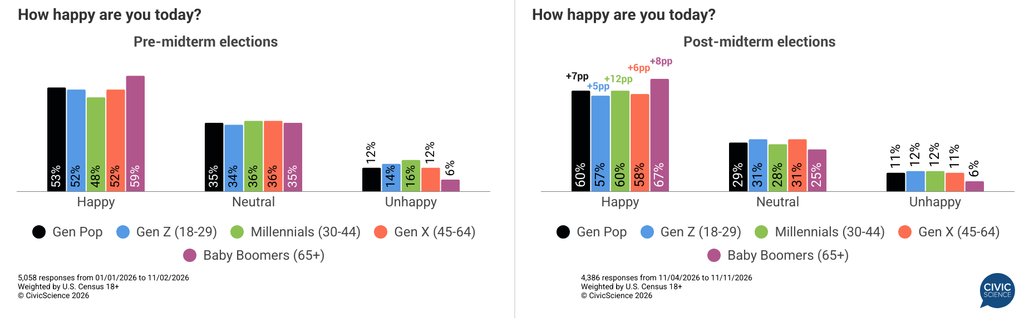
The midterm elections appear to have played a key role in the rebound, with many Americans so far feeling positive about the outcome. New CivicScience data show the share of Americans feeling ‘happy’ in the week since the midterms is seven percentage points higher than earlier in the year. The gain spans generations, with happiness rising by at least five percentage points in each generation, led by a 12-point jump among Millennials. Men (+7pp) and women (+8pp) recorded nearly identical post-election gains.
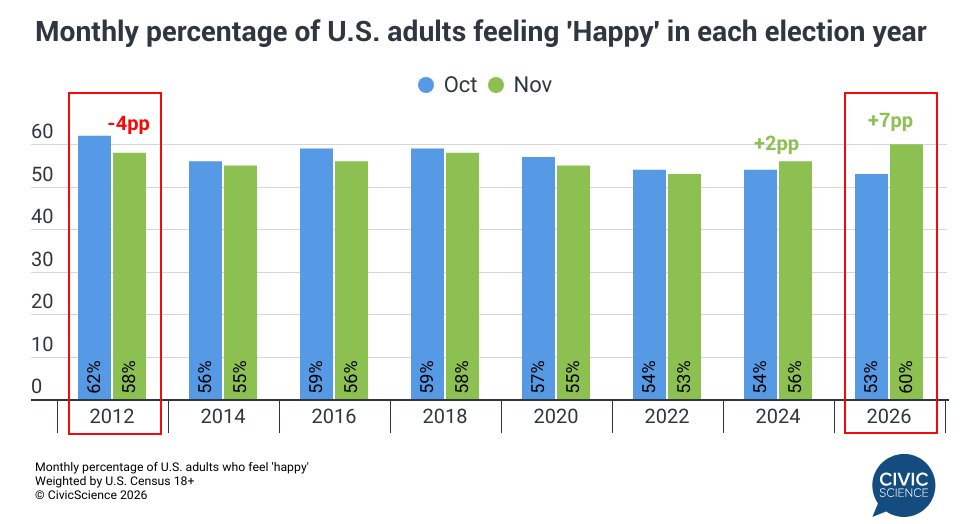
Historically, CivicScience data indicate Election Day hasn’t done much to improve Americans’ moods in the days that follow. In six of the previous seven election years (midterm and presidential), the share of U.S. adults who said they were ‘happy’ fell from October to NovemberThe lone exception, 2024, saw a modest two-percentage-point gain. Even more notably, until this year, the swing in either direction had never exceeded the four-percentage-point drop seen in 2012. This year’s seven-point increase is nearly double that.
What Drives American Happiness Today?
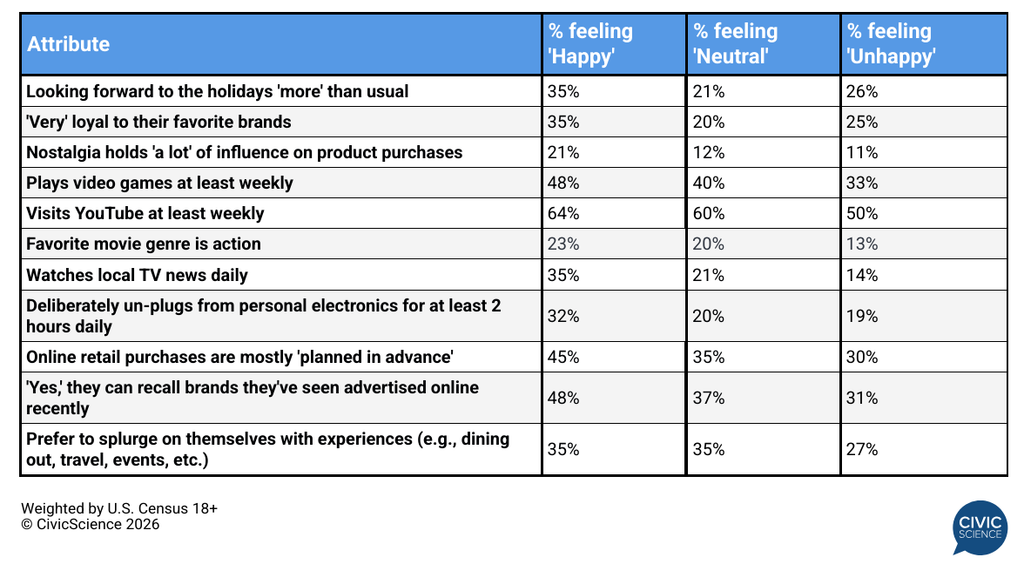
The happiness rebound comes amid a mix of other tailwinds beyond the midterms, hitting around the same time (falling gas prices help, too). A growing share of Americans say they’re looking forward to the holidays ‘more’ than usual this year (according to CivicScience data prior to the election). Consumer brand loyalty is on the rise. Brands, retailers, and media have leaned into the growing influence of nostalgia. Video game playing is trending upward ahead of the release of Grand Theft Auto VI, one of the most anticipated games in decades.
CivicScience data show self-described ‘happy’ Americans are ahead of their unhappy counterparts on each of these above consumer trends. They’re nearly twice as likely as those unhappy to report a strong influence of nostalgia and more likely to be ‘very’ loyal to their favorite brands (35% vs. 25%).
‘Happy’ Americans also stand apart beyond those trends. They’re more than twice as likely as ‘unhappy’ Americans to watch local TV news daily and more likely to visit YouTube at least weekly, favor action movies, and prefer splurging on experiences like dining out and travel. As shoppers, they’re more likely to plan online purchases in advance and to recall brands they’ve seen advertised online.
Americans’ improved mood likely reflects a mix of factors, some political, some economic, and some seasonal. Each may carry different implications for how people spend, what they buy, and which brands they turn to. Understanding that mix could prove more valuable than the happiness numbers alone.